
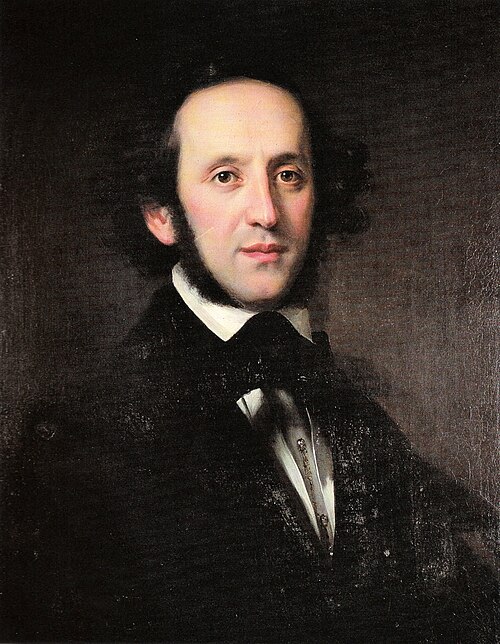
We don’t typically think of Felix Mendelssohn as a great outdoorsman nor as a composer of intimate songs. He’s associated most commonly with big orchestral works, notably his symphonies and concerti. His second area of expertise is in the area of big choral works, either his own (Elijah) or those of J. S. Bach. In fact, Mendelssohn was pretty much single-handedly responsible for getting Bach’s great music back into the public sphere, starting with his direction in 1829 of Bach’s St. Matthew’s Passion in Berlin. Mendelssohn was only 20 at the time, and for the rest of his short life he was profoundly influenced by Bach. In fact, Mendelssohn’s oratorio Elijah, his final large-scale masterwork achievement completed before his death, was written very much in the style of the Passion. (If you’re curious about how and why this young man was so taken with a Baroque composer whose works had completely fallen out of favor, you can’t do better than to read this article that lays out the whole chain of transmission. Key sentence: “Only the advent of an extraordinary individual could redirect an entire society’s attention towards a forgotten composer.”)
But enough of that. What about these outdoorsy songs? Well, I honestly don’t know why the rather frail young man who suffered from chronic ill health all his life liked being out in nature; I would have thought that he’d stick close to home and its comforts. But he wrote a whole set of lieder that were subtitled “To be sung outdoors” (“Im Freien zu singen”) and actively sought out lyrics to be used. In one letter he asked for his friend the poet Karl Klingemann to “send me a song or a pair, to be sung in autumn, or better yet in summer, or in spring, on the water or in a meadow or on a bridge, or in a forest or garden. …” And we do have one description in a letter to his mother of a time when Mendelssohn indeed got to fulfill his dream of an open-air concert:
How lovely the song sounded, how clearly the sopranos trilled in the air, and what a glow and charm enveloped all the pitches, everything so quiet and furtive and yet so clear – that I couldn’t have imagined. There was a chorus of 20 good voices, but during a rehearsal indoors there were several mistakes, and everything had become unsure. But during the evening when they arranged themselves beneath the trees, and lifted up my first song, ‘ihr Vöglein in den Schwanken zank’ [Op. 41 No. 1], it was magical in the forest solitude, so that tears almost came to my eyes. It sounded like pure poetry.
Nikolaus Lenau’s poetry was set to music by a number of late 19th-century lieder composers, among them Mendelssohn. He himself was a tragic figure who seems to have spent his adult life wandering and searching for meaning, dying in a mental asylum at the age of 48. Mendelssohn used only a few of his poems as lyrics, and he must have found “Herbstlied” to be a little too dark in its pessimism, since he changed the last line that refers to what each year reliably brings from “Welkes Laub und welkes Hoffen” (“Withered leaves and withered hopes”) to “Neues Laub wie neues Hoffen” (“New leaves and new hopes”). This, from someone who lived only until 35! I am astonished at the amount of creative work Mendelssohn crammed into his short life; one is irresistibly reminded of the prolific Mozart and his short 38-year life span. (A case can be made for saying that Mendelssohn was much more of a prodigy than was Mozart.1)
Here is the German text with two translations. You can see that Lenau’s imagery is a little more sophisticated than the usual “woe is me, as another year ends.” I found his use of the word “wunderbar” to be a bit jarring, as its usual meanings have to do with wonder and delight. The word fits well with Mendelssohn’s revised ending with its optimistic tone but not with Lenau’s dark conclusion in the original that each year simply brings more withered hopes.
| Herbstklage (Autumn Lament) by Nikolaus Lenau, adapted by Felix Mendelssohn as Herbstlied (Autumn Song) | Translation slightly adapted from YouTube by Debi Simons | Metrical translation provided by Bertram Kottman (not literal, but fun and singable) |
| Holder Lenz, du bist dahin! Nirgends, nirgends darfst du bleiben! Wo ich sah dein frohes Blüh’n Braust des Herbstes banges Treiben | Dear Spring, you are gone! Nowhere, nowhere may you stay! Where I saw your joyful blossoming Autumn’s fearful tumult rages. | Gentle spring, you’re gone again! Nowhere you may linger! Where your blooming once had reigned, autumn’s storms now wag their finger. |
| Wie der Wind so traurig fuhr Durch den Strauch, als ob er wein Sterbeseufzer der Natur Schauern durch die welken Haine | How sadly the wind swept Through the bush, as if it were weeping. Nature’s death sigh Shivers through the withered groves. | Through the shrubs the wind flies by, sobbingly, as if it’s grieving; nature heaves her dying sigh, shivers through the groves now leaving. |
| Wieder ist, wie bald, wie bald Mir dahin ein Jahr geschwunden Fragend rauscht es durch den Wald Hat dein Herz sein Glück gefunden? | Again, how soon, how soon Another year has vanished from my grasp Questioningly, it rustles through the forest Has your heart found its happiness? | Once again, how soon, how soon, lo, another year has faded! From the woods a soughing tune: “Has your heart its joy located?” |
| Waldesrauschen, wunderbar Hast du mir das Herz getroffen! Treulich bringt ein jedes Jahr Neues Laub wie neues Hoffen | Rustling forest, how powerfully Have you touched my heart! Faithfully, each year brings New leaves like new hope | Forest murmurs, deep and strange,
you have touched my heart with wonder! Faithfully the yearly change brings new leaves and hopes from under. |
I looked for an individual performance video of the song and was quite impressed with this one, with a choir from the Philippines:
(c) Debi Simons
- I’d have to say that I didn’t realize just what a towering genius Mendelssohn was until I did some background reading, although I had a vague memory of an NPR commentary saying that Mendelssohn’s early works display more maturity and accomplishment than those of Mozart. Heresy! But no. To quote from ClassicFM.com, “Felix Mendelssohn was the most profoundly gifted prodigy-composer of all time.” Yes, Mozart as well as Saint-Saens and Korngold produced skillful compositions during their teens, but Mendelssohn’s output included “full-blown masterpieces of supreme originality.” The German poet Goethe, who heard Mendelssohn perform at the age of 12, said that what he had accomplished “bears the same relation to Mozart of that time that the cultivated talk of a grown-up person bears to the prattle of a child.” (Not that we don’t all love Mozart!)
One reason why Mendelssohn’s music doesn’t get the same attention as Mozart’s is that he led a sheltered life as a child instead of being dragged around Europe to perform as Mozart was. Those with contented, well-regulated lives get far less attention than the ones with all the drama. Mendelssohn’s parents were wealthy, so much so that they could afford to hire a private string orchestra to perform his works at the intellectual salons they held. Although at first Mendelssohn’s father didn’t encourage the idea of his having a professional music career, he gave in when he saw his son’s dedication. So apparently no dramatic scenes with Abraham threatening to disinherit Felix if he didn’t become a banker like him. A movie about Mendelssohn’s life probably wouldn’t do very well at the box office, although it does resemble Mozart’s in one important, and tragic, aspect: both men died in their thirties, Mozart at 35 and Mendelssohn at 38. ↩︎
