
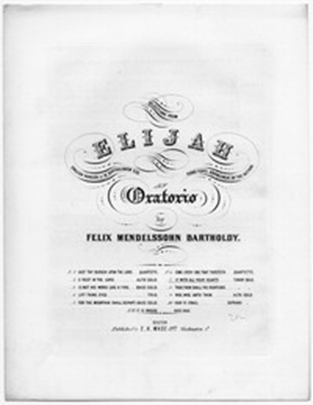
Note to my readers: This post is a chapter from the book I wrote about Mendelssohn’s oratorio Elijah, which I was privileged to perform with my own choir a number of years ago. This coming October the Cherry Creek Chorale will be performing one of Mendelssohn’s songs in a lovely, varied program titled “Harmony and Hops.” I’ll be writing specific posts about our selections, but in the meantime here’s this material on one of our composers:
I remember seeing this version of Mendelssohn’s name on a piano piece I was (very unsuccessfully) working on, and thinking, Is this another Mendelssohn? You’ll see both version of Felix’s last name used. So what gives? It’s a very complicated, and fascinating, story that concerns itself with Jewish culture in Europe and the role of anti-Semitism.
To begin with, Felix’s grandfather, Moses Mendelssohn, came to Berlin from a small town in Germany in 1743 at the age of 14, even though that city’s society was very hostile to Jews. He managed to become quite prominent in the philosophical and literary world, beating Immanuel Kant in an essay contest sponsored by the Berlin Academy. Frederick the Great even granted him the title of “Protected Jew,” which guaranteed his right to live peacefully in Berlin. (But of course this distinction only makes the lowly status of most Jews even more obvious by contrast.) Moses is a worthwhile historical figure in his own right and was hailed as the “German Socrates.” He devoted much of his later life to writings that eloquently supported the idea of religious freedom, saying that the state should not seek to control the religion of its citizens.
But even such a respected and beloved figure as Moses Mendelssohn couldn’t wipe out the widespread anti-Semitism in European culture. So Abraham, Moses’ son and Felix’s father, took several steps to distance himself and his family from their Jewish heritage. One of those actions was to adopt the surname “Bartholdy,” an action suggested by Abraham’s brother-in-law, Jakob Salomon, who took the name from a property he had acquired. Abraham urged Felix to drop the Mendelssohn name and just use Bartholdy, but even though Felix was baptized as a Protestant and married a minister’s daughter, he refused to drop his use of Mendelssohn. It’s never possible to know exactly what was going on in the mind and heart of someone from the past (or even someone in the present), but it seems to me that Felix wanted to honor both aspects of his background. Most of the time, his public knew him as Mendelssohn without the Bartholdy, but sometimes both names were listed. And that inconsistency has carried over until today.
His Jewish ancestry came to the fore during Germany’s Nazi regime, almost 100 years after his death. Even though Mendelssohn’s music was beloved by the German people as a whole, he just could not be tolerated by the Reichsmusikkammer (“Reich Music Bureau”). He was degenerate. His music could not be performed except for Jewish audiences. The monument built in his honor in Leipzig was removed; the scholarship bearing his name at the Leipzig Conservatory was discontinued. Even his incidental music to A Midsummer Night’s Dream was banned, a work that had been so popular that Queen Victoria had used the “Wedding March” in her own wedding. Nazi-approved composers were asked to write new music for the play. Guess who obliged? None other than Carl Orff of Carmina Burana fame. Can you believe it?
If you’d like more information on the whole Mendelssohn/Jewish/Christian/Nazi story, I would highly recommend that you watch the excellent documentary on “Mendelssohn, the Nazis, and Me.” It’s only about an hour long and will give you a real glimpse into this whole story.
Here’s a small bonus for this section that has nothing whatsoever to do with the foregoing but is so much fun that I couldn’t resist including it. I’m giving the original “teaser” question from the post I wrote on the Chorale website:
What 1940’s cartoon has the theme from Mendelssohn’s “Fingal’s Cave” as the motif for one of the characters?
I was so surprised when, probably sometime in my teens, I heard this piece in a concert or on a recording. ‘Why, that’s from the cartoon with the mynah bird!’ I thought. Sure enough, for some reason that tune was felt by someone in charge at Warner Bros. to be symbolic of the rather mysterious creature who appears in the following:
I will say that as far as I’m concerned this cartoon makes no sense whatsoever. And it’s probably not necessary for me to point out that Inki the African hunter is portrayed in a way that’s pretty typical of the times’ racial stereotypes. I had a reader point me to a Wikipedia article which pointed out that “The series’ director, Chuck Jones, said that these cartoons were baffling to everyone, including himself. He had no understanding of what the bird was supposed to do other than walk around. But the shorts were well-accepted by audiences. . . . Inki is an everyman who encounters mysterious forces of life. He serves as a symbol of all humanity, ‘frustrated and rescued by the wonderfully inexplicable.’ According to Jones, ‘he grew up sensitive to the feeling of minorities’ and so never set out to mock them”
(c) Debi Simons
