The Richer, Fuller Story behind “O Love That Will Not Let Me Go” by George Matheson

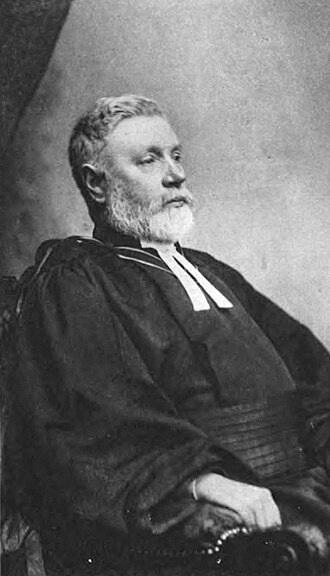
George Matheson image in public domain accessed via Wikimedia Commons.

I’m always a little suspicious of what I call “just-so stories,” ones that seem too neat and tidy in drawing straight lines to explain human actions. The “just-so” on the lyrics of “O Love That Will Not Let Me Go” says that George Matheson, a Scotsman living in the mid-1800s, was going blind. He had been at university and engaged to be married, but when he told his fiancé the news of his impending blindness she refused to marry him. So his sister became his housekeeper, assistant, and companion. She helped him with his scholarship as he became a prominent theologian and preacher, even learning Greek and Hebrew so that she could read those texts to him. 20 years later, though, she married. Matheson was heartbroken as he contemplated being alone again, perhaps reliving the rejection he had felt when his fiancé had ended their relationship. Out of his grief he penned the famous four-stanza poem that is the subject of this post.

It could certainly have happened that way, but real life is always messy. For one thing, we have no definitive source about this supposedly unfaithful fiancé, just a few allusions that say he “might have” been involved with a young woman who broke his heart. Here’s what one old hymnbook has to say: “There is a story of how years before, he had been engaged until his fiancé learned that he was going blind, and there was nothing the doctors could do, and she told him that she could not go through life with a blind man.” Not a lot of corroborating detail here, it must be said. And Matheson didn’t suddenly realize that he was going blind; in reality, his vision was never very good and steadily deteriorated over time. While at school he was able to make out texts by the use of a strong magnifying glass and always sat near the front of the classroom in order to see the board. He could see faint outlines and shadows throughout his life, but his poor vision made him almost totally dependent on others for the practicalities of daily life. Although the system of Braille writing for the blind had been invented in 1824, I don’t see any references to his use of it. In spite of these limitations, however, his list of accomplishments would be truly remarkable even for a sighted person. He published books, produced sermons, gave lectures, and even preached before Queen Victoria, all without being able to read or write without the aid of a secretary. His sister, Jane Gray Matheson, filled that role at least until she married, and he gave her credit for her help in his own works.

Read more

Two Hagenberg Hits

Image by 12019 from Pixabay

My own choir, the Cherry Creek Chorale, has performed quite of few of Elaine Hagenberg’s choral compositions, and we were privileged to be part of the original commissioning consortium for her first extended work, Illuminare. She burst on the classical choral world in 2013 with “I Will Be a Child of Peace,” an arrangement of a Shaker hymn, and hasn’t looked back since. We are now heading towards yet another Hagenberg premiere, her new major work Aeterna Via. We are performing the Colorado premiere on May 8 & 9, and its worldwide introduction will be in Paris this June. If you live in the Denver metro area and would like to attend this very special concert, you can get your tickets here. Below is a two-part post about some other Hagenberg works we’ve performed in the past. “You Do Not Walk Alone” will be a part of this upcoming program in May.

Read more

An Illuminating New Work–Elaine Hagenberg’s “Illuminare”

A Composer Composes

Image by Stefan Keller from Pixabay

Elaine Hagenberg’s Illuminare burst on the classical choral scene in 2022 with initial performances by member choirs of a commissioning consortium. My own choir, the Cherry Creek Chorale in the Denver area, was privileged to be a part of this group and to perform the work in March 2022. We had the additional privilege of having Ms. Hagenberg on board for our final rehearsal. The composer was a full collaborator that evening, listening and critiquing gently but firmly. She clearly knew exactly how she wanted the piece to sound, and we benefited greatly from her input.  I’m reminded of something that the director of my choir, Brian Patrick Leatherman, said when we started working on the piece: “This is going to be big.” He also said that when he’d been contacted about our participation in the consortium he’d “JUMPED AT!” it. I’d say that his enthusiasm has been fully justified. Illuminare was made available for sale in August 2022 and is now being performed widely all over the world. A gala performance in Paris is scheduled to take place on June 24, 2026; this concert will also include the performance of a new major Hagenberg work. I hope to write about the texts of that composition at some point.

Read more

Paul Simon Borrows from Bach (and Others), Producing Two Masterpieces

My Own Take on Originality

Interesting question: is anything actually original? John Lennon summed up the answer nicely when he said that 99% of popular music was reminiscent of something which had come before. But it isn’t just popular music—it’s everything. It’s all been done before, or, in the words of Ecclesiastes, “there is nothing new under the sun.” (Which had probably been said before.) So how do we determine the quality of art, if it all builds on the past? Well, it’s complicated, and so much of it is subjective. For instance (don’t judge me here), I have never been all that impressed with the Beatles. Or Bob Dylan. Or, for that matter, Elvis Presley. I just don’t get it, or them. One man’s horrible daub is another man’s inspiration for life. (Did I hear anyone say “Thomas Kinkade”?)

Read more

Aaron Copland Does More than Required for his Old American Songs

Copland, the Commission, and the Composition

Once again I’m on the hunt for the origins of a famous piece of music. Aaron Copland’s suite of early American tunes was commissioned by none other than Benjamin Britten and was presented at that composer’s newly-launched Aldeburgh Festival in 1950. Britten had developed a keen interest in performing American folk music, at least partly because of his long visit to the US from 1939-1942. While there he and his partner Peter Pears had spent a lot of time with Copland; he said later that Copland was “by far the best American composer.” Perhaps because of Pears’ abilities as a singer, he and Britten regretted the dearth of songs in the Copland catalog. So they decided to do something about that, and in 1950 commissioned a set of American folk songs to be performed at the Festival. Well! Copland dove into this commission head first, only coming up for air after he’d ransacked the sheet-music archives at Brown University for material. He did an enormous amount of work for what turned out to be a set of pieces that together total less than 13 minutes’ worth of performance time. But this wouldn’t be the first time Copland got completely caught up in writing music that he didn’t think would result in much return on his investment; he said about  the ballet music for Appalachian Spring, “It took me about a year to finish and I remember thinking how crazy it was to spend all that time because I knew how short‑lived most ballet scores are, but [it] took on a life of its own.”1

Read more

Virgil Thomson Sets Thomas Campion to Music

Image access via Wikipedia

Virgil Thomson is right up there in the pantheon of 20th century composers along with Aaron Copland and Benjamin Britten, men whose works he criticized rather harshly and whose greater popularity and success he envied. Alas! Even the greatest artists can have feet of clay. But he had much in common with these other two towering figures, not the least of which was an abiding interest in the proper setting of texts to music. How he ran across the four poems of the Renaissance poet Thomas Campion is unknown; I consulted the only authoritative biography available about him and saw no fascinating backstory such as the one I discovered about Benjamin Britten’s A Ceremony of Carols. Thomson did believe, however, that Campion’s poetry and music displayed the same qualities that he strove for: simplicity and directness, with the music serving the text instead of the other way around.

Campion wrote in various genres, but in these brief lyric poems he typically shows a delicacy of feeling about his subject: an idealized woman. Campion is not writing about real flesh-and-blood females in whom he has a romantic interest but is instead presenting a concept of beauty itself. If you read these poems as descriptions of real romantic relationships you might find them a bit depressing, but the metaphysical realm is always inspiring, I guess. Here one can go haring off into Platonic love and courtly love and the whole nine yards, but I do try to keep these posts somewhat reasonable in length. I will just say that the poet is striving for a certain effect and doesn’t necessarily have any emotional skin in the game. Beyond that it’s impossible to know what was going on in his head as he wrote his poems. He never married, so perhaps he preferred the ideal to the real. As for Thomson, we know his interest in the concept of female beauty was theoretical and not personal, as his romantic pursuits were confined to men.

Read more

The Deeper Meaning behind Copland’s “Ching-A-Ring-Chaw”

PictureNote: This post was written about an earlier concert of the Cherry Creek Chorale in which we sang Part 2 of Copland’s “Old American Songs.” We will be performing the songs from Part 1 for our upcoming concert on March 6 & 7 2026. But there’s so much interesting background on Copland in general below that I wanted to go ahead and post it again.

Sometimes I start researching these posts thinking that I know what’s what and I just need to fill in a few blanks, only find out that my ideas have been completely wrongheaded. Other times I think there’s not too much to say and end up with enough material for a doctoral dissertation. This post fulfills both conditions. Racism and the transformative power of art are all packed into this one short selection.

Read more

The Shakers’ Simple Music Inspires Dance and Song

By Unknown author - Public Domain, Wikimedia Commons. Shakers dancing.

It seems a little unfair that the word “Shakers” nowadays calls up only a furniture style and, probably, the tune “Simple Gifts,” when this religious group had such a long and fascinating history. Honestly, the Wikipedia article about them is well worth a read if you’re at all interested in early American history and/or revivalist religious movements.

I’m going to get into Shaker music, but I do need to explain their beliefs and practices a bit in order to do so. This sect, which got its start in Britain around 1750, was a fascinating mixture of strict rules on the one hand and ecstatic outbursts on the other. Absolute celibacy was required for full membership; the sexes were housed separately and could not even shake hands or pass one another on the stairs. (I’m assuming the latter rule was in place because the staircases were so narrow.) They also lived communally and were strict pacifists. Yet their worship services were a mixture of music, dancing, and manifestations of spirituality that included twitching, jerking, and shouting, usually in some type of unknown language. (Those outward physical actions gave the group their name; originally they were called the “Shaking Quakers” and were an offshoot of the original Quakers.) They had to let off steam somehow, I guess. In spite of all the kerfuffle, though, the music itself was very plain, with no musical instruments used for accompaniment and no harmonies, just the melody. You can do a lot with a little; as our friend Wikipedia says:

Read more

A Song of Hope Whatever the Version–“Bashanah Haba’ah”

Image by dae jeung kim from Pixabay

When a career as a lyricist ends up totaling around 1,250 songs, one might think that massive output would dwarf the importance of any individual piece. One would be wrong, of course. Ehud Manor, one of Israel’s greatest songwriters, was capable of producing deeply personal and meaningful words. Such is the case with his 1970 hit “Bashanah Haba’ah” (“Next Year”). Ehud had lost his younger brother two years earlier when Yehuda was killed during the 1968 War of Attrition between Israel and Egypt, and he wrote his lyrics in Yehuda’s memory. What would Ehud love to do if he had his brother back again? Here’s what he wrote:

Read more

Benjamin Britten’s “A Ceremony of Carols” with its Many Meanings

Image accessed via Pixabay

Introduction and Origins

As readers of this blog know by now, I’m obsessed with origins, especially the origins of creative ideas. So I’m fascinated that Lin Manuel-Miranda was inspired to write his musical Hamilton by reading the Ron Chernow biography of this fascinating figure. (35 hours in audio form, folks. I know this from experience.) Stephen Schwartz got the idea for Wicked from a conversation on a snorkeling trip in Hawaii, when someone mentioned having read the book Wicked: The Life and Times of the Wicked Witch of the West. He says, “As soon as I heard this I had one of those light bulb moments where something just said this is a really great idea.” And Anthony Lloyed-Weber says that he bought a copy of the original Phantom of the Opera novel by Gaston Leroux for a dollar at a used-book stall in Paris and fell in love with it.

Read more