
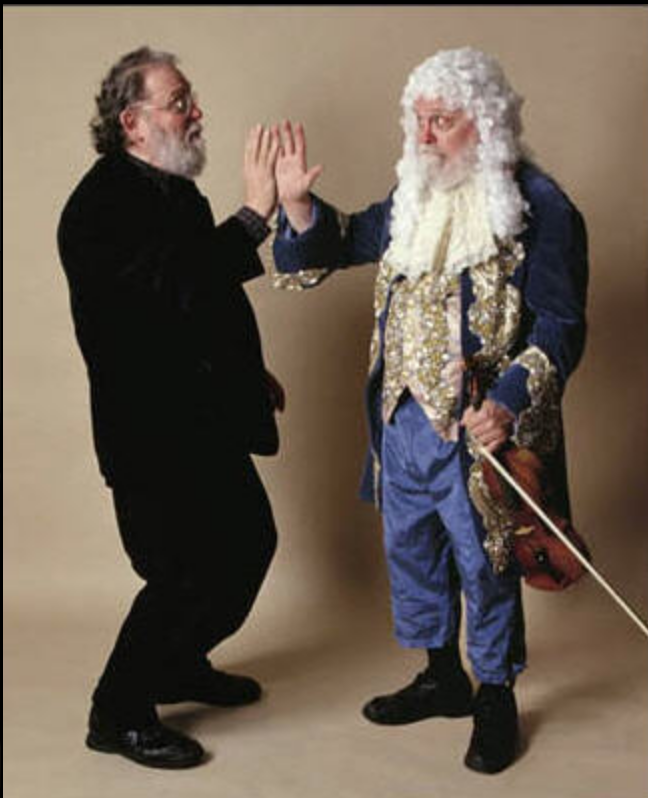
Here’s the thing, folks: If you’re funny, no one takes you seriously. But in order to be funny you have to be serious about whatever it is that you’re known for being funny about. (You may have to read that sentence several times.) And nowhere does this seriousness about humor apply more than in the area of music. You can’t be a funny musician unless you’re a serious musician to begin with. Just take a moment to think about great comic musicians of the past if you don’t believe me. Spike Jones played multiple instruments and had the impeccable timing that comedy requires. Victor Borge was a fine pianist. And . . . Weird Al Yankovic is a great performer. The humor is an added layer on top of the virtuosity and has had to be rehearsed relentlessly.
So it was with Peter Schickele, who was a very serious musician indeed. He had a master’s degree in composition from Julliard and was an excellent bassoonist. Okay, well and good. He might have ended up spending his life playing the bassoon in a symphony orchestra (which would have been perfectly fine, of course, if perhaps not terribly remunerative) had it not been for his early introduction to the music of Spike Jones. He heard a recording of Jones’ “Serenade to a Jerk” at age 10 and “was smitten by the King of Corn’s use of outrageous instruments and sound effects—like car horns and goat bleats—to burlesque popular songs.”1
I first got acquainted with this great comedian/musician back in the days when my son was little and we had no TV (or even a CD/DVD player on the computer—and well before the advent of YouTube). We listened to a lot of radio. NPR was a great favorite, and every Saturday morning at 11:00 they’d play an episode of “Schickele Mix.” (Yes, children, we had to listen at the right time.) His overarching principle was in his tagline: “If it sounds good, it is good.” I have such fond memories of his gravelly voice saying that. And guess what? I am pleased to announce that selected episodes of the program have been issued in podcast form! Go to the podcast platform of your choice and search under “Schickele Mix.” It should pop up. Listen to at least one episode!
But Peter Schickele was way more than a musicologist—he was also a composer of both serious music under his own name and also (very non-serious) music under the name of P.D.Q. Bach, whom he called the youngest, and oddest, of Johan Sebastian Bach’s 20-odd children. He (Schickele, not Bach) came up with the character while he was at Juilliard in the course of putting on a humorous concert that became an annual tradition at the school and later had to be moved to Avery Fisher Hall because of crowd size. And here’s the unifying cord (Or, ahem, chord) tying all of his musical endeavors together: he simply loved music. As he said in an interview, “I’ve been very lucky. In my life, I’ve always had a couple of irons in the fire, and when one goes away, another appears.” (from an article in the Seattle Times, August 31, 2007)
If you want more of an overview of this great modern musical figure, I’d suggest you just go to his Wikipedia page, where you’ll get a boatload about him. I must, however, home in on the PDQB works my own choir, the Cherry Creek Chorale, is performing in its in its October 2026 “Harmony and Hops” concert. Our wonderful artistic committee has chosen two of his “Liebeslieder Polkas” in which the humor arises from the contrasting natures of the poetic texts and the musical accompaniment. So I’m going to provide some semi-English-teachery analysis of each poem and then post a video of PDGB’s version of it. Ready? Let’s go, starting with #3, “The Passionate Shepherd to His Love” by the 16th-century playwright and poet Christopher Marlow:
Come live with me and be my love,
And we will all the pleasures prove, (test)
That Valleys, groves, hills, and fields,
Woods, or steepy mountain yields.
And we will sit upon the Rocks,
Seeing the Shepherds feed their flocks,
By shallow Rivers to whose falls
Melodious birds sing Madrigals.
And I will make thee beds of Roses
And a thousand fragrant posies,
A cap of flowers, and a kirtle (typical dress)
Embroidered all with leaves of Myrtle; (a shrub with fragrant leaves)
A gown made of the finest wool
Which from our pretty Lambs we pull;
Fair lined slippers for the cold,
With buckles of the purest gold;
A belt of straw and Ivy buds,
With Coral clasps and Amber studs:
And if these pleasures may thee move,
Come live with me, and be my love.
The Shepherds’ Swains shall dance and sing
For thy delight each May-morning:
If these delights thy mind may move,
Then live with me, and be my love.
(Note that PDQB didn’t use this final stanza.)
Yes, yes, yes—I know all about the poems written in response to this example of pure pastorality, with the most famous being Sir Walter Raleigh’s “The Nymph’s Reply,” in which he systematically debunks each of the promises made. One example will do here:
The flowers do fade, and wanton fields,
To wayward winter reckoning yields.
Hey, everybody—lighten up a little, can’t you? If anyone knew about life’s grim realities it was Christopher Marlowe, who lived his young adult life under the shadow of danger, with most sources agreeing that he was, in addition to being an accomplished playwright, a government spy in the pay of Queen Elizabeth’s administration, hired to sniff out Roman Catholic conspiracies against the Virgin Queen. At any moment he could be betrayed by either side, and indeed he was (we think) murdered at age 29, although the exact circumstances of the tragedy remain murky. The point is, he was no dewy-eyed Romantic; my own theory is that in this poem he was simply trying his hand at writing an example of purely idealized love. The title was added later; we’re not completely sure that the speaker is supposed to be a real shepherd. Where would a simple country bumpkin get gold, coral and amber? (Yes, the speaker does mention “our lambs,” but he doesn’t seem to have much of a concept about how sheep-shearing works.) So just enjoy the imagery, and then watch the video below of Schickele’s musical setting, in which he’s having a lot of fun with the words (and the choir is having a ball):
On to our second selection from this set of works: “Farewell Ungrateful Traitor,” in which the humor arises from the quite-serious text and its raucous musical accompaniment. Do I really hafta wade through all of this pining-deserted-woman flapdoodle? Let me just say this at the outset: The woman who’s speaking has been seduced and dumped, and now she rails against her seducer (thus the “ungrateful Traitor,” you see.) Tell you what—I’ll give brief summaries of all three verses even though Schickele uses only the first and third ones:
Farewell ungrateful traitor,
Farewell my perjured swain,
Let never injured creature
Believe a man again.
The pleasure of possessing
Surpasses all expressing,
But ’tis too short a blessing,
And love too long a pain.
A “swain” is a lover; the use of “perjured” to describe him is a nice touch. The speaker is saying, “Once bitten, twice shy”—that’s what she means by “let never injured creature/Believe a man again.” Hey, honey–maybe there are some nice guys out there! But no, she says. She seems to be saying that she was the one doing the “possessing” rather than the one being possessed. But the joy is too short and then the pain of unrequited love is too long to make the whole thing worthwhile.
‘Tis easy to deceive us
In pity of your pain,
But when we love you leave us
To rail at you in vain.
Before we have descried it,
There is no bliss beside it,
But she that once has tried it
Will never love again.
Men just pretend to be in the throes of love and so we pity you and give in. But then you leave! The thrill of the chase is over once we’ve surrendered. Look at lines 5-6; a paraphrase would be “before we have discovered it (the joy of love) (we think that) there is nothing like it or better than it”-but oh my! Once it’s over, it’s over.
The passion you pretended
Was only to obtain,
But when the charm is ended
The charmer you disdain.
Your love by ours we measure
Till we have lost our treasure,
But dying is a pleasure,
When living is a pain.
You pretended to love me only to get me. Once the thrill is over, so is your supposed love for me. I thought your love for me was equal to my love for you, but once I’ve lost my treasure (my heart) it would now be so painful to keep on living that I’d rather die.
Here’s a video of the whole collection; you’ll have to go to the 19:45 mark to hear the “Interlude” (which the Chorale is also performing) and then the song itself. The only single performance video I could find on YT wasn’t up to my (or PDQB’s) standards, so you’ll have to navigate this one (or just watch the whole thing):
I find that I can’t resist including the following two videos that basically say the same thing as the Dryden poem. First from the great Dionne Warwick:
And then–Fantine’s lament from Les Mis performed by the great Anne Hathaway (and if you haven’t seen her in The Odyssey yet, what are you waiting for?)–
And then, I beg you (with tears in my eyes) to listen to this section from PDQB’s great comic masterpiece, Oedipus Tex. Ya don’t think a man killing his father, marrying his mother, and then putting out his own eyes after seeing that his mother has hanged herself could possibly be funny? Well, au contraire! I thought I’d just have to play a clip from the CD, but then I found the following one from a live performance. Terrible camera work and very low def, but GREAT singing by the eponymous Oedipus Tex (“my friends just call me Ed”):
Whew–I’m exhausted! Hope you’ve enjoyed the fun.
(c) Debi Simons
- Google AI ↩︎
