
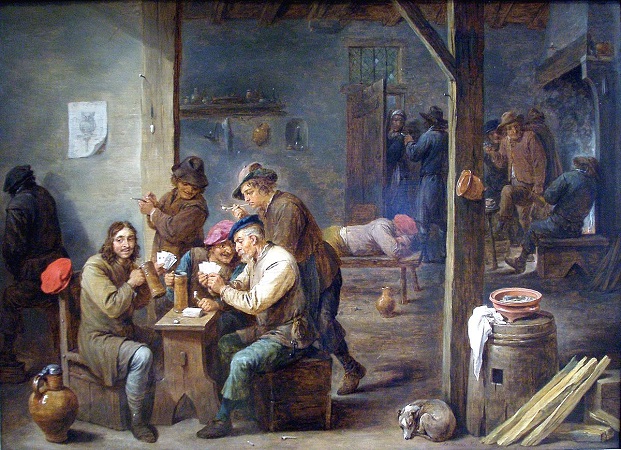
“In the Tavern” by David Teniers the Younger, 1610-1690, from The National Gallery of Art, public domain
One of the most popular concert choral works of the 20th century is Carmina Burana by Carl Orff. I’ve written a book about it, and I’d encourage you to take a look if your own group is involved in a performance. Below is a version of a chapter about one selection, “In Taberna,” which we’re including in an upcoming concert called “Harmony and Hops,” all about the joys of Germany and drinking, in whatever combination we can come up with.
This particular piece is part of a larger section of Carmina that is also titled “In Taberna.” In that section Orff includes some texts about the joys of drinking, gambling, and lust. It’s fair to say that it’s this section that has given Carmina as a whole its scandalous reputation of being sacrilegious, but in reality none of these pieces are directly about church institutions at all. That whole connection stems from the fact that the set of original medieval manuscripts from which the texts were taken happened to be found in a monastery. But even the piece “Ego sum Abbas/I Am the Abbot” isn’t about a real abbot at all but about an “abbot of the drinkers” who presides over a parodical “Drinkers’ Mass.” So don’t take any of this too seriously!
| In taberna quando sumus, non curamus quid sit humus, | When we are in the tavern, we do not care that we are but dust. |
| Sed ad ludum properamus, cui semper insudamus. | But we hurry to our gambling, which always makes us sweat. |
| Quid agatur in taberna, ubi nummus est pincerna, | What takes place in the tavern, where money is lost, |
| Hoc est opus ut queratur, sic quid loquar, audiatur. | Here is the question to be asked, so then I will talk and you can listen. |
| Quidam ludunt, quidam bibunt, quidam indiscrete vivunt. | Some gamble, some drink, some behave indiscreetly. |
| Sed in ludo qui morantur, ex his quidam denudantur, | But of those who linger in their gambling, they may come out of it naked. |
| Quidam ibi vestiuntur, quidam saccis induuntur. | One comes out well clothed, one wrapped in sackcloth. |
| Ibi nullus timet mortem, sed pro Baccho mittunt sortem: | No one is afraid of death, but throws the dice in Bacchus’ name. |
| Primo pro nummata vini ex hac bibunt libertini: | First it is to the wine sellers that the libertines drink, |
| Semel bibunt pro captivis, post hec bibunt ter pro vivis, | Then they drink to the captive, then they drink to the living, |
| Quater pro Christianis cunctis, quinquies pro fidelibus defunctis | Fourth to the Christians, fifth to the faithful dead, |
| Sexies pro sororibus vanis, septies pro militibus silvanis. | Sixth to the vain sisters, seventh to the soldiers in the woods. |
| Octies pro fratribus perversis, nonies pro monachis dispersis, | Eighth to the perverse brethren, ninth for the dispersed monks, |
| Decies pro navigantibus, undecies pro discordantibus, | Tenth for the sailors, eleventh for the discordant ones, |
| Duodecies pro penitentibus, tredecies pro iter angentibus. | Twelfth for the penitents, thirteenth for the wanderers. |
| Tam pro papa quam pro rege bibunt omnes sine lege. | As for the Pope, so for the king, everyone drinks without limit. |
| Bibit hera, bibit herus, bibit miles, bibit clerus, | The mistress drinks, the master drinks, the soldier drinks, the priest drinks, |
| Bibit ille, bibit illa, bibit servus cum ancilla, | This one drinks, that one drinks, the servant drinks with the maid. |
| Bibit velox, bibit piger, bibit albus, bibit niger, | The swift man drinks, the lazy man drinks, the white man drinks, the black man drinks. |
| Bibit constans, bibit vagus, bibit rudis, bibit magus. | The constant man drinks, the vague man drinks, the stupid man drinks, the wise man drinks. |
| Bibit pauper et egrotus, bibit exul et ignotus, | The poor man drinks, the sick man drinks. The exile drinks, the stranger drinks. |
| Bibit puer, bibit canus, bibit presul et decanus, Bibit soror, bibit frater, bibit anus, bibit mater, Bibit iste, bibit ille, bibunt centum, bibunt mille. | The young man drinks, the old man drinks, the priest and the deacon drink, the sister drinks, the brother rinks, the old lady drinks, the mother drinks. This one drinks, that one drinks, A hundred drink, a thousand drink. |
| Parum sexcente nummate durant cum immoderate bibunt omnes sine meta, | Six hundred pieces of money will hardly suffice if everyone drinks immoderately without measure, |
| Quamvis bibant mente leta, Sic nos rodunt omnes gentes et sic erimus egentes. | All who drink with a merry mind. Everyone scolds us, and thus we are poor. |
| Qui nos rodunt confundantur et cum iustis non scribantur. | Those who condemn us should not be written in the book of justice. |
| Io, io, io! … | Heigh-ho! |
For the Cherry Creek Chorale’s concert, however, we are using the following singable English translation:
When we’re in the tavern, drinking,
Mighty thoughts no one is thinking.
We run over to the table,
Betting, sweating, and unstable.
If you ask me, then you can learn
Just what happens in the tavern.
Money hosting, people paying.
Listen to what I am saying.
Money hosting, people paying.
Listen to what I am saying.
Some folks gamble, some are aimless.
Some are nasty, loud and shameless.
Those who lose the coins they gamble
Exit nakedly to ramble.
Those who win a few more rounds will
End up wearing sacks and towels.
Death forgotten, nothing shocks us,
Dicing in the name of Bacchus.
Death forgotten, nothing shocks us,
Dicing in the name of Bacchus.
First we take the dice and cast them
Drunk enough with wine to last them.
Then drink twice for those in prison,
Drink three times for all the living.
Four to Christian souls pure hearted,
Five times for the long departed.
Six to nuns who have taken off their habits,
Seven times for the roguish forest bandits.
Eight times drink to all the fallen preachers,
Nine to monks who are now disgusting creatures.
Ten to those who sail the ocean,
Eleven to those who cause commotion,
Twelve to those who do their penance,
Thirteen to rovers and dependents.
Pope and King in acclamation
Toast with all immoderation.
Drinks the mistress, drinks the master,
Drink the guard, the cleric faster,
Drinks he, drinks she, free and fervent.
Drinks the maid beside the servant,
Drinks the worker, drinks the sluggard.
Drinks white, black and every color,
Drinks the constant, drinks the fickle,
Drinks the learned and the simple.
Drinks the poor, the sick in danger,
Drinks the exile, drinks the stranger.
Drinks the child and drinks the elder,
Drinks the prelate and his helper,
Drinks the sister, drinks the brother,
Drinks the grandma, drinks the mother.
Drinks this one and that, carousing,
Drink by hundreds, drink by thousands.
All our coin in dissipation
Spent here with immoderation.
All are drinking without measure,
But our drinking brings us pleasure.
Everybody scolds us bluntly,
And we’re always short of money.
Sober critics who won’t buy in,
Devil take them, no one likes them!
Io, Io, Io, Io, Io, Io, Io, Io, IO!!!
Singable English translation by Carol Anne Parry Lagemann, adapted by Brian Patrick Leatherman
https://creativecommons.org/licenses/by-sa/4.0/deed.en
Here are a few ideas about the clever wording in the original Latin text (which I’m a little sorry we’re not using for the current concert, as I worked so hard to learn this when we sang it back as part of the entire work, but oh well!)–
What gardening term is used in the first line?
“Humus,” the word we use today to denote rich, black earth with lots of decayed organic matter. This word is typically translated as “dust” for this song, so that the line reads, “When we are in the tavern, we do not care that we are but dust,” referring to the Biblical idea that God made man out of the dust of the ground: “For dust thou art, and to dust thou shalt return.” Since we tend to think of dust as dry and powdery, we don’t get the actual image that’s being used. Looking at the individual words in the text will often show clever meanings that don’t show up in a translation. The men in the tavern forget when they are drinking that one day they will have to die, and that their bodies will decay, not to put too fine of a point on it.
What betting game are they playing in lines 6-7 that would be instantly recognizable to modern gamblers?
And the answer is: strip poker. Well, sort of. We are told, “But of those who linger in their gambling, they may come out of it bare. One comes out well clothed, one wrapped in sackcloth.” Betting on clothing items almost certainly didn’t have the same sexual overtones as it would today, though. Cloth was very expensive since it was all handwoven, and clothing was often passed down in wills. So these guys are gambling with their clothes because that’s all they have. They’ve probably lost all their money but still want to play. We still use this type of imagery when we say that someone “lost his shirt” in a business venture.
How is enumeration used?
There are two sections in this piece that use enumeration for effect. First, the numbers one through thirteen are used to name groups that the drinkers can drink to. There are varying interpretations/translations of these different group names, but in general they seem to go back and forth between respectable and disreputable. You can imagine a rowdy group in the bar saying, “And now let’s drink to the . . . lusty nuns!” (One way of translating “sororibus vanis.”) And everyone chimes in, “Yeah, the lusty nuns!” and tilts his mug. The list goes on, with everyone getting progressively drunker. (But it’s pretty hard to get a high-grade choral group to sound very drunk and still stay in tune and on time.) Second, there’s a list of pairs who drink; depending on how you count the items, you can say that this list also totals thirteen. Some of the pairs are contrasting: old vs. young, swift vs. lazy; others are typically joined: master and mistress, priest and deacon, sister and brother. The conclusion? Everyone without exception drinks, and if you don’t like it, well, may your name be erased from the book of the just!
Watch these guys spit out those words:
(c) Debi Simons
