The Many Creative Wellsprings for the Musical “Guys and Dolls”

English: Portion of title page of Guys and Dolls, Libretto and Vocal book, printed by Music Theatre International, 1978.

First, let’s define a few terms that will help along the way in outlining the wellsprings mentioned in the title above, particularly “libretto” or “lyrics” vs. “book.” I’ve run into these terms before and never quite gotten them straight. So the “libretto” (literally “little book” in Italian and typically used for opera) is the text of the sung parts, including the individual songs (or arias, again used primarily in opera) and any recitatives (that is, sung exposition). While an opera is usually all sung (but there are certainly exceptions such as The Magic Flute), musical theater typically has spoken parts as well. So the “book” is the compendium of everything the performers say or sing, as well as the stage directions. And thus the stage is set (ahem) for endless combinations, borrowings and re-workings. You’ll hear about someone getting an idea for a musical or an opera from seeing a play or reading a book and then going through the long and sometimes tortured process that will turn one format into another. Unless the creative mind behind it all is capable of doing everything—the words, the music, the staging—various roles have to be farmed out.

Read more

Who are the two heavy hitters involved in the light, shimmering piece “A Boy and a Girl”?

Image by StockSnap from Pixabay

And they are: Eric Whitacre, one of today’s most popular American composers of classical choral music, and Octavio Paz, Nobel-Prize-winning poet, essayist and diplomat. Quite a team!

Let’s start with Paz and his poem. While the title’s translation from the original Spanish is typically rendered as “A Boy and a Girl,” I ran into an interesting blog post that had this to say:

As a side note, the title “Los Novios” is very difficult to translate into English without losing something.  The word “novio” means a boyfriend or a romantic partner and comes from the Latin novus, or new.  The feminine form “novia” means the same thing, and in Spanish, if there are multiples in a group consisting of females and males, the plural word takes the masculine plural.  While “los novios” could be translated as “the boyfriends,” context here is clear that it is the sum of a boyfriend and a girlfriend and not some sort of homoerotic message.  Because “The Boyfriend and the Girlfriend” is an awkward title, I took the liberty of translating the title as “The Lovers,” which seems to me to capture the essence of what Paz was trying to convey. (from “The Lovers”: A New Translation of Octavio Paz’ “Los Novios)

Read more

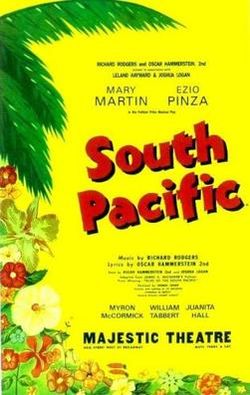
What Serious Moral/Social Issue Is Addressed in the Musical “South Pacific”?

Musical1949-SouthPacific-OriginalPoster.jpg
Original Broadway poster, 1949, accessed via Wikipedia

And the answer is: racial prejudice. If you don’t know the plot of this musical and think it’s just something lighthearted, you might be surprised by its content. The location is an island in the (where else?) south Pacific during World War II. The central conflict between the two main characters, Nellie the Naval nurse and Emile, the French planter with whom she falls in love, is that Nellie finds it very difficult to accept that Emile has been married before to a “dark-skinned Polynesian” and has two “mixed race” children. It’s only after Emile is almost killed in a secret mission to spy on the Japanese forces that Nellie realizes how much she loves him and his children. Another character, the Naval officer Cable, falls in love with a Polynesian girl, Liat, and that romance is also considered pretty scandalous. He decides that he can’t marry her because of how his family back home would react. He’s killed during the spy mission. But before he goes off to that fate he sings a very famous (and controversial at the time) song about how prejudice develops: “You’ve Got to be Carefully Taught.”

Read more

How Has the Jewish Bible book of Ecclesiastes Been Used in Musical Settings?

Wooden carving of an Jewish prophet or preacher
Image from Pixabay

I’ve had the privilege of singing a piece titled “Beautiful In His Time” by the American composer/arranger Dan Forrest, which uses a passage from the book of Ecclesiastes chapter 3 in the Jewish Bible. Forrest is by no means the first to set verses from this chapter to music, though; there’s a long history of doing that, going all the way back to Brahms. Before I get to an overview of that history, though, I’d like to comment a bit on the book as a whole, since Ecclesiastes is fascinating in and of itself, considered to be part of the “wisdom” section of the Old Testament along with Job, Psalms, Proverbs, and Song of Solomon. Yet it seems to have a very different message from any other book of the Bible, for it can come across as cynical and fatalistic, especially in the earlier chapters. Most Bible scholars believe that it was written by Solomon, king of Israel after David, who would certainly fit the description of “teacher, son of David, king in Jerusalem” given in the first verse. But why would Solomon, whom the Bible says had the greatest wisdom of all mankind, say in verse 2, “It is useless, useless . . . life is useless, all useless”? We are given at least a partial answer at the end of chapter 1: “The wiser you are, the more worries you have; the more you know, the more it hurts.” (Good News Translation)

Read more

Three Men, Three Countries, One Masterpiece—“Homeland”

National Guard troops guarding the US Capitol building, Jan. 13, 2021, accessed via bbc.com.

Do you want to know my clearest memory of this piece? My choir had scheduled it for a March 2013 concert; when we sang it through for the first time at rehearsal I suddenly realized that the woman who sat next to me was crying. The words had hit her like a ton of bricks—her fiancé had been killed in Vietnam, she said. And indeed the words are very emotional, even more so when you know their history.

The first of the three men associated with this piece was Cecil Spring Rice, a British diplomat who served as ambassador to the US starting in 1912 and who wrote a poem named “Urbs Dei

Read more

The Little-Known but Greatly-Affecting “Rainsong” by Houston Bright

Image by Ioannis Ioannidis from Pixabay

Until I sang this gorgeous and poignant piece with my own choir back in the spring of 2017 I had never heard of Houston Bright, a prolific and esteemed composer and conductor who lived from 1916-1970, dying far too young at age 54 from cancer.

Bright spent his entire career teaching music at West Texas State University, although his 30 years there were punctuated with a stint in the military during World War II and some time off to earn his Ph.D. at the University of Southern California. Along the way he taught composition and music theory, formed and led choirs, and worked on his own compositions, which number over 100, for piano, solo voice, band, orchestra, and, especially, choir. Interestingly, one of the few poems by someone other than himself that he set to music was Lewis Carroll’s “Jabberwocky.” I was very interested in finding a performance of this piece since it seems so outside the range of Bright’s other music, but even the vast resource of YouTube doesn’t seem to have an example.

Read more

Who’s “She,” and What Mountain is She Comin’ Round?

Picture This is another one of those endlessly variable folk songs with about a hundred verses. You might ask, though, “Okay, but who’s the ‘she’ who’s comin’ round the mountain?” Good question. I originally made an assumption here, thinking that this was a literal woman, but she’s not that in the original at all. Guess what ‘she’ actually is? A chariot. That’s right. This song is drawn from a spiritual about the Second Coming of Christ, and the “she” refers to the chariot that “King Jesus” will be riding. As with many spirituals, though, there may be an underlying meaning about freedom and the Underground Railroad.

Read more

Just how much literary and historial wonkery can be mined from Longfellow’s poem “Jugurtha,” which forms the text for a song by Daniel Morel?

Jugurtha in chains before Sulla, from Sallust’s La conjuracion de Catilina y la Guerra de Jugurta (Madrid, 1772)

Answer: You won’t believe how much. Keep reading to find out.

The contemporary American choral composer/arranger Daniel Morel has set to music a poem by Henry Wadsworth Longfellow about an African king named Jugurtha who was captured during (what else?) the Jugurthine Wars with Rome in the first century B.C. The king was brought back to Rome to be paraded in chains as a spoil of war by the Roman general who had defeated him. He then was taken to the Tullianum, a dungeon in Rome, and left to starve to death. I have no contemporary descriptions of Jugurtha as he lived out his last miserable days, but I was reminded of a scene in a historical novel about another captured king, the Gallic leader Vercingetorix, as he sits underground awaiting his own fate:

I moved the lamp so that I could see him. He shivered and trembled. He hid his face in his hands. Insects and glistening slugs crept amid the strands of his matted, filthy hair. A rat skittered between us. (from The Triumph of Caesar by Steven Saylor, accessed via Amazon)

Read more

The Roots of Aretha’s “Respect”

Aretha Franklin 1968.jpg
Aretha Franklin in 1968; image source Wikipedia

I’ve been doing a deep dive into the lyrics and the background of this mega-hit by the Queen of Soul. “Respect” has always been seen as a strong statement of a strong woman who’s insisting that her man treat her right. But is that view of the song really true? I have to admit that I was surprised when I actually looked at the words. It didn’t seem to me that the woman in the song was laying down a demand—more that she was begging for the bare minimum. (Her plea reminded me of something my mother said to me once about my room, “All I’m asking is that you at least quit throwing your clothes on the floor.”)

Read more

In the Blurred Line Between Waking and Sleeping, Reflections on the Past in “The Stilly Night”

Billie Grace Ward from New York, USA / CC BY (https://creativecommons.org/licenses/by/2.0)

As I write this post my beloved choir has recently performed a great concert of Irish music in the latest of our every-other-year Celtic concerts. (Sadly, because of the pandemic, as of March 2020, we have just had to cancel our final concert of the year that would have been performed in May. But we’ll be back!) The tenors and basses (in other words, the men plus me) sang “Oft in the Stilly Night” with text by the early-19th-century Irish poet Thomas Moore. So I want to explore the imagery of the poem and then take a look at the composer of the version we sang.

Read more