Sweet Charity’s Sisterly Sourcing and Songs

Actress Giulietta Masina in Nights of Cabiria; licensed under Creative Commons https://creativecommons.org/licenses/by-sa/4.0/legalcode

The Sourcing

The Broadway musical Sweet Charity opened in 1966 to rave reviews, sweeping up nine Tony nominations and winning one, lasting for a respectable 600+ performances and then being revived many times, both in the US and abroad. Bob Fosse won the Tony for choreography and then ended up directing the film version, his directorial debut in that genre. Everybody could be pretty happy about how this story about “a girl who wanted to be loved” turned out. But where did the idea for the whole thing come from in the first place?

All sources I’ve consulted agree that the precursor to the plot of Sweet Charity was the 1957 film by famous Italian director Federico Fellini called Nights of Cabiria, which concerns an ever-hopeful prostitute who never loses her optimism that someday she’ll find true love and happiness. And where did he get the idea for the plot, you ask? Well, often the source of ideas is completely unknown, even to the artist him/herself. (One of the most irritating questions you can ask an author is, “Where do you get the ideas for your books?” The only legitimate answer is usually a shrug, perhaps accompanied by an eye roll.) But for this story we do have at least somewhat of a source, probably gleaned from Fellini’s letters or other papers. It’s not terribly upbeat: “The film took its inspiration from news reports of a woman’s severed head retrieved in a lake and stories by Wanda, a shantytown prostitute Fellini met” on the set of a previous movie. (Wikipedia) The mystery of creativity, of course, is that lots of other people had read that head-in-the-lake story, and Wanda probably talked to lots of other people on the film set. But only Fellini got the idea of making those disparate elements into a movie. He started the film with his main character ending up in the river, not a lake, and still in possession of her head—but having been pushed in by her cad of a boyfriend who then stole all of her money. The story went on from there with Cabiria going from cad to cad; at the end she was left alone but still hopeful.

Read more

A Hard Truth Expressed Joyfully–Gloria Srikijkarn’s “Laugh, Sing, Rejoice”

Image by StockSnap from Pixabay

It’s an unusual concert at which there will be in attendance two composers of the music being performed. It’s even more unusual to have one of those composers actually singing in the choir. (We’re also singing an arrangement by a member of the choir; I’m going to try to get to that piece in a later post.) We’ve been privileged in the past to sing Gloria Srikijkarn’s rousing setting of Psalm 100; now we get to present her 2019 composition using lyrics from “Solitude” by the mid-19th-century American poet Ella Wheeler Wilcox. Srikijkarn is a long-time member of the Cherry Creek Chorale and at present serves as the chair of our artistic committee.

I asked the composer about her creative process with this song, and she told me that when she was growing up her father had a book of poetry containing “Solitude.” (The poem has as an alternate title “The Way of the World.” Don’t know why.) As an adult Srikijkarn remembered the poem and decided to set it to music, but when she went back and read the whole thing she realized that it was much darker than she’d thought. Her first draft ended up being unusable, and she used just half of the lines in her finished piece. Here they are:

Read more

Jan Garrett writes a paean to rain

Image by Fotoauge from Pixabay

Oh my goodness. As I’ve said before in these posts, a huge plus for me as I research and write about the texts, composers and backgrounds of the programmed pieces for my beloved Cherry Creek Chorale is that I discover wonderful music and people that I’d never known existed. Such is the case with “I Dreamed of Rain” by Colorado composer Jan Garrett. What a character! Garrett’s been writing music for decades and won many awards, but had I ever heard of her? No, not at all.

Garrett describes herself as a “a jazz singer with a poet’s soul. A native of Colorado and a lifelong musician, she is a master teacher, wilderness vision quester, creativity guide, and (yes) certified laughing instructor.” I find that last item to be the most intriguing, don’t you? You can listen to a track of (I’m assuming) her and her husband, laughing uproariously, on her website. (Link is to the home page, with the audio button on the right sidebar.)

Read more

Was the Singing of the Angels on Christmas Night “Soft,” “Sweet,” or “Faint”?

Image by falco from Pixabay. Kind of a cool contemporary stained-glass depiction of the angels and shepherds.

Let me start out by questioning the very supposition in the above title: did the angels in the Christmas story actually do any singing at all?

Here’s the relevant text from the translation I know best, the King James Version:

And there were in the same country shepherds abiding in the field, keeping watch over their flock by night. And, lo, the angel of the Lord came upon them, and the glory of the Lord shone round about them: and they were sore afraid. And the angel said unto them, Fear not: for, behold, I bring you good tidings of great joy, . . . And suddenly there was with the angel a multitude of the heavenly host praising God, and saying, Glory to God in the highest, and on earth peace, good will toward men. (Luke 2:9-10, 13-14)

Read more

What’s the Historical Background of “Do You Hear What I Hear?”?

Note the nicety of the double question mark, please!
Okay. If you’ve ever thought about it at all, didn’t you assume that this Christmas carol was along the lines of an old folk song? I certainly did, at least partly because the words don’t make a lot of sense—to me, anyway. But when I googled “Do you hear what I hear meaning” I found something quite different, and rather surprising, about its source.

Read more

How Can I Explain the Backstory of “How Can I Keep from Singing?”?

Image by Lukas Bieri from Pixabay

I think this is the second time I’ve had a double question mark in a post title. Always up for a grammatical challenge, that’s me. (That’s I?)

Anyway, when my choir, the Cherry Creek Chorale, recently rehearsed this piece the conductor said, “This is one of the most-frequently arranged songs around.” There’s no way to definitively quantify the number of arrangements out there for any piece, but it does seem to be quite popular. As usual I’m more interested in the words than the music, but the tune is truly lovely, written by a Baptist minister, Robert Lowry, in the mid-1800’s. I was interested to see that his three other most-famous hymns, “Christ Arose,” “Nothing but the Blood of Jesus,” and “Shall We Gather at the River?” are all songs I’ve sung in church myself. I love, love, love “Shall We Gather” and always sort of thought that it was a folk song or spiritual.

Read more

A Song about Singing—“It’s a Grand Night for Singing”

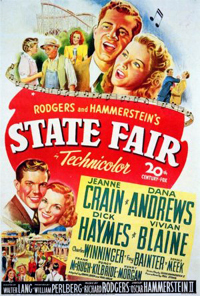
Starfair1945poster.jpg
Image accessed via Wikipedia.

The long road to this song started with a novel, State Fair by Phil Strong, written in 1932. Its unifying event is . . . wait for it . . . the three days of the Iowa State Fair, in which a farm family consisting of a husband, wife, daughter and son have various adventures and romances over that period. And in case you were wondering, yes, the fair is still being held. I just looked it up. Now it lasts 11 days instead of three; the 2021 dates were August 12-22. It’s quite a production these days with all sorts of entertainment and events, some separately ticketed and some included with the general admission charge. There are still the various competitions including livestock, beekeeping and beermaking, and, of course, you can still get food in ample supply—including anything and everything you can eat off a stick. The fair had some COVID advisories in place this year but nothing mandatory; the fair was, however, canceled in 2020, marking the first cancellation of the event since World War II.

Read more

A Timeless Text Set by a Timely Composer—Elaine Hagenberg’s “Alleluia”

Image by DEZALB from Pixabay

One of the greatest pleasures for me in writing these music posts lies in finding out about choral composers who are active today. Yes, it’s always rewarding to find out more about the creative geniuses of the past, and I’m typically surprised when diving into the life of someone such as, say, Antonio Vivaldi or Robert Schumann. So fascinating! But guess what? I can’t go onto those guys’ websites and use the contact form. I can’t message them on Facebook. It’s very gratifying to get info straight from the composer’s mouth, as it were, as I’ve been privileged to do a number of times.

So I was pleased to find out that we’re singing a piece by Elaine Hagenberg for the October 2021 concert of the Cherry Creek Chorale, my beloved community choir. Our conductor, Brian Leatherman, had told us previously that a consortium of choirs had commissioned a 20-minute piece from Hagenberg which will be premiered in May 2022, but I didn’t know until the music list came out that we were also performing an already-published short work of hers. The title led me to believe that we were singing the Randall Thompson version, which we have done before and which is seriously, seriously great. But so is the Hagenberg piece! My take, as a totally underqualified music analyst, is that Thompson is . . . sturdier? And Hagenberg more . . . lyrical? Or is that too gender stereotypical? What I think is really interesting is that Thompson’s piece is more than double the length of Hagenberg’s but that he uses only the single word “alleluia,” while Hagenberg has a middle section in which she uses text from St. Augustine. Very different approaches, totally masterful results.

Read more

Copland Struggles to Put the Struggles of a Poor Farming Family On Stage

Image by Colin Ross from Pixabay

As you know if you’ve read many of the posts on this site, I love tracking down the origins of creative works. So “The Promise of Living” from Aaron Copland’s opera The Tender Land has provided me with a number of rabbit trails to pursue in this regard. My choir sang it several years ago as the finale to a concert, and while I didn’t manage to squeeze in a post about it then it’s been on my list of Intriguing Pieces To Discuss.

On the surface the words would imply that this is a harvest/Thanksgiving piece, and indeed some program notes or even sheet music characterize it as such. Here’s how it starts:

The promise of living with hope and thanksgiving
is born of our loving our friends and our labor.

Read more

A Rich American Musical Tradition in “Hark! I Hear the Harps Eternal”

Image by falco from Pixabay

There’s approximately ONE TON of information that I could include in this article, ranging from Gregorian chant to early American shape-note singing to the great Alice Parker and her arrangements for the Robert Shaw Chorale, of which “Hark” is one of many. I’m going to rein myself in at least somewhat, though, fascinating as all of this is.

Let me just briefly say first of all that we haven’t, of course, always had the musical notation that we have today, nor have we had the mathematical theory behind it. The Greek mathematician Pythagoras is the one who came up with at least the basic ideas of how pitches work. (So he wasn’t just about triangles.) He figured out that a plucked string vibrated at a certain frequency, or pitch, and that a string half that length vibrated an octave above it. In other words, the same note, but higher. I guess one of these days I’ll have to read up on how he figured all of this out, if indeed we have any info about that process at all. Then, as far as we know, it took only about 1500 years for the notation system of today to get its start, in connection with what we call “Gregorian chant,” used in services of the Roman Catholic Church. But this system didn’t really specify pitches but only direction of pitches—up or down. Someone who knew the melody had to teach the monks or nuns or whatevers the actual tune. The music, an oral (or aural) medium, had to be passed down orally, that is, by memory. But that idea shouldn’t be terribly strange to us, as we know that verbal material was also passed down orally. Ancient poets and bards who didn’t have access to writing recited long stories that they had learned “by heart.”

Read more