

My own choir, the Cherry Creek Chorale, has performed quite of few of Elaine Hagenberg’s choral compositions, and we were privileged to be part of the original commissioning consortium for her first extended work, Illuminare. She burst on the classical choral world in 2013 with “I Will Be a Child of Peace,” an arrangement of a Shaker hymn, and hasn’t looked back since. We are now heading towards yet another Hagenberg premiere, her new major work Aeterna Via. We are performing the Colorado premiere on May 8 & 9, and its worldwide introduction will be in Paris this June. If you live in the Denver metro area and would like to attend this very special concert, you can get your tickets here. Below is a two-part post about some other Hagenberg works we’ve performed in the past. “You Do Not Walk Alone” will be a part of this upcoming program in May.
American Music
An Illuminating New Work–Elaine Hagenberg’s “Illuminare”
A Composer Composes

Elaine Hagenberg’s Illuminare burst on the classical choral scene in 2022 with initial performances by member choirs of a commissioning consortium. My own choir, the Cherry Creek Chorale in the Denver area, was privileged to be a part of this group and to perform the work in March 2022. We had the additional privilege of having Ms. Hagenberg on board for our final rehearsal. The composer was a full collaborator that evening, listening and critiquing gently but firmly. She clearly knew exactly how she wanted the piece to sound, and we benefited greatly from her input. I’m reminded of something that the director of my choir, Brian Patrick Leatherman, said when we started working on the piece: “This is going to be big.” He also said that when he’d been contacted about our participation in the consortium he’d “JUMPED AT!” it. I’d say that his enthusiasm has been fully justified. Illuminare was made available for sale in August 2022 and is now being performed widely all over the world. A gala performance in Paris is scheduled to take place on June 24, 2026; this concert will also include the performance of a new major Hagenberg work. I hope to write about the texts of that composition at some point.
Paul Simon Borrows from Bach (and Others), Producing Two Masterpieces
My Own Take on Originality
Interesting question: is anything actually original? John Lennon summed up the answer nicely when he said that 99% of popular music was reminiscent of something which had come before. But it isn’t just popular music—it’s everything. It’s all been done before, or, in the words of Ecclesiastes, “there is nothing new under the sun.” (Which had probably been said before.) So how do we determine the quality of art, if it all builds on the past? Well, it’s complicated, and so much of it is subjective. For instance (don’t judge me here), I have never been all that impressed with the Beatles. Or Bob Dylan. Or, for that matter, Elvis Presley. I just don’t get it, or them. One man’s horrible daub is another man’s inspiration for life. (Did I hear anyone say “Thomas Kinkade”?)
Aaron Copland Does More than Required for his Old American Songs
Copland, the Commission, and the Composition
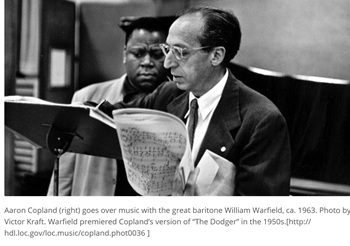
Once again I’m on the hunt for the origins of a famous piece of music. Aaron Copland’s suite of early American tunes was commissioned by none other than Benjamin Britten and was presented at that composer’s newly-launched Aldeburgh Festival in 1950. Britten had developed a keen interest in performing American folk music, at least partly because of his long visit to the US from 1939-1942. While there he and his partner Peter Pears had spent a lot of time with Copland; he said later that Copland was “by far the best American composer.” Perhaps because of Pears’ abilities as a singer, he and Britten regretted the dearth of songs in the Copland catalog. So they decided to do something about that, and in 1950 commissioned a set of American folk songs to be performed at the Festival. Well! Copland dove into this commission head first, only coming up for air after he’d ransacked the sheet-music archives at Brown University for material. He did an enormous amount of work for what turned out to be a set of pieces that together total less than 13 minutes’ worth of performance time. But this wouldn’t be the first time Copland got completely caught up in writing music that he didn’t think would result in much return on his investment; he said about the ballet music for Appalachian Spring, “It took me about a year to finish and I remember thinking how crazy it was to spend all that time because I knew how short‑lived most ballet scores are, but [it] took on a life of its own.”1
Virgil Thomson Sets Thomas Campion to Music
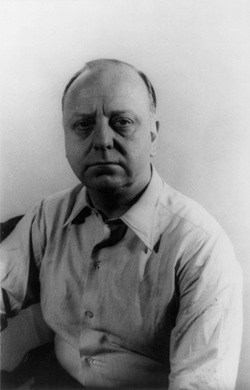
Virgil Thomson is right up there in the pantheon of 20th century composers along with Aaron Copland and Benjamin Britten, men whose works he criticized rather harshly and whose greater popularity and success he envied. Alas! Even the greatest artists can have feet of clay. But he had much in common with these other two towering figures, not the least of which was an abiding interest in the proper setting of texts to music. How he ran across the four poems of the Renaissance poet Thomas Campion is unknown; I consulted the only authoritative biography available about him and saw no fascinating backstory such as the one I discovered about Benjamin Britten’s A Ceremony of Carols. Thomson did believe, however, that Campion’s poetry and music displayed the same qualities that he strove for: simplicity and directness, with the music serving the text instead of the other way around.
Campion wrote in various genres, but in these brief lyric poems he typically shows a delicacy of feeling about his subject: an idealized woman. Campion is not writing about real flesh-and-blood females in whom he has a romantic interest but is instead presenting a concept of beauty itself. If you read these poems as descriptions of real romantic relationships you might find them a bit depressing, but the metaphysical realm is always inspiring, I guess. Here one can go haring off into Platonic love and courtly love and the whole nine yards, but I do try to keep these posts somewhat reasonable in length. I will just say that the poet is striving for a certain effect and doesn’t necessarily have any emotional skin in the game. Beyond that it’s impossible to know what was going on in his head as he wrote his poems. He never married, so perhaps he preferred the ideal to the real. As for Thomson, we know his interest in the concept of female beauty was theoretical and not personal, as his romantic pursuits were confined to men.
The Deeper Meaning behind Copland’s “Ching-A-Ring-Chaw”
 Note: This post was written about an earlier concert of the Cherry Creek Chorale in which we sang Part 2 of Copland’s “Old American Songs.” We will be performing the songs from Part 1 for our upcoming concert on March 6 & 7 2026. But there’s so much interesting background on Copland in general below that I wanted to go ahead and post it again.
Sometimes I start researching these posts thinking that I know what’s what and I just need to fill in a few blanks, only find out that my ideas have been completely wrongheaded. Other times I think there’s not too much to say and end up with enough material for a doctoral dissertation. This post fulfills both conditions. Racism and the transformative power of art are all packed into this one short selection.
The Shakers’ Simple Music Inspires Dance and Song
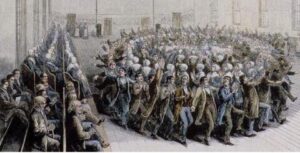
It seems a little unfair that the word “Shakers” nowadays calls up only a furniture style and, probably, the tune “Simple Gifts,” when this religious group had such a long and fascinating history. Honestly, the Wikipedia article about them is well worth a read if you’re at all interested in early American history and/or revivalist religious movements.
I’m going to get into Shaker music, but I do need to explain their beliefs and practices a bit in order to do so. This sect, which got its start in Britain around 1750, was a fascinating mixture of strict rules on the one hand and ecstatic outbursts on the other. Absolute celibacy was required for full membership; the sexes were housed separately and could not even shake hands or pass one another on the stairs. (I’m assuming the latter rule was in place because the staircases were so narrow.) They also lived communally and were strict pacifists. Yet their worship services were a mixture of music, dancing, and manifestations of spirituality that included twitching, jerking, and shouting, usually in some type of unknown language. (Those outward physical actions gave the group their name; originally they were called the “Shaking Quakers” and were an offshoot of the original Quakers.) They had to let off steam somehow, I guess. In spite of all the kerfuffle, though, the music itself was very plain, with no musical instruments used for accompaniment and no harmonies, just the melody. You can do a lot with a little; as our friend Wikipedia says:
The Great Tito Puente Writes Fewer than a Dozen Words—And Creates a Hit with “Oye Como Va”
Podcast: Play in new window | Download
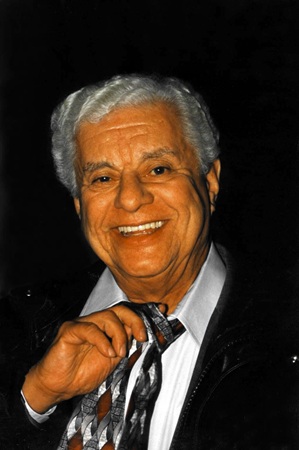
I had no clear idea who Tito Puente was until I started researching his massive hit from the 1960s, “Oye Como Va.” Just reading his Wikipedia page was quite an experience. He grew up in New York City’s Spanish Harlem and drove the neighbors crazy when he was a boy because he was constantly pounding on pots and pans, so his mother signed him up for 25-cent piano lessons. And it only got better from there as his musical talents expanded into any number of instruments. He ended up serving in the US Navy during World War II on an aircraft carrier in the Pacific. A list of his duties as noted in Wikipedia included:
playing alto saxophone and clarinet in the ship’s big band as well as occasionally drum set, piano during mess hall, acting as the ship’s bugler, and serving as a machine gunner in the battles of Leyte and Midway. (And when did he learn to operate a machine gun? Not clear.)
This wartime experience led to two great influences on his later music career: he went on a tour of Asia, traveling for several months after the end of the war, and he attended Julliard on the G.I. bill, where he studied orchestration and conducting. (His conducting teacher there was Japanese, thus cementing those Asian influences from his travels.) From there he went on to a rich and varied career in music, becoming especially known for his playing of the timbales, a type of shallow metal drum. Because Puente was such an active and engaging performer he was usually put at the front of bands so that people could see the show he put on. (I can’t resist pointing out here that a timbale resembles an overturned flat-bottomed stew pot.) Eventually he started his own band and was a mainstay at the Palladium Ballroom during the 1950s and 60s. If you want to get more info about this remarkable man, follow this link below to his Wikipedia page.1 I, however, had better get on to the ostensible subject of this post, “Oye Como Va.”
A Medley from Tim Burton’s “Nightmare Before Christmas”

Two Bittersweet Ballads Teamed Up in a Melancholy Medley

Fall is my favorite time of year: I love the colors, the smells, and the crisp air. I remember so vividly how exciting it was for me as a kid to go shopping for school supplies with my mom. There was the pristine Big Chief tablet and new pencils. Maybe even an unsmudged pink eraser. Everything seemed possible.
But for some autumn is a sad season, as it starts the inevitable slide toward winter with its darkness and cold. Two songs with lyrics by Johnny Mercer portray this viewpoint: “Autumn Leaves” and “When October Goes.” They’ve been put together in a lovely medley by the modern composer/arranger Paul Langford, a true powerhouse whose arrangements I’ve sung myself. Both of these songs have a fascinating backstory.