
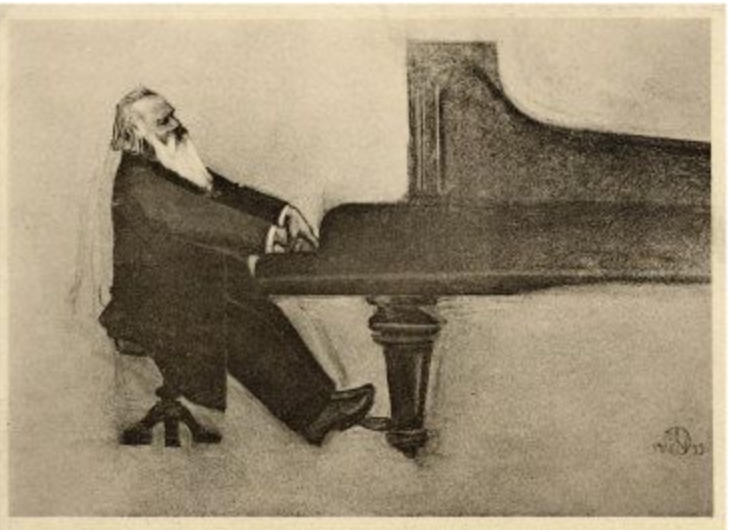
Betcha were a little surprised to see that Brahms even had such a side. Isn’t he rather . . . monumental for such a description? After all, isn’t he one of the three B’s of classical music, along with Bach and Beethoven? Bach certainly wrote lighter music–his “Coffee Cantata” contains the immortal lines “If I can’t drink my bowl of coffee three times daily, then in my torment I will shrivel up like a piece of roast goat.” You can’t quite picture Brahms, or for that matter Beethoven, writing something that silly.
But there were several aspects of Brahms’ life that lent themselves to his writing this music. First, he loved getting together socially with his circle of friends to discuss and perform chamber works. Second, he felt the need for somewhat lighter composing as a relief from his work on Symphony No. 1, an endeavor that took him 21 years. Third, he was always falling in love with unattainable women. Oh dear! First (we think) he fell in love with the wife-then-widow of Brahms’ mentor Robert Schumann and then with a succession of already-taken younger women, one of which was the Schumanns’ daughter Julie. Whew! And, last but not least, Brahms was greatly influenced by the earlier composer Franz Schubert (editing some of Schubert’s music for publication), by Robert Schumann, and by the Waltz King Johann Strauss. The first two wrote many songs, some based on folk tunes, and Strauss of course took the public by storm during his career. Those composers’ lives span from 1797 (Schubert’s birth) to 1899 (Strauss’s death). And there’s Brahms, smack in the middle, living from 1833-1897. But Brahms also kept a pretty canny eye on the musical scene, and it can be said that “these works, in a deliberately popular style, were overwhelmingly responsible for spreading Brahms’ reputation to the general music-buying public, and became the chief source of his personal wealth.”1 After the success of the original Opus 52 set of 18 pieces published in 1869 Brahms went ahead and produced another set of 15, Neue Liebeslieder Walzen, Opus 65. published in 1865.
These beautiful little jewels are still performed quite regularly today. I myself was privileged to see a version that included dancers at the Vienna Opera House in the late 1970’s. We were definitely shooting for the “Europe on $5 a Day” goal but managed, with the help of one girl in our group who spoke fluent German, to get standing-room tickets to a concert that included the Brahms works. What a charming and delightful evening! I can still see that stage with its piano, small group of singers, and four couples waltzing in beautiful 19th-century ball costumes.
A full performance of both sets will quite comfortably fill up a solid first half of a concert, so most programs include only a selection. I’m going to confine myself to a discussion of the ones that my own choir, the Cherry Creek Chorale, is performing (or has performed, depending on when you read this) for its October 2026 concert. (If you live in the Denver metro area not only can you attend this concert in person but you can also buy season tickets if you do so before the October concert. We have quite a lineup for the year.) The lyrics came from a book of international folk songs and verses titled Polydora put together by a folklorist and translator named George Daumer. Brahms described meeting the man who’d given him such lovely texts to set to music: “In a quiet room I met my poet. Ah, he was a little dried-up old man!.. I soon perceived that he knew nothing either of me or of my compositions, or anything at all of music. And when I pointed to his ardent, passionate verses, he gestured, with a tender wave of his hand, to a little old mother almost more withered than himself, saying, ‘Ah, I have only loved the one, my wife!'”2 Isn’t that poignant?
The Chorale is doing waltzes 11-15 in the Opus 52 set, so here they are:
| #11–German Lyrics | #11–Singable English Translation |
| Nein, Es Ist Nicht auszukommen mit den Leuten Alles wissen sie so giftig auszudeuten. Bin ich heiter, hegen soll ich lose Triebe; bin ich still, so heißts, ich wäre irr aus Liebe. | No, I will not listen to them with their chiding, All one does, they talk about it, criticizing. If I’m cheerful. then they say I’m evil-minded. If I’m sad, that means by foolish love I’m blinded. |
| #12– German Lyrics | #12–Singable English Translation |
| Schlosser auf, und mache Schlösser, Schlösser ohne Zahl; denn die bösen Mäuler will ich schließen allzumal. | Locksmith, go and bring me padlocks, many padlocks, Padlocks large and small. The the gossip, spiteful gossip, will I silence, silence once for all. |
Numbers 11 and 12 form a set. First the speaker complains about how people talk about him as a single person. He can’t do anything right! So, his solution is to lock up all the gossips (or perhaps their mouths).
| #13–German Lyrics | #13–Singable English Translation |
| Vögelein durchrauscht die Luft, sucht nach einem Aste; und das Herz, ein Herz begehrt’s, wo es selig raste. | Every bird that soars the sky seeks a branch for nesting; and each heart a heart deserves for the spirit’s resting. |
A lovely melody imitates the soaring of the bird as it searches for a place to perch.
| #14–German Lyrics | #14–Singable English Translation |
| Sieh, wie ist die Welle klar, blickt der Mond hernieder! Die du meine Liebe bist, liebe du mich wieder! | See how bright the fountain gleams from the moon above her! If my love can light your dreams, love me, dear, forever! |
The piano imitates the the splashing of the fountain while the voices sing of love.
| #15–German Lyrics | #15–Singable English Translation |
| Nachtigall, sie singt so schön, wenn die Sterne funkeln. Liebe mich, geliebtes Herz, küsse mich im Dunkeln! | Nightingale, you sing so sweet, when the stars are sparkling. Yield your love, my fondest heart, kiss me when ’tis dark’ning. |
Such a gorgeous melody, imitating the song of the nightingale.
Texts for the above four selections are taken from Liebeslieder Walzer “Lovesong Waltzes” Opus. 52 by Johannes Brahms, edited by Robert Shaw with English text by Basil Swift, Lawson-Gould Music Publishers, Inc., (c) 1961. For more literal translations, visit An Analysis of Brahms’ Liebeslieder Waltzes Op. 52.
Then we’re performing only one of the later set, #12–
| #12–German Lyrics | #12–English Translation |
| Schwarzer Wald, dein Schatten ist so düster! Armes Herz, dein Leiden ist so drückend! Was dir einzig wert, es steht vor Augen, Ewig untersagt ist Huldvereinung. | Dark forest, your shadows are so grim! Poor heart, your suffering is so oppressive! The one thing you value is before your eyes, Forever forbidden is a happy union. |
The music maintains its waltz lilt while still expressing the sadness of unrequited love, symbolized by the grim shadows of a dark forest.
Text and translation are taken from Emerald Ensemble Love Songs featuring Johannes Brahms’s Liebeslieder Waltzes and Neue Liebeslieder Waltzes.
I really wanted to find a complete performance with dancers, but alas–no such luck. There’s a very low-res ballet version that just didn’t ring my chimes. This one really seemed to enter into the spirit of the thing, and the singers’ diction is impeccable. The setting is suitably opulent.
(c) Debi Simons
- “The Music of Poetry: Johannes Brahms: Liebeslieder Waltzes Op. 52” in the online magazine Interlude ↩︎
- Ibid.
↩︎
