Why Is Mendelssohn’s Name Sometimes Listed as Mendelssohn-Bartholdy?

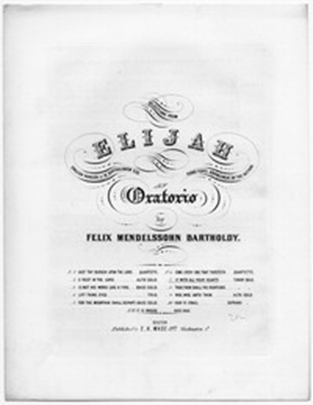
(Image accessed via Library of Congress website)

Note to my readers: This post is a chapter from the book I wrote about Mendelssohn’s oratorio Elijah, which I was privileged to perform with my own choir a number of years ago. This coming October the Cherry Creek Chorale will be performing one of Mendelssohn’s songs in a lovely, varied program titled “Harmony and Hops.” I’ll be writing specific posts about our selections, but in the meantime here’s this material on one of our composers:

I remember seeing this version of Mendelssohn’s name on a piano piece I was (very unsuccessfully) working on, and thinking, Is this another Mendelssohn? You’ll see both version of Felix’s last name used. So what gives? It’s a very complicated, and fascinating, story that concerns itself with Jewish culture in Europe and the role of anti-Semitism.

To begin with, Felix’s grandfather, Moses Mendelssohn, came to Berlin from a small town in Germany in 1743 at the age of 14, even though that city’s society was very hostile to Jews. He managed to become quite prominent in the philosophical and literary world, beating Immanuel Kant in an essay contest sponsored by the Berlin Academy. Frederick the Great even granted him the title of “Protected Jew,” which guaranteed his right to live peacefully in Berlin. (But of course this distinction only makes the lowly status of most Jews even more obvious by contrast.) Moses is a worthwhile historical figure in his own right and was hailed as the “German Socrates.” He devoted much of his later life to writings that eloquently supported the idea of religious freedom, saying that the state should not seek to control the religion of its citizens.

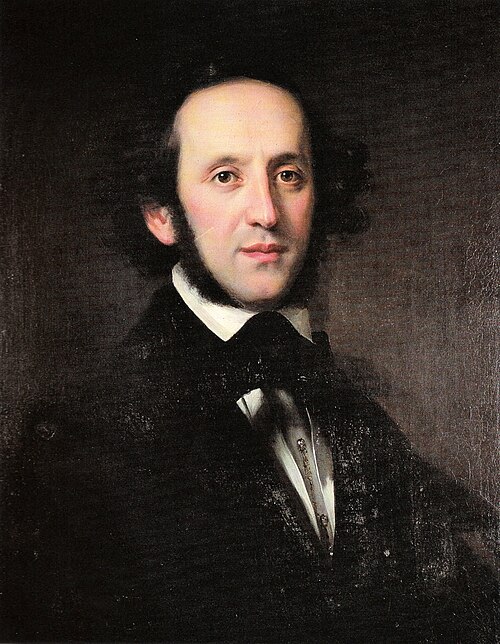
But even such a respected and beloved figure as Moses Mendelssohn couldn’t wipe out the widespread anti-Semitism in European culture. So Abraham, Moses’ son and Felix’s father, took several steps to distance himself and his family from their Jewish heritage. One of those actions was to adopt the surname “Bartholdy,” an action suggested by Abraham’s brother-in-law, Jakob Salomon, who took the name from a property he had acquired. Abraham urged Felix to drop the Mendelssohn name and just use Bartholdy, but even though Felix was baptized as a Protestant and married a minister’s daughter, he refused to drop his use of Mendelssohn. It’s never possible to know exactly what was going on in the mind and heart of someone from the past (or even someone in the present), but it seems to me that Felix wanted to honor both aspects of his background. Most of the time, his public knew him as Mendelssohn without the Bartholdy, but sometimes both names were listed. And that inconsistency has carried over until today.

Read more

What’s a herald angel? And other questions answered about a confusing Christmas carol.


Image by LoggaWiggler from Pixabay

It’s a great joy to begin introducing music that will be included in the December 2025 concert of my own beloved community choir, the Cherry Creek Chorale. If you live in the Denver area, be sure to follow the link to our website and click on the “purchase tickets” tab.

Let me start out with the correct way to punctuate the title; it should be “Hark! The Herald Angels Sing.” So the title actually comprises two sentences. “Hark!” is a one-sentence command meaning “Listen!” or “Pay attention!” (The same thing is going on grammatically in “Hark! I Hear the Harps Eternal,” which is also not typically punctuated properly.) And to whom should we pay attention? Why, the “herald angels,” of course. (Let’s spare everyone the joke about the angel’s name being “Harold,” okay?) A ”herald” is a messenger who sometimes blows a trumpet to get everyone’s attention before an announcement. The angels in the Christmas story don’t blow trumpets; they don’t even sing. They simply proclaim. So the illustration that I chose for this post is not correct biblically, but it does agree with the carol.

Read more

Mendelssohn’s Farewell–Three Sections from His “Christus”

Image by marian anbu juwan from Pixabay

O-o-o-o-h man! Are there ever going to be some deep theological highways and byways in this post. So hang on and let’s get started with this wonderful choral piece which was tragically truncated by Mendelssohn’s early death in 1847 at the age of 38. He had apparently planned to write an entire oratorio, Christus, following the same trajectory as Handel’s Messiah, but left only a few finished sections and a number of fragments. A set of three excerpts dealing with the birth of Christ is well suited for use at Christmas, and consists of a soprano recitative, a male trio, and a chorus.

Read more