
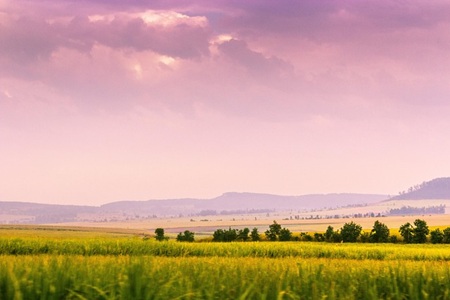
Why, you might ask, is the Cherry Creek Chorale singing a quintessentially American piece in a German-themed program? “Well,” said our artistic director Brian Leatherman, “it’s America’s 250th, and so . . . we wanted to put it in.” I can’t argue with his reasoning, especially since its inclusion caused me to think about the words of this song in a way I hadn’t done so before. What’s up with those alabaster cities? And who was Katherine Lee Bates, the author of the lyrics? If put to the test I’d probably have pictured her gazing out of the window of her farmhouse over fields of wheat to see the line of Rocky Mountains in the distance. (Yes, you can in theory see them from as far away as western Kansas.)
The real woman was very different, with all due props to American farm woman. During her life during the first half of the 20th century she was a college professor, a world traveler, an author with an astounding output of work, and a social activist interested in the struggles of marginalized people including women, racial minorities, and the poor. She was also very interested in the global peace movement and broke with the Republican party in 1924 over their opposition to the League of Nations. Honestly, I’m just scratching the surface here about her accomplishments,1 but I do need to get on with the ostensible subject of this post, the poem “America the Beautiful.” The foregoing should tell you in at least broad brush strokes that she was no starry-eyed naif with idealistic ideas of American perfection. Once you know the type of person she really was, the words of the song become more realistic and moving than you might have thought.
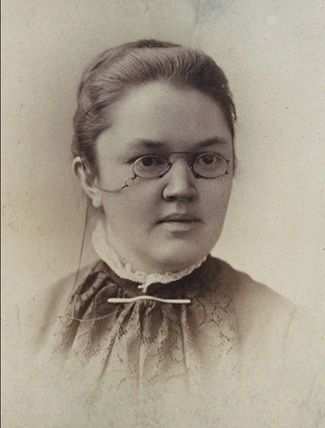
First, what led to her writing? Let me quote her own words here, taken from her journal written during her time in Colorado as a visiting professor at Colorado College during the summer of 1893:
One day some of the other teachers and I decided to go on a trip to 14,000-foot Pikes Peak. We hired a prairie wagon. Near the top we had to leave the wagon and go the rest of the way on mules. I was very tired. But when I saw the view, I felt great joy. All the wonder of America seemed displayed there, with the sea-like expanse.
I love the detail about the mules! And she’d already been impressed with the beauty and breadth of the American landscape during her cross-country trip from her home in Massachusetts to the great state of Colorado. She’d passed through Chicago on the way, a reference that will crop up in her final verse. So let’s get to it:
First, has it ever occurred to you to wonder what the phrase “O beautiful for . . . “ actually means? I guess I’m an irredeemable grammar wonk; here’s the interpretation that seemed the most sensible to me after I consulted a few sources: “O America, I consider you beautiful for the following reasons . . .” Once you get hold of that idea you can then see a logical progression of ideas with each verse moving farther away from the purely physical beauty of the country to its more idealized qualities. I’m going to go stanza by stanza through the four sections as they appeared in the final 1911 version:
O beautiful for spacious skies,
For amber waves of grain,
For purple mountain majesties
Above the fruited plain!
America! America!
God shed His grace on thee
And crown thy good with brotherhood
From sea to shining sea!
This is the verse we all know and which concentrates on America’s physical bounty. Bates would have crossed Kansas on the way to Colorado, and anyone who’s done that even today knows about the endless fields in that state. “Fruited” doesn’t necessarily mean “with fruit trees” but “fruitful.” What about those last three lines, though? Once Bates’s political and philosophical ideas come into focus they take on an imperative mood. The lines don’t mean “God has shed His grace on America and crowned her good(s), her bounty, with universal amity and fellowship” but “We ask that God will do so.” This request aspect becomes clearer as the verses go on.
O beautiful for pilgrim feet,
Whose stern, impassioned stress
A thoroughfare for freedom beat
Across the wilderness!
America! America!
God mend thine every flaw,
Confirm thy soul in self-control,
Thy liberty in law!
“Pilgrims” doesn’t necessarily mean “the Pilgrims,” as in those very early settlers who came to America in search of religious freedom, but Bates was a native Massachusettan and their story would have been imbibed with her mother’s milk. I love that phrase “stern, impassioned stress,” which to me always brings to mind an image of a bewigged Minuteman kind of figure taking very firm steps as he sternly strides forward. But now look at the last three lines here: “God, we ask you to amend America’s flaws, thus saying that we have some. Help us to follow the path of ordered liberty, not reckless abandon.”
O beautiful for heroes proved
In liberating strife,
Who more than self their country loved
And mercy more than life!
America! America!
May God thy gold refine,
Till all success be nobleness,
And every gain divine!
I think Bates would have enjoyed Ken Burns’ latest oeuvre covering the Revolutionary War, since he made efforts to show at least some of the warts in his portraits of the time. Bates hints at said warts in her call for God to refine America’s gold—thus implying that there’s some dross in there.
O beautiful for patriot dream
That sees beyond the years
Thine alabaster cities gleam
Undimmed by human tears!
America! America!
God shed His grace on thee
And crown thy good with brotherhood
From sea to shining sea!
This was the verse that got me thinking about the meaning of this whole song, since I suddenly thought, ‘Hey, wait a minute! What are we talking about here? Heaven? America is going to turn into Heaven? I’m confused.’ Well, it won’t surprise you that I’m not the only one who has wondered about this imagery of the “alabaster cities.” Just as a general note, let me point out that Bates would have grown up in a society that was saturated with Christian thought and imagery and that she considered herself a Christian. She was also solidly in favor of church and state separation and religious pluralism. So we can throw out the idea that she was some kind of Christian nationalist.
Her imagery of those gleaming cities has several sources, which I will duly note as briefly as I can without wearing you out too much. (But I make no promises.) To find the original wording we have to go all the way back to the Christian New Testament and the words of Jesus in Matthew 5:14: “Ye are the light of the world. A city that is set on an hill cannot be hid.” (KJV) The idea of America’s being such a city, taken from this verse, was first articulated by Governor John Winthrop of the Massachusetts Bay Colony in a sort of unofficial sermon delivered to the settlers before they even got off the ship. But I must point out here that Winthrop didn’t use the word “shining” any more than Jesus did. Here’s what he actually said: “For we must consider that we shall be as a city upon a hill.” It’s a warning, not a promise: if the new settlement doesn’t fulfill its ideals as a Christian endeavor then the rest of the world will take note and condemn it. This founding statement took place in 1630, l-o-n-g before the Constitution with its “Congress shall make no law concerning religion” wording was enacted. As far as I can tell, the word “shining” wasn’t added until 350 years later, in Ronald Reagan’s November 1980 election-eve address, “A Vision for America.”
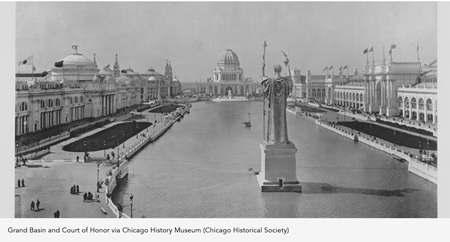
As for the “alabaster cities” image: Bates would have passed through Chicago on her way to Colorado in 1893 and thus been able to see the gleaming white buildings constructed for the World’s Fair. Here’s a historical image of the complex:
Bates echoes (at least I think that’s what she’s doing) this idea from Revelation 21:4: “And God shall wipe away all tears from their eyes; and there shall be no more death, neither sorrow, nor crying, neither shall there be any more pain: for the former things are passed away.” I don’t think Bates was predicting some type of human perfection to come for America, but instead hoping that her progressive visions of equality would come to pass; note her word “dream.” One source has called the poem as a whole a “civic prayer,” and that phrasing makes a lot of sense to me.
The poem was set to a number of tunes but its most enduring one is the original, by Samuel A. Ward. And with that I’d better stop. Here’s what I consider to be the definitive performance of the song, and if you don’t get a little choked up as you listen and watch, well, I just don’t know what to say!
- If you’d like to learn more about her, her Wikipedia article is well worth a look. ↩︎
- Another Wikipedia plug! ↩︎
(c) Debi Simons
