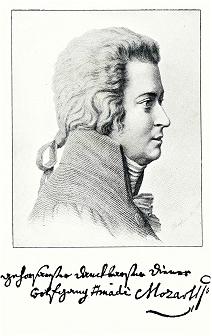
Who really commissioned Mozart’s
Requiem, and who actually wrote it?
What a fantastically complicated story lies behind these two simple questions! All sorts of theories have been suggested: that Mozart thought the commission had come from the Underworld and that he was writing his own funeral music, that Antonio Salieri, Mozart’s musical rival, was behind the commission (and also behind Mozart’s death), and so on. We do have an actual anecdote, mentioned in several reputable Mozart biographies, that Mozart told his wife, Constanze, that he was thinking of death and didn’t believe he had much longer to live, that he felt that he was writing the requiem for himself, and that he was sure he had been poisoned. So Constanze took the score away from him for awhile until his spirits lifted. We have no concrete evidence that a) Mozart actually said this or b) he was actually being poisoned. Indeed, while there have been over 100 theories proposed as to the cause of his death, the most credible idea is that he died of a recurrence of rheumatic fever, a disease he had first contracted as a child.

 There’s a famous essay by Edgar Allan Poe titled “The Philosophy of Composition,” in which the poet and storyteller outlines what he says to be the method used in writing his famous poem, “The Raven.” I rather blush to say that I have taught about this piece in a high-school English class (hey, it was in the anthology) and taken it seriously, as indeed a quick Google search will show that most reviewers do.

 Of all the spirituals I’ve sung with my own choir, this one, with its slow pace and minor key, conveys the feelings of an oppressed people the most strongly. It’s not just a series of complaints or calls for help, though. There’s a lot of scriptural truth packed into it.
 The simplified explanation of how black spirituals came about goes like this: slaves heard about Christianity after arriving in the US and, especially on the southern plantations, came up with sung versions of those teachings that gave them hope of a better life, expressed their longings for deliverance, and often served as rhythmic work songs. All of this is perfectly true but raises further questions: how did this “hearing about Christianity” come about? And why, if you think about it, would slaves adopt the religion of those who had enslaved them? Wouldn’t they see that religion as massive hypocrisy on the part of the slave owners? There’s also a tendency, which I have unfortunately shared, to think of spirituals as rather primitive. But that tendency is clearly mistaken: these are songs with deep meaning, displaying a breadth of Scriptural knowledge. To quote a modern African-American scholar and preacher,
