Medleys from musicals or films are a popular way for a choir to be able to give its audience a taste of the original without having to worry about staging the entire work. Listeners who are familiar with the source material will be given an opportunity to hear it in a different venue; listeners who aren’t familiar with it may be encouraged to seek it out. These opportunities also apply to the performers. For instance, I had never seen Guys and Dolls, but when my own choir performed a medley from that musical, I was inspired to watch the film. And the same thing happened to me with Nightmare. I have to say that it sounded pretty icky to me when we first got our music, but I decided to watch the movie anyway so that I’d have a good basis for this post. Guess what? I totally fell in love with it. So very, very creative!
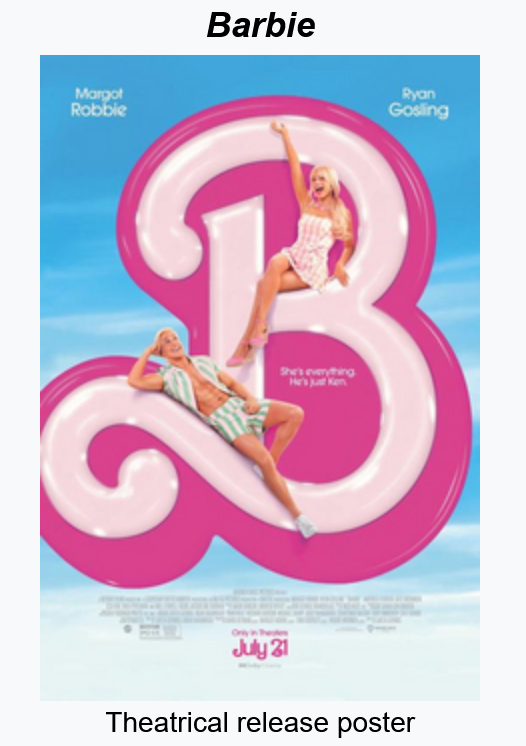
My choir, the Cherry Creek Chorale in the Denver area, performed Billie Eilish’s “What Was I Made For” from the movie Barbie in our May 2025 concert, California Dreamin’. The scene in which Barbie meets her creator, Ruth Handler (played by the great Rhea Perlman), and decides to leave Barbieland and live in the real world gets me misty-eyed every time I watch it.
(Side rant: Just because I choke up at the above scene doesn’t mean that I approve of everything in this movie, especially the portrayal of men. Honestly, folks: If there were ever to be a movie titled Ken, and women without men were to be portrayed the same way that men without women are shown in Barbie, there would be rioting in the streets—and the rioters wouldn’t be wearing pink pussy hats but Brunnhilde horned helmets, and they’d be carrying spears to boot! End of rant.)
Ho-kay. Where were we? Ah yes—Barbie’s decision to become “real.” Suddenly I realized that this is the same story as that of Pinocchio and also of the Velveteen Rabbit1, both about toys who become living creatures. Since the Chorale has sung a number from the Disney Pinocchio movie I’ve written a post about that story, which I’d encourage you to read. Pinocchio has to prove that he’s worthy of becoming a real boy by being “brave, truthful, and unselfish.” Becoming real is all upside for him once he rescues Geppetto from the whale, but it’s a different story for Barbie. Here’s the dialogue that comes right before the song, in which Barbie talks to Ruth Handler. I went to the trouble of transcribing it because I wanted to be sure that the meaning came through. I’ll post a video of the movie clip at the end of this post:
If my choir is performing a song from a film or play I always like to put the piece in context, which often means that I have to wade through summaries of plots that make very little sense. Many if not most musical comedies have plots that are simply frameworks, often flimsy, to hang the song-and-dance numbers on. (It’s okay for me to end that previous sentence with a proposition since one of these song titles does that, too.) Also, sometimes the musical numbers have outlived the production for which they were written and it’s very difficult to get access to the original story.
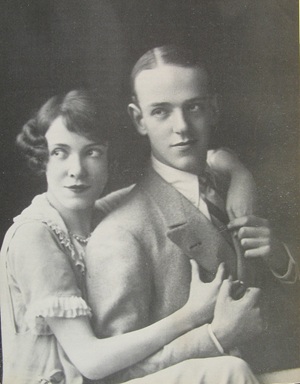
1919 publicity photo of Adele and Fred Astaire, accessed via Wikipedia.
Have you ever had the experience of paying attention to the lyrics of a familiar song and thinking, “Hmmm. This doesn’t say what I’d always thought it did”? You might take a look at my post about the song “Oh the Days of the Kerry Dancing” in which this same realization took place for me.1
Anyway, you’d think from the title of this song that it would be about how wonderful it is to be in thrall to a particular set of notes or to musical rhythm in general, but that’s not really what the words say. Here’s perhaps the clearest statement about the rhythm’s deleterious effects on the speaker:
I know that once it didn’t matter, but now you’re doing wrong; When you start to patter, I’m so unhappy. Won’t you take a day off? Decide to run along somewhere far away off, and make it snappy! Oh, how I long to be the man I used to be! Fascinating rhythm, oh, won’t you stop picking on me?
Let me say first off that the song itself has very little to do with the plot of either the 1924 stage musical Lady, Be Good! or the 1941 film Lady Be Good in which it appears. I’m not even going to try for a plot summary of either one; suffice it to say that the song provides an excuse for a big dance number in each. In the stage version Fred Astaire and his sister Adele performed their dance midway through and then as the grand finale. In the movie the great Eleanor Powell gave an astounding tap routine.
Good question! Do you mean the place, the actual isle or island? Or do you mean the song? Or perhaps the poem? As you can see, it’s complicated.
Let me start out with the poem that William Butler Yeats wrote in 1888, “The Lake Isle of Innisfree.” Since it’s only 12 lines I’m going to quote it in full here:
I will arise and go now, and go to Innisfree, And a small cabin build there, of clay and wattles made; Nine bean-rows will I have there, a hive for the honey-bee, And live alone in the bee-loud glade.
Not at all. I don’t have space to deal with the lyrics as a whole, so let me start with the opening phrase and go on from there. The lyricist himself, a son of Jewish immigrants who had taken the name of “Yip” Harburg, had been writing as a sideline while running a successful business which tanked in 1929. He said, “The capitalists saved me in 1929, just as we were worth, oh, about a quarter of a million dollars. Bang! The whole thing blew up. I was left with a pencil and finally had to write for a living… what the Depression was for most people was for me a lifesaver!”
This will be yet another of my long, meandering posts telling you more than you ever wanted to know! This time it’s about the song “Get Happy.”
First off, I remember seeing Judy Garland sing it in the famous clip from the 1950 movie Summer Stock. It was some kind of television retrospective on Garland and her career, and I can hear the narrator’s voice saying, “Everyone agrees that this performance was one of her very, very best.” The song, which comes at the end of the movie, also marked the end of Garland’s career at MGM. She had been struggling with drugs and depression and had been let go from the movies The Barkleys of Broadway in 1948 (and replaced with Ginger Rogers) and Annie Get Your Gun in 1949 (and replaced with Betty Hutton). It’s hard to imagine those two movies with Judy in the lead, for me anyway. I don’t think of her particularly as a dancer. She was given another chance with Summer Stock and managed to get through the filming with lots of sympathy and help from her co-stars, but MGM had had enough. Her contract was terminated “by mutual consent” after the film was finished. The final number, though, was filmed two months after the rest of the movie was completed, after Garland had lost a fair amount of weight by means of hypnosis. (That’s the story, anyway.) Observers have noted that she’s thinner in that final sequence than she is in the rest of the film.
My choir, the Cherry Creek Chorale, has sung a great jazzy arrangement of “I[‘ve] Got No Strings” by composer/arranger Paul Langford. The original song was written for the 1940 Disney movie Pinocchio and was also released the same year, with slightly different lyrics, by Decca Records. Most post-1940 performances use the Decca lyrics, I suspect because they fit into a more generalized meaning than the film’s wording, which is closely tied to the scene at the marionette theater where Pinocchio performs along with other, stringed puppets. I’ll include videos and lyrics for the two different versions at the end of this post.
The original story of the wooden puppet who comes to life was written by an Italian, Carlo Collodi, in the late 1800’s. His tale is considerably darker than the Disney version. Pinocchio is downright nasty! He kills Jiminy Cricket! With a hammer! (The cricket reappears as a ghost later on in the story.) There’s a lot of violence in the original that doesn’t appear in the film: Pinocchio goes to sleep with his feet propped up on the stove and wakes up to find that they’ve burned off; Geppetto makes him some new ones. Pinocchio bites off a cat’s front paw when the cat is disguised as a bandit. At one point Pinocchio is being hanged, but apparently he’s taking too long to die and so his would-be murderers, the cat and the fox, wander off. The Turquoise/Azure/Blue Fairy rescues him. And so on.
Since I’m always so fascinated with origin stories, I’m going to quote a rather long section from Smithsonian magazine about how (perhaps) Collodi got at least the germ of his plot:
Imagine, if you will, a film with tremendous star power, including Jeremy Irons and Robert de Niro in the two leading roles, a spectacular setting centered around a South American waterfall that’s 100 feet higher than Niagara Falls, and cinematography if the highest order, and yet . . . it didn’t even earn enough in theaters to repay production costs. And it’s remembered today almost solely for its soundtrack, whose composer Ennio Merricone was best known up till that time for his music in the so-called “spaghetti westerns” that included The Good, the Bad, and the Ugly.
The great film critic Roger Ebert said that:
The Mission feels exactly like one of those movies where you’d rather see the documentary about how the movie was made. You’d like to know why so many talented people went to such incredible lengths to make a difficult and beautiful movie – without any of them, on the basis of the available evidence, having the slightest notion of what the movie was about. There isn’t a moment in The Mission that is not watchable, but the moments don’t add up to a coherent narrative. At the end, we can sort of piece things together, but the movie has never really made us care. (“The Mission”)
You’ll probably think as you read the lyrics below that they sound familiar, and you’d be right. This song has had a very long and popular life, starting with its first publication in the 1880’s. The most recent incarnation has been as the theme song for the long-running drama Outlander, based on a series of novels by Diana Gabaldon. I’m not going to deal with anything outside of the actual historical origins of the song, as there’s plenty to say just in that area.
The short version of the story behind the lyrics is that it centers around the Battle of Culloden in 1746, in which the Scots were soundly defeated by a much-larger English force. The battle had come about through an attempted restoration of the Stuart dynasty to Britain’s throne, with the Scottish forces being led by Charles Stuart, or “Bonnie Prince Charlie” (and often referred to in the material below as “BPC.”) It’s an incredibly complicated bit of history that I won’t go into in detail here. If you’d like to get a more thorough overview of the events referred to in the song, let me direct you to a post I wrote several years ago that tells the story behind yet another very famous song associated with this battle: “I’ll Take the High Road and You’ll Take the Low Road.”





 This will be yet another of my long, meandering posts telling you more than you ever wanted to know! This time it’s about the song “Get Happy.”

