
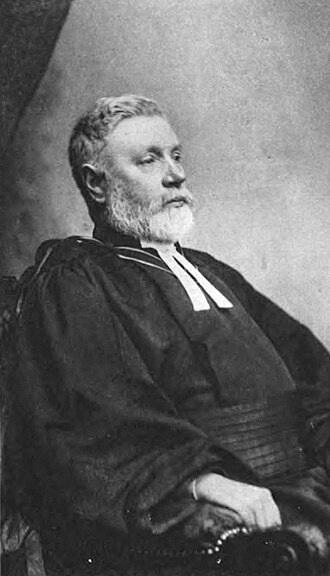
I’m always a little suspicious of what I call “just-so stories,” ones that seem too neat and tidy in drawing straight lines to explain human actions. The “just-so” on the lyrics of “O Love That Will Not Let Me Go” says that George Matheson, a Scotsman living in the mid-1800s, was going blind. He had been at university and engaged to be married, but when he told his fiancé the news of his impending blindness she refused to marry him. So his sister became his housekeeper, assistant, and companion. She helped him with his scholarship as he became a prominent theologian and preacher, even learning Greek and Hebrew so that she could read those texts to him. 20 years later, though, she married. Matheson was heartbroken as he contemplated being alone again, perhaps reliving the rejection he had felt when his fiancé had ended their relationship. Out of his grief he penned the famous four-stanza poem that is the subject of this post.
It could certainly have happened that way, but real life is always messy. For one thing, we have no definitive source about this supposedly unfaithful fiancé, just a few allusions that say he “might have” been involved with a young woman who broke his heart. Here’s what one old hymnbook has to say: “There is a story of how years before, he had been engaged until his fiancé learned that he was going blind, and there was nothing the doctors could do, and she told him that she could not go through life with a blind man.” Not a lot of corroborating detail here, it must be said. And Matheson didn’t suddenly realize that he was going blind; in reality, his vision was never very good and steadily deteriorated over time. While at school he was able to make out texts by the use of a strong magnifying glass and always sat near the front of the classroom in order to see the board. He could see faint outlines and shadows throughout his life, but his poor vision made him almost totally dependent on others for the practicalities of daily life. Although the system of Braille writing for the blind had been invented in 1824, I don’t see any references to his use of it. In spite of these limitations, however, his list of accomplishments would be truly remarkable even for a sighted person. He published books, produced sermons, gave lectures, and even preached before Queen Victoria, all without being able to read or write without the aid of a secretary. His sister, Jane Gray Matheson, filled that role at least until she married, and he gave her credit for her help in his own works.



 The texts of the first two sections of Vivaldi’s Gloria are the words of the angels in their announcement of Christ’s birth, words that are sung repeatedly in Christmas music, either in Latin or English:
 And the answer is: an arch. We all know about Roman arches, don’t we? The architectural point, which ties in with the musical point, is that there are matching stones on each side of the arch, each one bending closer and closer to the center, with the top stone, the one that holds it all in place, called the “key stone.” Without that center stone that whole thing collapses.
 You just never know what you’re going to find out when you google something! I assumed (a common action for me) that Franz Biebl was someone who lived several hundred years ago, as the music has a very old-ish feel to me. Perhaps he lived in the 1600’s or 1700’s? And it certainly would never have occurred to me that:

 I’ve sung with my choir a version of Gregorio Alberti’s “Miserere” edited by John Rutter, who includes a rather lengthy and somewhat technical commentary about how the current version of this piece came about. Rutter does not include the most famous story about how the piece became available to the general public, though, a tale about the child prodigy Mozart and his ability to write down music from memory, even music that he had heard only once. I’ll get to that story in a minute. (Don’t you just hate it when writers do that?)