
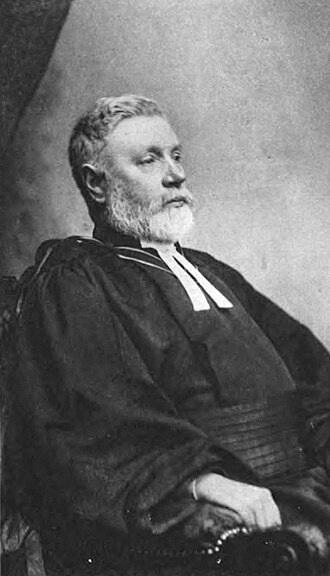
I’m always a little suspicious of what I call “just-so stories,” ones that seem too neat and tidy in drawing straight lines to explain human actions. The “just-so” on the lyrics of “O Love That Will Not Let Me Go” says that George Matheson, a Scotsman living in the mid-1800s, was going blind. He had been at university and engaged to be married, but when he told his fiancé the news of his impending blindness she refused to marry him. So his sister became his housekeeper, assistant, and companion. She helped him with his scholarship as he became a prominent theologian and preacher, even learning Greek and Hebrew so that she could read those texts to him. 20 years later, though, she married. Matheson was heartbroken as he contemplated being alone again, perhaps reliving the rejection he had felt when his fiancé had ended their relationship. Out of his grief he penned the famous four-stanza poem that is the subject of this post.
It could certainly have happened that way, but real life is always messy. For one thing, we have no definitive source about this supposedly unfaithful fiancé, just a few allusions that say he “might have” been involved with a young woman who broke his heart. Here’s what one old hymnbook has to say: “There is a story of how years before, he had been engaged until his fiancé learned that he was going blind, and there was nothing the doctors could do, and she told him that she could not go through life with a blind man.” Not a lot of corroborating detail here, it must be said. And Matheson didn’t suddenly realize that he was going blind; in reality, his vision was never very good and steadily deteriorated over time. While at school he was able to make out texts by the use of a strong magnifying glass and always sat near the front of the classroom in order to see the board. He could see faint outlines and shadows throughout his life, but his poor vision made him almost totally dependent on others for the practicalities of daily life. Although the system of Braille writing for the blind had been invented in 1824, I don’t see any references to his use of it. In spite of these limitations, however, his list of accomplishments would be truly remarkable even for a sighted person. He published books, produced sermons, gave lectures, and even preached before Queen Victoria, all without being able to read or write without the aid of a secretary. His sister, Jane Gray Matheson, filled that role at least until she married, and he gave her credit for her help in his own works.
We don’t really have to guess at the inspiration for Matheson’s poem, because in this case we have his own words:
My hymn was composed . . . on the evening of the 6th of June, 1882, when I was 40 years of age. I was alone in the manse at that time. It was the night of my sister’s marriage, and the rest of the family were staying overnight in Glasgow. Something happened to me, which was known only to myself, and which caused me the most severe mental suffering. The hymn was the fruit of that suffering. It was the quickest bit of work I ever did in my life. I had the impression of having it dictated to me by some inward voice rather than of working it out myself. I am quite sure that the whole work was completed in five minutes, and equally sure that it never received at my hands any retouching or correction . . . this came like a dayspring from on high.
Note that Matheson was apparently not attending his sister’s wedding that evening since he wasn’t in Glasgow with the rest of the family. Why wasn’t he there? It’s puzzling. I did see a reference to the idea that he didn’t like traveling by train, so perhaps that aversion explains things. After all, we’re probably not talking about a big church wedding with multiple bridesmaids; it may be that Glasgow was simply a convenient location for the two families to congregate. Innellan, the town where Matheson lived, is only about 40 miles from Glasgow, but you have to take a ferry as well as a trail to get there. It’s possible that he just decided to stay home as a favor to all concerned. If I wanted to comb through his writings I could probably find out about how this whole sister situation came about, but I’m going to call an arbitrary halt.
The point is (yes, there is a point buried in here somewhere) that we don’t really know what great mental and spiritual distress produced Matheson’s poem; he declined to describe the content of his “severe mental suffering,” saying that it was “known only to myself.” It is indeed possibly the case that he was overcome by the emptiness and loneliness of his house that would now be without the presence of his sister. But he’s described in firsthand sources as being “invariably radiant and cheerful” despite his blindness. I guess my objection to the usual story is that it’s simplistic and makes Matheson sound like this poor old guy who had no other resources besides this one devoted person. That characterization is absolutely wrong. Whatever suffering overwhelmed him as he sat alone in that Scottish manse, it caused only a temporary low point. He lived for 24 more years and kept on writing and preaching; his output after 1882 was phenomenal. So he got hold of a secretary, or hired an additional one, and just kept on going. In the end, “O Love” expresses his hopefulness and not his despair.
Matheson’s lyrics were first set to music by British organist, arranger, composer, editor and author Albert Lister Peace. There have been a number of arrangements since then that use this melody, but as far as I can tell the modern choral composer Elaine Hagenberg is the only one to have set the lyrics to, as she puts it, a “fresh melody.” So here are two performance videos, with commentary below them on the full set of verses.
First, a performance of the setting by Peace with lovely transitional bridges between the verses and in a stunning setting (and yes, I know that this has to have been dubbed in a studio–so sue me!):
And here’s the Elaine Hagenberg setting in the official performance video from her website:
My own choir, the Cherry Creek Chorale in the Denver metro area, performed the Hagenberg setting in a special all-Hagenberg concert in May 2026, “From Darkness into Light.” Truly lovely!
I do want to include the full text of Matheson’s original poem below. Since this post is running a bit long I’ll keep the comments brief:
O Love that wilt not let me go,
I rest my weary soul in Thee;
I give Thee back the life I owe,
That in Thine ocean depths its flow
May richer, fuller be.
Here’s a statement of Matheson’s theme that he’ll repeat in the following verses: that you lose nothing by immersing yourself in God. Divine love enriches man’s puny contributions.
O Light that followest all my way,
I yield my flickering torch to Thee;
My heart restores its borrowed ray,
That in Thy sunshine’s blaze its day
May brighter, fairer be.
Don’t you just love that image of Matheson lifting up a guttering torch and seeing it blaze anew?
O Joy that seekest me through pain,
I cannot close my heart to Thee;
I trace the rainbow through the rain,
And feel the promise is not vain,
That morn shall tearless be.
Divine joy actively seeks out those who grieve, but the recipient has to choose to receive that joy. Matheson had originally written “I climb the rainbow” instead of “I trace the rainbow” but was asked to change the wording by the publishers of the Scottish hymnbook. Perhaps they thought that the idea of climbing a rainbow was too fanciful, but I have to say I prefer it.
O Cross that liftest up my head,
I dare not ask to fly from Thee;
I lay in dust life’s glory dead,
And from the ground there blossoms red
Life that shall endless be.
Matheson now moves from a general idea of God to a specifically Christian image of the cross. The wording is striking, and I’m sorry that this verse is usually not included.
(c) Debi Simons
