The Inn, the Manger, the Shepherds, and the Stable


Not terribly inaccurate! Image accessed from https://donnagawell.com/2020/12/17/away-in-a-manger-at-migdal-eder/; no attribution given.

I never want with these posts to make musical texts less meaningful to those who sing or hear them, and that is especially true with Christmas music. If I disagree with conventional ideas, rest assured that there will always be a deeper and richer meaning to be had in their place. As usual, I’ve had a ball diving down into various and sundry websites, finally coming up for air to share with you what I’ve discovered.

Probably everyone reading this post knows that the context for the birth of the Christ child in the town of Bethlehem is a Roman census: everyone has to go “to his own city.” (There’s a ton of controversy out there about what and when this “census” was; I’m not going to get into that whole issue here.) Joseph, we are told, was descended from King David, who came from Bethlehem and had been plucked out of obscurity as a youngest son and shepherd boy, ruling Israel way back around 1,000 BC. Bethlehem was therefore probably where Joseph was born. Why wasn’t he living there at the time of the census? We don’t know; in fact, we know very little about Joseph. Perhaps he had moved to Nazareth because there wasn’t much work for a carpenter in Bethlehem. But now he and Mary have had to travel back, a distance of about 100 miles. They would almost certainly have traveled in a group with other people; a lone journey was very dangerous, and they can’t have been the only ones needing to show up for the census. And those scenes with Mary barely making it into town and almost giving birth in the street are most assuredly not confirmed in the text, since we’re told that “while they were there, the days were accomplished that she should be delivered.” They got there with time to spare. I’ve wondered, though, if perhaps they’d delayed their journey in the hopes that the baby would come before the trip? Impossible to know.
Read more

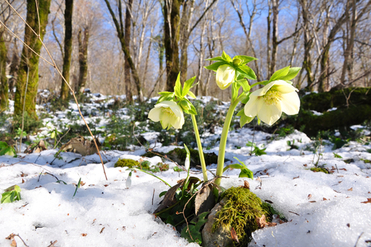
Why Is the Christ Child Sometimes Called the “Christmas Rose”?


image source unknown

There are many Christmas carols and songs that include the image of the Christ child as a rose. “Lo, How a Rose E’re Blooming” is a famous one, made even more so from the modern pairing of that 17th century hymn with the contemporary pop song “The Rose” by  Amanda McBroom. “When Blossoms Flowered ‘Mid the Snows,” is another one such with its lines:

When blossoms flowered ‘mid the snows
Upon a winter night,
Was born the Child, the Christmas Rose,
The King of Love and Light.

(This song was originally titled “Gesu Bambino,” written by—you guessed it—an Italian.)

So I had always vaguely thought of the image of a rose, possibly a red one for contrast, blooming against the white snow, a miraculous event like the story of Christmas itself. And that would indeed be a beautiful image, except for one problem:

Read more

Is “Joy to the World” a Christmas song?


Hey, isn’t that a pretty dumb question? “Joy to the World” is one of our most traditional of Christmas carols. At least, that’s what most of us would say. But a quick look at the words reveals no mention of mangers, angels, shepherds, stars, or Christ as a baby. So what’s the song really about? I was intrigued to see the name “Isaac Watts” as the author of the lyrics. He’s known as the author of many famous hymns, including “When I Survey the Wondrous Cross” and “Oh God, Our Help in Ages Past.” So it wouldn’t be surprising for him to have written about Christmas.

Read more

What’s the Mystery in “O Magnum Mysterium”?


Master of the Nativity of Castello (fl. 1450–1500), image accessed via Wikimedia Commons, public domain

I’d always kind of assumed that the answer to this question would involve something high-flown and theological about the incarnation of Christ, but that’s not really the case. This text, which has been set to some of the most sublime music ever written, is all about the earthy details of the Christmas story. Does that surprise you? It did me, when I actually took the time to look at the translation.

Before I go any further, here’s the Latin original with the English version:

[one-half-first]

O magnum mysterium,
et admirabile sacramentum,
ut animalia viderent Dominum natum,
iacentem in praesepio!
Beata Virgo, cujus viscera
meruerunt portare
Dominum Iesum Christum.
Alleluia![/one-half-first]

[one-half]

O great mystery,
and wonderful sacrament,
that animals should see the newborn Lord,
lying in a manger!
Blessed is the virgin whose womb
was worthy to bear
the Lord, Jesus Christ.
Alleluia!

[/one-half]

What Happens to the Ivy in “The Holly and the Ivy”?


Pixabay

I had never noticed this before analyzing the carol for this post, but the ivy is mentioned in the first line and then it just disappears. Here are the first two lines:

The holly and the ivy, when they are both full grown,
Of all the trees that are in the wood, the holly bears the crown.

Wouldn’t you expect that there would be a third line explaining the role of the ivy, something that starts out with “Of all the vines that are in the wood, the ivy bears . . . ” But there isn’t. Here’s somewhat of a explanation from an academic website:

The lyrics are somewhat puzzling. The first line is “The Holly and the Ivy,“ yet ivy is mentioned nowhere else in the carol except in the last verse, which is a repeat of the first verse. Holly is given the starring role in the song and ivy is ignored, so it seems strange that ivy is even mentioned.

The explanation that is often given is that the first line in the carol is a remnant of the old custom of linking holly and ivy together. In the rest of the carol ivy isn’t needed. The “holly” in the carol refers to Christ and the theme of the carol is his life. (“English Ivy Symbolism, Traditions, and Mythology“)

Read more

In “It Came Upon A Midnight Clear,” What’s “It”?

Image by b0red from Pixabay; I like this image because the angel isn’t doing anything not included in the biblical story.

I classify this carol along with “Hark! The Herald Angels Sing” as having a very confusing title. In order to understand the meaning we’ll have to dive into a little grammar wonkery, with some biblical doctrine along the way.

Okay. Everybody got that? The lyrics were written by an American Unitarian Universalist minister, Edmund H. Sears, and, notably, they do not mention the actual birth of Christ at all. Let’s look at the first two lines of the carol itself:

It came upon a [or the] midnight clear,
That glorious song of old,

Read more

Did the lyricist of the famous song actually get to go “walking in a winter wonderland?”

Image by StockSnap from Pixabay

In a word: No. Why not? Because he was in a tuberculosis sanitarium. How weird and sad is that? Very.

So, back in the winter of 1934, 33-year-old Richard Smith was sitting in his room at the West Mountain Sanitarium after having a recurrence of his TB, trying to keep himself occupied by entering jingle contests for ad copy. (He actually won the Maybelline eye shadow contest with the slogan “The Eyes Have It.” Clever!) He could see children playing in the snow outside his window and was reminded of how much he’d enjoyed those same activities when he was growing up in the small town of Honesdale, Pennsylvania. A powerful nostalgia was at work here, but, given the actual wording of the song I think there was something else going on: he missed his wife, Jane, whom he’d married in 1930.

Read more

Z. Randall Stroope, Heritage and HODIE

image accessed via zrstroope.com

A Rich Vein of Influence

The “Z” stands for “Zane.” Just in case you’re wondering.

Now that we have that out of the way we can get to the real stuff, notably the great compositional heritage embodied in the work of this very-active American composer. A look at his teachers and their teachers and their teachers shows a line going all the way back to the great French composer Gabriel Fauré, who lived from the mid-1800’s until the 1920’s and who in turn had been taught by none other than Camille Saint-Saëns. Wow. Ancestry.com should do a family tree on this.

Fauré had a long and varied career as a performer, composer, and teacher. The next step on the ladder of Stroope’s influences came from Fauré’s student Nadia Boulanger. It’s fair to say that while no one today is going to program a concert featuring her own works, she has permeated American music to a surprising degree, with pupils including Aaron Copland, Virgil Thompson, Quincy Jones and Burt Bacharach. Two pupils relevant to Stroope were Cecil Effinger and Normand Lockwood, both of whom became Stroope’s teachers and mentors.

Read more

Was the Singing of the Angels on Christmas Night “Soft,” “Sweet,” or “Faint”?

Image by falco from Pixabay. Kind of a cool contemporary stained-glass depiction of the angels and shepherds.

Let me start out by questioning the very supposition in the above title: did the angels in the Christmas story actually do any singing at all?

Here’s the relevant text from the translation I know best, the King James Version:

And there were in the same country shepherds abiding in the field, keeping watch over their flock by night. And, lo, the angel of the Lord came upon them, and the glory of the Lord shone round about them: and they were sore afraid. And the angel said unto them, Fear not: for, behold, I bring you good tidings of great joy, . . . And suddenly there was with the angel a multitude of the heavenly host praising God, and saying, Glory to God in the highest, and on earth peace, good will toward men. (Luke 2:9-10, 13-14)

Read more

Who were the Magi?

Image accessed via Pixabay.

So, to begin, let me just say, once again, with feeling, that the Magi did not show up on Christmas night with the shepherds. The Gospel of Matthew 2:11 says, “On coming to the house, they saw the child with his mother Mary, and they bowed down and worshiped him.” At this point it makes sense to think that it’s been at least a year since the Magi set out from their home. I know that those colorfully-bedecked camels (which are never mentioned in the biblical narrative) add quite a splash to the manger scenes we set up every year, but they weren’t there.