Why Is Henry VIII Associated with the Song “Greensleeves,” and Does the Song Have Anything to Do with Sleeves on a Dress? Etc.

“The Lady Greensleeves” by Dante Gabriel Rossetti, By Dante Gabriel Rossetti – No machine-readable source provided. Own work assumed (based on copyright claims)., CC BY-SA 3.0, https://commons.wikimedia.org/w/index.php?curid=2522302

I am constantly, I mean constantly, realizing that some piece of music I’ve heard all my life is full of unanswered questions. So, honestly, I had never asked myself, ‘Is someone actually wearing green sleeves in “Greensleeves”?’ When I saw this piece on the list for a concert by my own choir, however, I realized that I knew very little about it even though I’ve heard it all my life. The tune is also used for “What Child Is This?” and for one of the songs in the movie How the West Was Won, “I’ll Build You a Home in the Meadow.” So what’s what here?

Let’s start with the whole reason that this piece is seen as having some connection to royalty: the idea that King Henry VIII of England wrote it for the woman he loved, Anne Boleyn, who became his second wife and ultimately lost her head. Alas, my friends. That little idea seems to be a total myth, although it makes a good story. The first public appearance of the song was as a “broadside ballad” in 1580, but Henry had died in 1547, and his pursuit of Anne Boleyn had taken place well before that, in the mid-1520’s. Could he have written the song then, with its only being ublished over 50 years later? Well, of course he could have. Anything could have happened with this song, really. But is there any actual evidence of Henry’s authorship? Not a jot. There’s one glancing reference in another song using the same tune to “King Harries time,” and that’s it.

Read more

Was There Really Any Winter’s Snow at the Time of the Nativity in Bethlehem?

When you see the title of the English Christmas carol “See Amid the Winter’s Snow,” you have to ask yourself the question in the title of this post.
And the answer is: Probably not. Snow in Israel is very rare. I’m posting a picture below of a historic snowfall in Jerusalem in 2013. Normally, though, there are two seasons in this part of the world: the wet and the dry. If Jesus were indeed born in December, the weather could have been cold and wet but probably not snowy.

Read more

Blue Bird Thoughts

Photo credit: Jim Simons

I’ve written about bluebirds before, when I asked why Uncle Remus had a bluebird on his shoulder in the song “Zip-A-Dee-Doo-Dah,” and I revisited that image when I talked about “Over the Rainbow.” Now I want to re-revisit the topic in a short post about the short piece “The Blue Bird” by Charles V. Stanford with lyrics by Mary Coleridge. I probably can’t add anything to the musical analysis given below by a professional, so I’ll confine myself to some info on the author of the text and also about the composer.

Read more

What’s the Real Story Behind “Grimsby Town”?

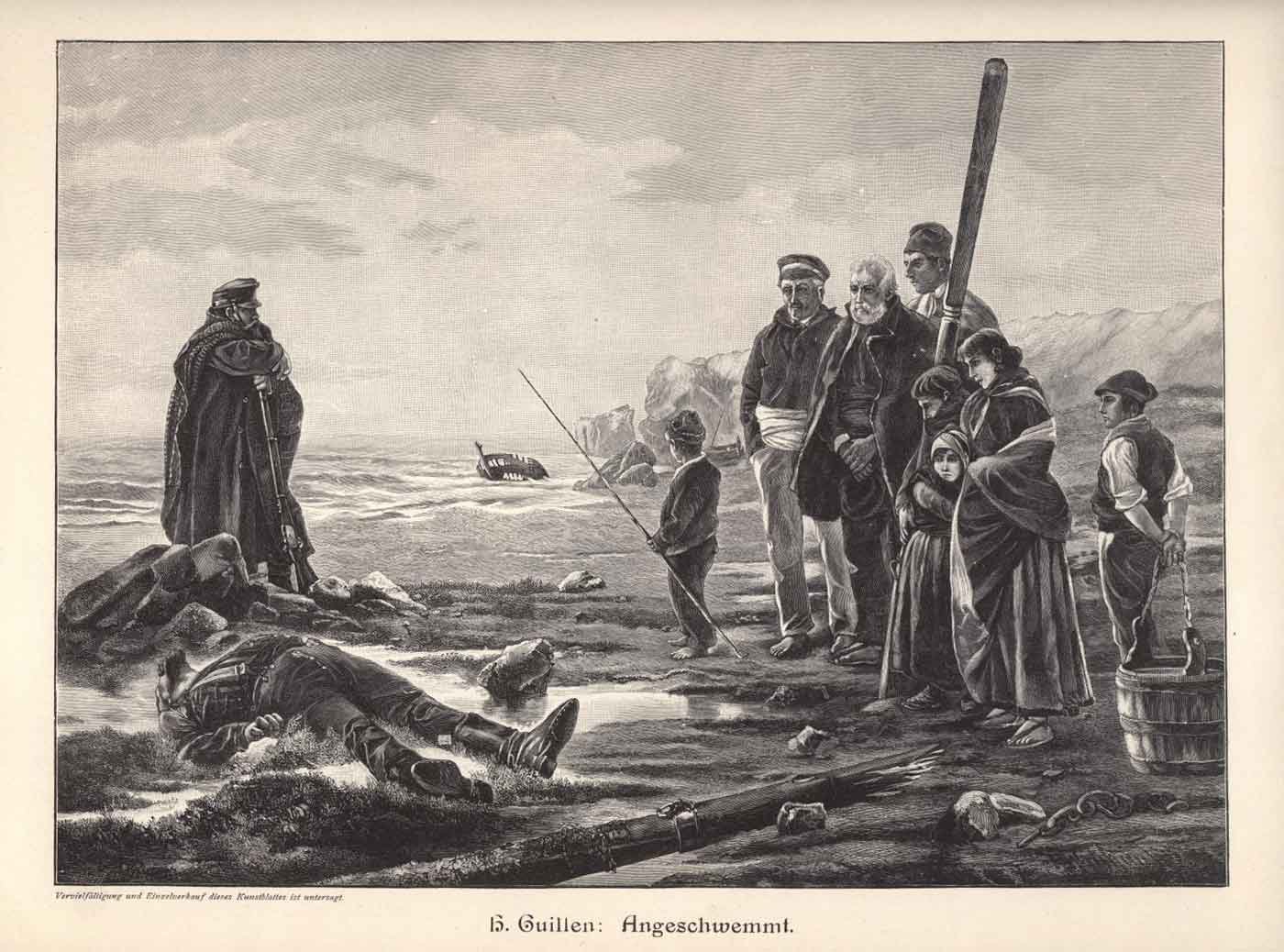
c1900 Art Print Engraving Tragedy Drowned Fisherman Washed Ashore By H.Guillen – Original Magazine Print, accessed from Amazon.com.

The short answer that this folk song describes an actual event that took place on February 8 and 9, 1889. That being said, there’s an almost endless array of discussion/argument about its wording. To give you just a taste of this backing and forthing, there are whole threads on discussion forums talking about why the song says “from Yarmouth down to Scarborough” when Scarborough is clearly north of Yarmouth. (Don’t believe me? Here’s the link to Google maps.) Since I’m no sailor, I can’t pretend to understand the reasoning as to why this wording is perfectly accurate in nautical terms, but it has something to do with the direction of the winds and currents. I think. And that’s just one small point in the whole mix. If you’re of a mind to do some reading yourself, google “Grimsby Town fishing disaster” and you’ll have more than enough to keep you busy. (Don’t just google “Grimsby Town” on its own, as all you’ll get is stuff about their football club—soccer to us ignorant Americans. Very interesting in its way, of course, but not much to our point here.)

Read more

About the lyrics to “Cailleach an airgid”–say wh-a-a-a-a-t?

I know. This song is, like, seriously crazy. Right? Well, yes and no.

First of all, the crazy part. Or at least the let’s-not-take-this-too-seriously part. This is a get-up-and-dance, stomp-those-feet kinda tune. (Okay, I’ll try not to use any more hyphens.) The words don’t really matter all that much in the final analysis. I’ve been in a Celtic concert before in which we sang a song about a lonely fish! By comparison this one is a model of reason and logic. Still, by the time it has repeated “Si do Mhaimeoi I” about five hundred times any sense of the words is lost, whether you know the translation or not.

Read more

“Danny Boy” and His Descendants–A Musical Journey through Time

Where did the tune originate?

The tune used for “Danny Boy” is a true folk melody, originally called “Derry Air,” because it was first written down in County Derry, Ireland, in the town of Limavady. Once Ireland became an official part of Britain, the county was renamed “Londonderry,” with the choice of name somewhat determined by one’s political views. But whatever the name of the county, the origin story seems fairly straightforward: Jame Ross, a collector of Irish traditional folk music, heard a harpist (or a fiddler, depending on the version, and usually identified as blind) performing in the street outside her house and rushed out to copy down the tune he was playing. Unfortunately, she neglected to get the performer’s name, but she sent in her notated manuscript, along with a number of others she had collected. to the musicologist George Petrie, whose 1855 book The Ancient Music of Ireland listed the tune as an anonymous air but with a note attributing its collection to Ross. The tune was published as an instrumental piece with no lyrics but quickly became extremely popular with songwriters. The most well-known of these settings is the song “Danny Boy,” written in 1910 by an English lawyer named Frederic Weatherly. The meaning of the lyrics has been consistently misunderstood, however, leading to the next question:

Read more

Why Would You Try to Tell a Star What to Do?

Oh folks, you’d just never believe how much I want to say about “Twinkle, Twinkle, Little Star”! I will try to rein myself in, but it’s hard.

Let’s start with this whole idea of talking to or about stars in poetry or song lyrics. I’ll mention two famous ones here: First, John Keats’ poem “Bright Star, Would I Were Steadfast As Thou Art” and, second, the song “Catch A Falling Star and Put It In Your Pocket.” (I was reminded of the gift that the Lady Galadriel gives to Frodo, the light of a literal star to put in his pocket: “In this phial,’ she said, ‘is caught the light of Eärendil’s star, set amid the waters of my fountain.” Later, the light from that star glass helps Sam and Frodo in their flight from and fight with the horrible Shelob: “Slowly his hand went to his bosom, and slowly he held aloft the Phial of Galadriel. For a moment it glimmered, faint as a rising star struggling in heavy earthward mists, and then as its power waxed, and hope grew in Frodo’s mind, it began to burn, and kindled to a silver flame.”)

Read more

What’s Everybody So Glad About in “I Was Glad”?

If you had been around in 1902 and invited to the coronation of Queen Victoria’s son Edward VII (“Bertie” to his friends), you would have heard the premier performance of Sir Hubert Parry’s setting of Psalm 122 from the Church of England’s Book of Common Prayer, always known by its opening words: “I Was Glad.”

Psalm 122 in the Jewish Bible is one of a group of Psalms (songs) usually called “Psalms of ascent.” Scholars disagree on what exactly the word “ascent” refers, but the idea that’s usually listed first is that these psalms were sung by pilgrims on their way to Jerusalem to participate in various festivals in the Jewish calendar. Jerusalem is built on several hills (one of which had the name “Zion,” sometimes used to refer to Jerusalem as a whole), so you would indeed be ascending as you made your approach into the city.

Read more

Does the Word “Tibi” Have Anything to Do With Your Tibia?

PictureNo. Your shinbone is named after an ancient Greek wind instrument, sort of like a flute.

Everybody got that? Maybe it’s just me, but I’m very distractible. So it’s good for me to get that out of the way. What does “tibi” mean? Basically, “to you.” Latin nouns and pronouns have various forms that determine their use in a sentence so that you don’t have to use a preposition. And you don’t have to worry about word order. You just have to learn all six types (called “cases”) of nouns and pronouns. Then you have to learn tense, voice and mood for each verb, and degrees of comparison for each adjective . . . and don’t get me started on the adverbs. It’s very complicated. How did the Romans have time to conquer the world when they had to learn all this grammar? Beats me.

Read more

How Is John Rutter Connected to the Good Ol’ USA?

PictureSo, last night we had the family over to watch the Broncos win over the Chargers (this post was originally written in October 2016), and I was telling my father-in-law about my choir’s upcoming Christmas concert with the Denver Brass, and how they’d be playing with us for the Rutter Gloria, among other pieces, and since he’s a former brass player himself he was quite interested. He looked through the copy I had sitting on the coffee table, taking note of the instrumentation, and then he read the intro material. “Guess where this was first performed?” he asked. “Somewhere in England,” I said. “Nope. Omaha, Nebraska.”

Read more