As readers of this blog know by now, I’m obsessed with origins, especially the origins of creative ideas. So I’m fascinated that Lin Manuel-Miranda was inspired to write his musical Hamilton by reading the Ron Chernow biography of this fascinating figure. (35 hours in audio form, folks. I know this from experience.) Stephen Schwartz got the idea for Wicked from a conversation on a snorkeling trip in Hawaii, when someone mentioned having read the book Wicked: The Life and Times of the Wicked Witch of the West. He says, “As soon as I heard this I had one of those light bulb moments where something just said this is a really great idea.” And Anthony Lloyed-Weber says that he bought a copy of the original Phantom of the Opera novel by Gaston Leroux for a dollar at a used-book stall in Paris and fell in love with it.
Sources are unanimous in saying that the origins of this Irish folk song are “somewhat unclear.” Since its theme is so universal (a woman left behind as her sweetheart goes to war), you could say that the exact historical reference doesn’t really matter all that much, but it’s always interesting to dig into such things (if you’re a history nerd like me). The most common theory about the song’s background says that it refers to the time of the British Glorious Revolution in 1688, when James II of England, a Roman Catholic, was deposed and replaced by William of Orange,1 a Protestant, and his wife Mary, the daughter of James by a previous marriage and also a Protestant. (If you want a fuller overview of this turbulent time, see my post about the song “Loch Lomond.”)
The Irish were solidly on the side of Catholicism, joining in with James II’s heirs in various attempts to wrest the throne from the wicked William’s hands. (That’s how they saw him, anyway.) But it was all in vain. By 1691, three years after William’s ascension to the English throne, the so-called Williamite War in Ireland was ended with the Treaty of Limerick (a town in Ireland).2 Although there were assurances of safety for Irish soldiers who remained at home, many of these men chose to go to France for military service there. (They were pretty savvy to leave, as the promises to those who stayed weren’t kept.) After all, if your profession is that of a soldier, and you’re forbidden to fight in your homeland, why not go somewhere you can? Louis XIV of France really wanted Irish soldiers to help him in his war against the Dutch, and William III was Dutch. So these exiled Irish soldiers could console themselves with the thought that they were continuing to fight the good fight. This exodus of Irish soldiers to France is called “the flight of the wild geese.” About 20,000 Irish in total fled Ireland, including about 6,000 women.
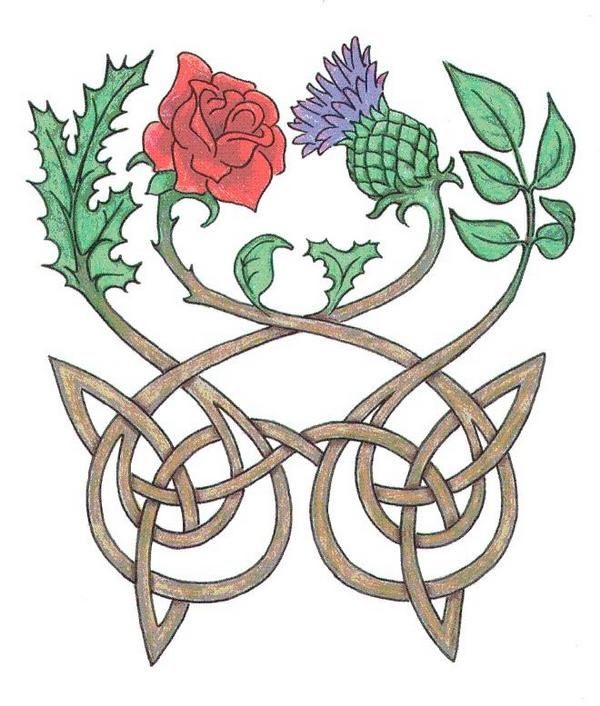
I could just quote the e-mail sent to me by the composer/arranger of “Thistle and Rose (with ‘Ye Bonnie Banks and Braes of Bonnie Doon’),” Phyllis White, in answer to my inquiries about her thought processes as she wrote the piece, and you’d be quite well informed. I will indeed quote her later in this post. Have to say that it’s a total joy when I can communicate with living musicians as I’ve been able to do here. Let me first, though, unpack the symbolism of the thistle and the rose, which stand for Scotland and for England respectively. The story about the thistle comes from an incident in Scotland’s history:
It was 1263 when King Haakon’s fleet of battle-hardened Norsemen was blown off course and landed on the shores of Largs in Ayrshire. To their delight there was a sleeping Scottish army nearby. Not suspecting an attack, the Scottish were doomed to suffer an ambush. The Norsemen removed their boots in preparation for sneaking up on the slumbering soldiers. Fortunately, a field of thorny thistle flowers surrounded the Scottish. One Norse soldier, stepping on a thorn, yelled out in pain. This scream woke the Scottish men, who jumped into action and slaughtered the invading Norsemen.1
There are many versions of this song, with varying words and melodies. I’ve tried to distill the various ideas down into something digestible, always keeping in mind that it’s a folk song and its origins are therefore murky. The initial inspiration may have come from a farewell letter written by Scotsman Thomas Armstrong on the eve of his execution in 1605 for border raiding. Here’s what he wrote:
This night is my departing night, For here nae langer must I stay; There’s neither friend nor foe o’ mine, But wishes me away. What I have done thro’ lack of wit, I never, never, can recall; I hope ye’re a’ my friends as yet; Goodnight and joy be with you all!
The answer is a resounding “Yes!” You just never know until you start diving into a piece how much you can find out. Such is the case here–I’ve had quite a time finding out about the tragic love story of the Irishman Joseph Mary Plunkett and his beloved Grace Gifford. It’s hard to know even where to start, but here goes:
You may have looked at Joseph’s full name and questioned why his middle name is “Mary.” Was that his mother’s name, perhaps, and he had no sisters to carry it on? No. It was a symbol of his deep Roman Catholic faith and his devotion to the Virgin Mary. (I’m assuming that he added the name himself.) Plunkett seems at first glance to be a contradictory figure in Irish history, combining religious mysticism and hard-headed military abilities. In reality, though, Ireland’s desire to be an independent country and not under Protestant English rule stemmed at least in part from its loyalty to Catholicism. So Plunkett could help plan a violent bloody uprising against the British government and see it as a profoundly moral cause, which is exactly what he did with his fellow Irish revolutionaries in the spring of 1916 for an event known as the “Easter Uprising” because it started in Dublin on the Monday after Easter. “Wait!” you might say, “1916? World War I is going on at the same time. How did anyone have spare energy for carrying out a revolution?” Good question. In reality, at least part of the reason for this specific rebellion was that it was seen as a way for Irish men to escape conscription into the British army to fight in that war, since they certainly had no great loyalty towards England.
A Canadian bagpiper playing “Amazing Grace” during a memorial service, 29 October 2009, at Forward Operating Base Wilson, Afghanistan. Image soure Wikipedia
Probably everyone who’s attended some kind of Christian funeral has heard this hymn, as it’s especially popular for those occasions. And you can see why. The words are beautiful and striking, and the melody is at the same time lovely and singable. What’s not to like?
Then there’s the backstory to the song, which contains drama and irony in about equal parts: John Newton, a slave trader, is converted to Christianity and leaves his dreadful business, becoming a part of the anti-slavery movement. We all love a good redemption story, don’t we?
Real life, however, is seldom if ever so simple and straightforward. The more you delve into a person’s actions the more complicated and messy they become. I used the example in an earlier post about fractals, those designs that reveal new layers as they are magnified. There is never an end to the detail. The same is true in your life, even if you think of it as rather mundane. So it is with John Newton.
Contemporary portrait of Newton; image source Wikipedia.
We left John Newton on the way back to England after having been rescued from slavery to the African Princess Peye. Be sure to go back and read Part I if you haven’t done so already to find out how he got himself into this pickle to begin with. The ship ran into a severe storm off the coast of Ireland and almost sank. At this point of crisis Newton turned to God, praying for mercy. The storm died down and the ship was able to reach port. For the rest of his life Newton marked the anniversary of this event: March 10, 1748. However, he didn’t give up participation in the slave trade, signing on with a slave ship after he got back to England and making several more voyages. He did not leave active participation in this horrible business until he suffered a stroke in 1754, when he stopped going to sea but continued to invest in others’ efforts. It isn’t clear to me exactly when he gave up even that support of slavery. Here’s a good summary from Wikipedia, however:
Pieter Bruegel the Elder – Massacre of the Innocents – Google Art Project
When people first realize what the words to this carol are actually saying, they tend to be puzzled and/or outraged. I remember clearly someone in my own choir, the Cherry Creek Chorale, saying, “What on earth is going on with those kids being murdered?” Well, I can’t blame him. While I do love the song myself, it certainly can’t be said that it fits the stereotypical cheery Christmas template. The haunting melody is paired with a text that describes a horrible scenario: Herod the King commanding all young children in Bethlehem to be killed. Here are the relevant two verses that spell out the story:
O sisters too, how may we do For to preserve this day This poor youngling for whom we sing, “Bye bye, lully, lullay”?
I had never noticed this before analyzing the carol for this post, but the ivy is mentioned in the first line and then it just disappears. Here are the first two lines:
The holly and the ivy, when they are both full grown,
Of all the trees that are in the wood, the holly bears the crown.
Wouldn’t you expect that there would be a third line explaining the role of the ivy, something that starts out with “Of all the vines that are in the wood, the ivy bears . . . ” But there isn’t. Here’s somewhat of a explanation from an academic website:
The lyrics are somewhat puzzling. The first line is “The Holly and the Ivy,“ yet ivy is mentioned nowhere else in the carol except in the last verse, which is a repeat of the first verse. Holly is given the starring role in the song and ivy is ignored, so it seems strange that ivy is even mentioned.
The explanation that is often given is that the first line in the carol is a remnant of the old custom of linking holly and ivy together. In the rest of the carol ivy isn’t needed. The “holly” in the carol refers to Christ and the theme of the carol is his life. (“English Ivy Symbolism, Traditions, and Mythology“)
No. Hey, that was easy, wasn’t it? You can just stop reading now if you want to.
However, if you’d really like to know what “Scarborough Fair” is about, I’ll say that the true meaning is probably quite different from the impression you have. That was certainly the case for me, as I always vaguely thought as I listened to Simon and Garfunkel that the song was about a pining lover asking someone to say hello to a former true love if that someone was going to the fair where presumably the former true love was going to be. A wistful “Say ‘hi’ to him/her for me,” in other words, perhaps in the hope that the lover would say, “Oh yeah–I should get in touch.” (This sort of thing never happens.)





 No. Hey, that was easy, wasn’t it? You can just stop reading now if you want to.