How Much Verbiage Can Possibly Be Lavished on the History and Meaning of “The Battle Hymn of the Republic”?

Answer: a lot. Like, a whole lot. The following isn’t at all definitive, but it should give you a sense of the historical milieu from which the song came.

I think all of us have a vague idea that “The Battle Hymn of the Republic” has something to do with the Civil War, and you may or may not be aware that its tune is the same as “John Brown’s Body.” a popular song among Union soldiers that they had adapted from an old Methodist revival song, “Say, Brothers, Will You Meet Us.” Wikipedia says this about the origin of the words, taken from an account by a soldier::
Read more

The Rich Imagery in Ferril’s Texts for Effinger’s “Four Pastorales”

Both Thomas Hornsby Ferril and Cecil Effinger are fascinating characters. Ferril was Colorado’s first poet laureate, holding that title from 1979 until his death in 1988. He was chosen to write the captions for the first-floor rotunda in the Colorado state capitol building in Denver, and his home in the Capitol Hill neighborhood is a historical and literary landmark. Effinger was a Colorado composer and contemporary of Ferril who should be much better known than he is, having written well over 150 works, including operas and symphonies. But his fame rests largely on the Pastorales, a fact that he was wont to get a little testy about at times. As he’s said, “I’ve got the Four Pastorales for Oboe and Chorus which has gone hog-wild all over the place!  It is done time and time again, you know, and others that I think are just as good, somehow don’t find their way!”

I would love to know how Effinger chose these four poems; I thought at first that Ferril had put them together into a set, but that’s not true. The poems are from several different books of Ferril’s poetry and don’t have a unifying theme that I can see. I’m going to guess that these four just happened to catch Effinger’s eye. The suite has a lovely, haunting oboe accompaniment which adds to its evocative power and is probably one reason for its popularity. Here are the four poems with my attempts to analyze/explain them without ruining the poetry.

Read more

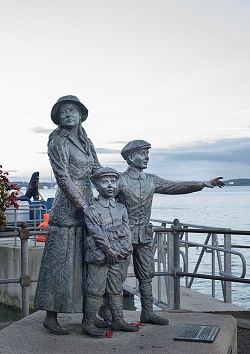
Was Annie Moore in “Isle of Hope, Isle of Tears” a Real Person?

Why yes. I’m glad you asked.

First, a little personal context. I’ve just spent awhile trying to find a picture that has haunted me ever since I visited Ellis Island back in the summer of 2010. I think it’s one of the many blown-up photographs that line the Great Hall, the area where immigrants were initially processed, but I haven’t been able to find it. So I’ll just describe it: a woman on her hands and knees, with a bucket and a brush, scrubbing a hallway. Her back is to the picture and you can’t see her face. Out of all the old photographs I saw that day I remember only this one. To me it’s a representation of the life that many of these people faced. On that same trip we also toured a tenement museum, trying to imagine the lives of people just like the woman in that photo, living in crowded apartment buildings with no running water and barely enough space to breathe. People slept in all sorts of strange contortions, the most memorable being that of the boys who had their upper bodies on a couch and their feet on chairs. (Visit the Tenement Museum the next time you’re in NYC!)

Read more

How Many Double Meanings Are There in “And You Will Sleep”?

The choir to which I belong performed this piece only two years after its 2015 premier. The composer, Philip Biedenbender, was a senior at St. Olaf College at the time and a member of the famous choir attached to the school. He’s gone on to build a career, with many other works to his credit. You can visit his website here. Such a great joy to present works by young, up-and-coming artists! 

Read more

Is “Oh Hush Thee” a Christmas Song?

Image from the Library of Congress, Storer, Florence Edith, artist created circa 1912

The original title of this poem is “Christmas Eve,” and it was published in a book of poems and short stories by Eugene Field called Christmas Tales and Christmas Verse. So those facts would seem to end the matter. It’s a lullaby being sung by a mother to her child at Christmas, with stars and angels in the mix. It must be Mary singing to the baby Jesus, right? Well, I don’t think so.

Why not? First of all, look at the illustration that goes with the poem. It’s of an early 1900’s mother and child—and note the “child” part, as it’s not a baby. Secondly, consider the title: “Christmas Eve,” not “Christmas Night.” Nit-picky to the max, I know, but still! It’s taking place the night before Christmas. I will also take a little credit myself here and say that I found the words of the song to be puzzling the first time I heard it, even before I knew the original title, because there seemed to be a muddle about who’s being addressed. The child who is being sung to sleep is told to “hear the Master calling” and reminded that “the Shepherd calls his little lambs.” It seems clear that the Master and Shepherd titles refer to someone other than the child, right? That’s the way I read it, anyway.

Read more

Why Would You Try to Tell a Star What to Do?

Oh folks, you’d just never believe how much I want to say about “Twinkle, Twinkle, Little Star”! I will try to rein myself in, but it’s hard.

Let’s start with this whole idea of talking to or about stars in poetry or song lyrics. I’ll mention two famous ones here: First, John Keats’ poem “Bright Star, Would I Were Steadfast As Thou Art” and, second, the song “Catch A Falling Star and Put It In Your Pocket.” (I was reminded of the gift that the Lady Galadriel gives to Frodo, the light of a literal star to put in his pocket: “In this phial,’ she said, ‘is caught the light of Eärendil’s star, set amid the waters of my fountain.” Later, the light from that star glass helps Sam and Frodo in their flight from and fight with the horrible Shelob: “Slowly his hand went to his bosom, and slowly he held aloft the Phial of Galadriel. For a moment it glimmered, faint as a rising star struggling in heavy earthward mists, and then as its power waxed, and hope grew in Frodo’s mind, it began to burn, and kindled to a silver flame.”)

Read more

What Can We Learn from a Taciturn Star?

Image by TeeFarm from Pixabay

I have been absolutely salivating at the idea of sinking my teeth into this Frost poem. We tend to associate Frost with his familiar and simple poems: “Stopping by Woods,” “The Road Not Taken,” and perhaps “Mending Wall.” Even those poems can be mined for deeper meaning, but when you get to some of his other ones, well! You (or perhaps I) can go on just about forever.

Read more

Should Dan Forrest’s Three Nocturnes Inspire Us to Look Up at the Stars?

Um, I guess so. I’m going to try, anyway.

I’ve had the great privilege of singing this work with my own choir, the Cherry Creek Chorale. We loved it! (So did the audience.) All three parts of the Nocturnes have lyrics from American poems, and I’m going to take a stab at clarifying them. As I’ve said this before, though, taking a poem apart to pry out the meaning is a little bit like explaining a joke: when you’re all done, you’ve destroyed the original. Still, there are some intriguing lines in all three selections that repay analysis. If you’d rather leave the mystery intact, you can skip the following.

Read more

Why Write a Song About a Painting?

A painting of a scene at night with 10 swirly stars, Venus, and a bright yellow crescent Moon. In the background are hills, in the foreground a cypress tree and houses.
Image accessed via Wikipedia; original painting is in the Museum of Modern Art, New York City

First of all, I have to confess my (former) utter ignorance about who Don McLean is. I was of course familiar with the song “American Pie,” but for some reason had never actually noticed who its original performer was. (And I’m much more taken with the parody version of it from Weird Al Yankovic.) So when I got the music for a 2017 concert with my own choir and I saw McLean’s name as the author of “Vincent,” I just assumed he was some sort of obscure artsy-jazzy guy who was interested in art and liked Vincent van Gogh. Well, au contraire! One YouTube version of McLean’s performance has had almost ten million views. (“American Pie” has had over 71 million views from one video; I didn’t go through and add up the numbers from them all but would guess it’s close to 100 million.) McLean is still alive and still performing, although none of his songs has ever approached the popularity of these two, both of which were on his second album, also titled American Pie, released in 1971.

Read more

What’s the Origin of the Phrase “Pennies from Heaven”?

Picturephoto credit: Wikipedia

You wouldn’t believe the highways and byways I’ve traversed trying to get the full scoop on this one little phrase. I started out by googling, as usual. Of course the movie by that name came up—I’ll get to that in a minute. For the phrase itself, there was a lot about angels dropping coins from Heaven as a way of showing support and sympathy. Or departed loved ones doing so. Or both. It was a little confusing. The Oxford English Dictionary entry said: “pennies from heaven: money acquired without effort or risk; unexpected benefits, esp. financial ones.” It said that the phrase’s first use, at least in a printed source, was from something called Ghetto Messenger by A. Burstein, published in 1928. Well, I thought, that’s easy. I’ll just look it up on Google Books. Alas, they didn’t have the entire story but just part of the page with the phrase. There seemed to be a group of little boys involved, so I assumed that they were messenger boys, probably African-American, living in an inner city. I found the book in my library system and put it on hold, finally got it last week, and found out that my assumptions were pretty much wrong.

Read more