
Podcast: Play in new window | Download
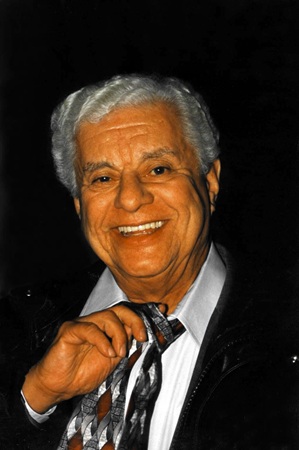
I had no clear idea who Tito Puente was until I started researching his massive hit from the 1960s, “Oye Como Va.” Just reading his Wikipedia page was quite an experience. He grew up in New York City’s Spanish Harlem and drove the neighbors crazy when he was a boy because he was constantly pounding on pots and pans, so his mother signed him up for 25-cent piano lessons. And it only got better from there as his musical talents expanded into any number of instruments. He ended up serving in the US Navy during World War II on an aircraft carrier in the Pacific. A list of his duties as noted in Wikipedia included:
playing alto saxophone and clarinet in the ship’s big band as well as occasionally drum set, piano during mess hall, acting as the ship’s bugler, and serving as a machine gunner in the battles of Leyte and Midway. (And when did he learn to operate a machine gun? Not clear.)
This wartime experience led to two great influences on his later music career: he went on a tour of Asia, traveling for several months after the end of the war, and he attended Julliard on the G.I. bill, where he studied orchestration and conducting. (His conducting teacher there was Japanese, thus cementing those Asian influences from his travels.) From there he went on to a rich and varied career in music, becoming especially known for his playing of the timbales, a type of shallow metal drum. Because Puente was such an active and engaging performer he was usually put at the front of bands so that people could see the show he put on. (I can’t resist pointing out here that a timbale resembles an overturned flat-bottomed stew pot.) Eventually he started his own band and was a mainstay at the Palladium Ballroom during the 1950s and 60s. If you want to get more info about this remarkable man, follow this link below to his Wikipedia page.1 I, however, had better get on to the ostensible subject of this post, “Oye Como Va.”
Sometimes there’s this little musical phrase that comes out of nowhere and socks you in the jaw. (“Louie Louie” and “Who Let the Dogs Out” come to mind.) Who knows how Puente thought of it in 1962 or thereabouts; many have pointed out that it bears a close resemblance to the 1957 mambo song “La Chanchullo.” In fact, the YT recording says it was “later reworked by Tito Puente.” I don’t know if this is fair or not; the two songs were published five years apart, and the resemblance between them may have been simply a matter of familiarity with the whole genre. This was before the copyright battles around, for instance, George Harrison’s “unconscious plagiarism” of The Chiffons’ “He’s So Fine” with his song “My Sweet Lord,” a case that was finally settled in 1981 with Harrison’s payment of over half a million dollars. I think John Lennon summed up the whole issue nicely when he said that 99% of popular music was reminiscent of something which had come before. And actually that’s probably true of music in general, don’t you think? Who owns that dah-dah-dah-DAAAAH of Beethoven’s Fifth Symphony?
On to the words, of which there aren’t many. The original version simply says:
Oye cómo va, mi ritmo
Bueno pa’ gozar
Mulatta/Mulatto.
which translates to:
Hey! or Listen! How does it go? (How’s it going?) My rhythm
Goes to enjoy. (Is good to enjoy.)
(I say that to you) Mulatta or Mulatto.
So what’s with these terms “mulatta” and “mulatto”? They have instigated somewhat of a backlash against the song (which is a shame), and there’s now sort of a backlash to the backlash. I was originally going to include my whole screed on the use of these words as a footnote but decided that they’re so integral toward attitudes about the song that I’d include them here.
First off, there’s no question that the original meaning of the word “mulatta/o” was a racially-charged one. It literally refers to a person (female or male) who is half Black and half White, coming from the Spanish/Portuguese word for “mule,” which is an animal that is half donkey and half horse. The term carried over into English-speaking countries as well. The whole system of racial classification in the US during and after slavery was decidedly degrading and inhumane, with this term feeding into the mix. Eventually the “one-drop rule” was developed and in some states codified into law, saying that any Black ancestor in a person’s history rendered that person Black also. I could go on and on here, but this isn’t actually an article about racial attitudes in America, so I’ll just say that the US Supreme Court ruling that overturned remaining laws against interracial marriage, Loving v. Virginia, was not handed down until 1967. Hard to believe.
But you know what? By the time Puente wrote his song in 1962 the concept of a vibrant Afro-Latino community was decidedly on the ascendant in various communities including those in his native New York City, especially with the big draw of the Palladium Ballroom. Let’s not sugarcoat things—racial prejudice didn’t go away even though there were big-name White Hollywood stars out on the dance floor at the height of its popularity. Everyone pretty much went home to their own segregated neighborhoods when the lights were turned out. (You may or may not be aware that the famed Cotton Club in NYC, a venue during the 1920s and 30s that featured many Black jazz artists, was a Whites-only establishment as far as actually patronizing the establishment was concerned. No Black musicians were allowed to eat in the restaurant but instead had to eat their meals in their cramped dressing rooms.)
All that being said, it’s fair to say that Puente is using “mulatta/o” as an affectionate term, sort of like “person in the neighborhood,” “person like me,” or even something like “homeboy.” It’s kind of a wink and a nod to his listeners: “You know what I mean. I don’t have to spell things out. Just get out there and groove.” (Well, I guess he wouldn’t have used the word “groove.”) And there’s a whole movement in Afro-Latino culture today to reclaim this word and use it proudly:
Some might call the reclamation of terms like mulatta, politicized. In some ways that might be true. But there’s also something beautiful about a community of people coming together to transform a word that was once associated with so much pain and transforming it into something uplifting. It’s about making yourself visible and being unapologetic about it. It’s about the refusal and unwillingness to conform to what society has tried to tell us to be.2
The original Puente version of the song was quite popular within his own venues but didn’t really become a breakout hit until 1970 with the rock musician Santana decided to include it in his second album. You can read all about his determination to do so by following the link below.3 We’re told that “when interviewed, Puente explained how he was initially outraged by his song being covered by a rock band, until he received his first royalty check.” (Wikipedia)
On to the really important part of this post–the videos. Here’s the great man himself performing at a live venue, and I have to say that he more than lives up to his reputation of being a showman (love the shocking pink drumheads–and be sure you note what the guy who seems to be playing a flute is actually doing):
Sigh, I guess I’ll have to include the Santana version, since he’s the one who made the song such a hit. But I feel about this performance about the same way I feel about The Doors’ extended version of “Light My Fire.” Ah well–not everyone agrees with my musical taste:
And just in case you’d like to hear the song that Puente is supposed to have “reworked”:
My own choir, the Cherry Creek Chorale, sang an arrangement by the prolific arranger and composer Kirby Shaw in our October 2025 concert. He was kind enough to confirm in answer to my inquires that he had indeed added the lines “You can feel the rhythm/You can feel it down in your soul” along with all of the fun syllabification. After all, he has to give the choir something to do! This video using his arrangement deserves to get many more views, so I’m doing my small part here:
I can’t resist adding a rather lengthy note here about a passage in Little Women that always puzzled me when I read it as a girl. (Apparently it never occurred to me that I could just look the problematic word up in the dictionary.) I’m a confirmed LW junkie, having read it at least half a dozen times, crying over Beth’s death at each repetition. Some things never get old! Anyway, at the end of the book Jo March has finally married Mr. Bhaer and they’ve established a school for boys. We’re told that:
There were slow boys and bashful boys, feeble boys and riotous boys, boys that lisped and boys that stuttered, one or two lame ones, and a merry little quadroon, who could not be taken in elsewhere, but who was welcome to the “Bhaer-garten,” though some people predicted that his admission would ruin the school.
Mrs. March’s birthday is celebrated at the school and the boys have composed a song in her honor, which surprises and pleases her. Here’s what happens there:
During the ceremony the boys had mysteriously disappeared, and when Mrs. March had tried to thank her children, and broken down, while Teddy wiped her eyes on his pinafore, the Professor suddenly began to sing. Then, from above him, voice after voice took up the words, and from tree to tree echoed the music of the unseen choir, as the boys sang with all their hearts the little song that Jo had written, Laurie set to music, and the Professor trained his lads to give with the best effect. This was something altogether new, and it proved a grand success, for Mrs. March couldn’t get over her surprise, and insisted on shaking hands with every one of the featherless birds, from tall Franz and Emil to the little quadroon, who had the sweetest voice of all. (emphasis mine in both quotations)
The puzzling word, of course, was “quadroon.” What or who was that? I had no idea. Years later, I finally looked it up—it means, as all of you reading this probably know, a person who is one-quarter Black; that is, one grandparent was Black. An “octoroon” was one-eighth Black.
One could ask all sorts of questions here, such as: how would you ever really know for sure? But a close parsing of the term isn’t my point here. Rather, the way in which this boy is referred to is a whole window into racial attitudes as they existed even in the supposedly enlightened world of Jo March. Yes, they take in this unfortunate child whose racial heritage makes him unwelcome at any other boarding school, so that’s good. But it’s telling, I think, how Mrs. March’s act of kindness in shaking everyone’s hand is portrayed as something of a condescension on her part toward this boy who’s never given a name. And he’s portrayed as “merry” and having a sweet voice, a description very much in the tradition of how Blacks were portrayed in the infamous minstrel shows of the time. I’m not trying to dump on Louisa May Alcott, to be clear. She’s doing her best to portray Jo as a broadminded and generous person who’s willing to take in a racially-mixed child even if she pays some sort of price for it. The point is, society could indeed have exacted a price, even in Concord, Massachusetts in the post-Civil War period. I hope we’ve all learned a few things since then, but sometimes I wonder. I’d encourage you to read the whole book if you’ve never done so, by the way. And then watch the Greta Gerwig film that came out in 2019. She did a fabulous job of inserting modern feminist subtext into the story without anachronizing it. And with that I’ll finally stop!
- Tito Puente ↩︎
- Why Some Latinas are Reclaiming the Term “Mulatta” ↩︎
- The Meaning Behind “Oye Como Va” and Why Carlos Santana “Had to Put My Foot Down” to Get It on ‘Abraxas’ ↩︎
(c) Debi Simons
