Aaron Copland Does More than Required for his Old American Songs

Copland, the Commission, and the Composition
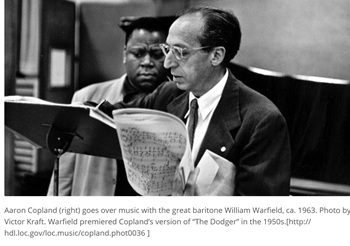
Once again I’m on the hunt for the origins of a famous piece of music. Aaron Copland’s suite of early American tunes was commissioned by none other than Benjamin Britten and was presented at that composer’s newly-launched Aldeburgh Festival in 1950. Britten had developed a keen interest in performing American folk music, at least partly because of his long visit to the US from 1939-1942. While there he and his partner Peter Pears had spent a lot of time with Copland; he said later that Copland was “by far the best American composer.” Perhaps because of Pears’ abilities as a singer, he and Britten regretted the dearth of songs in the Copland catalog. So they decided to do something about that, and in 1950 commissioned a set of American folk songs to be performed at the Festival. Well! Copland dove into this commission head first, only coming up for air after he’d ransacked the sheet-music archives at Brown University for material. He did an enormous amount of work for what turned out to be a set of pieces that together total less than 13 minutes’ worth of performance time. But this wouldn’t be the first time Copland got completely caught up in writing music that he didn’t think would result in much return on his investment; he said about  the ballet music for Appalachian Spring, “It took me about a year to finish and I remember thinking how crazy it was to spend all that time because I knew how short‑lived most ballet scores are, but [it] took on a life of its own.”1
Read more

The Shakers’ Simple Music Inspires Dance and Song

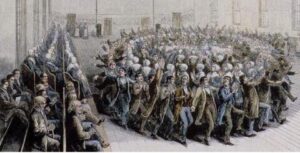
By Unknown author - Public Domain, Wikimedia Commons. Shakers dancing.

It seems a little unfair that the word “Shakers” nowadays calls up only a furniture style and, probably, the tune “Simple Gifts,” when this religious group had such a long and fascinating history. Honestly, the Wikipedia article about them is well worth a read if you’re at all interested in early American history and/or revivalist religious movements.

I’m going to get into Shaker music, but I do need to explain their beliefs and practices a bit in order to do so. This sect, which got its start in Britain around 1750, was a fascinating mixture of strict rules on the one hand and ecstatic outbursts on the other. Absolute celibacy was required for full membership; the sexes were housed separately and could not even shake hands or pass one another on the stairs. (I’m assuming the latter rule was in place because the staircases were so narrow.) They also lived communally and were strict pacifists. Yet their worship services were a mixture of music, dancing, and manifestations of spirituality that included twitching, jerking, and shouting, usually in some type of unknown language. (Those outward physical actions gave the group their name; originally they were called the “Shaking Quakers” and were an offshoot of the original Quakers.) They had to let off steam somehow, I guess. In spite of all the kerfuffle, though, the music itself was very plain, with no musical instruments used for accompaniment and no harmonies, just the melody. You can do a lot with a little; as our friend Wikipedia says:

Read more