
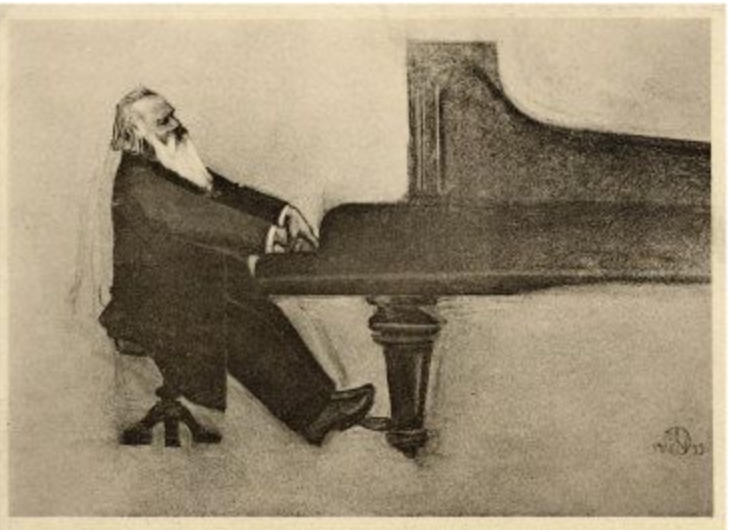
Betcha were a little surprised to see that Brahms even had such a side. Isn’t he rather . . . monumental for such a description? After all, isn’t he one of the three B’s of classical music, along with Bach and Beethoven? Bach certainly wrote lighter music–his “Coffee Cantata” contains the immortal lines “If I can’t drink my bowl of coffee three times daily, then in my torment I will shrivel up like a piece of roast goat.” You can’t quite picture Brahms, or for that matter Beethoven, writing something that silly.
But there were several aspects of Brahms’ life that lent themselves to his writing this music. First, he loved getting together socially with his circle of friends to discuss and perform chamber works. Second, he felt the need for somewhat lighter composing as a relief from his work on Symphony No. 1, an endeavor that took him 21 years. Third, he was always falling in love with unattainable women. Oh dear! First (we think) he fell in love with the wife-then-widow of Brahms’ mentor Robert Schumann and then with a succession of already-taken younger women, one of which was the Schumanns’ daughter Julie. Whew! And, last but not least, Brahms was greatly influenced by the earlier composer Franz Schubert (editing some of Schubert’s music for publication), by Robert Schumann, and by the Waltz King Johann Strauss. The first two wrote many songs, some based on folk tunes, and Strauss of course took the public by storm during his career. Those composers’ lives span from 1797 (Schubert’s birth) to 1899 (Strauss’s death). And there’s Brahms, smack in the middle, living from 1833-1897. But Brahms also kept a pretty canny eye on the musical scene, and it can be said that “these works, in a deliberately popular style, were overwhelmingly responsible for spreading Brahms’ reputation to the general music-buying public, and became the chief source of his personal wealth.”1 After the success of the original Opus 52 set of 18 pieces published in 1869 Brahms went ahead and produced another set of 15, Neue Liebeslieder Walzen, Opus 65. published in 1865.
