
My Own Take on Originality
Interesting question: is anything actually original? John Lennon summed up the answer nicely when he said that 99% of popular music was reminiscent of something which had come before. But it isn’t just popular music—it’s everything. It’s all been done before, or, in the words of Ecclesiastes, “there is nothing new under the sun.” (Which had probably been said before.) So how do we determine the quality of art, if it all builds on the past? Well, it’s complicated, and so much of it is subjective. For instance (don’t judge me here), I have never been all that impressed with the Beatles. Or Bob Dylan. Or, for that matter, Elvis Presley. I just don’t get it, or them. One man’s horrible daub is another man’s inspiration for life. (Did I hear anyone say “Thomas Kinkade”?)
But enough snarkiness and self-indulgence from me. Let’s get to Paul Simon, who was actually quite open about the sources for some of his songs. My own choir, the Cherry Creek Chorale, is singing two arrangements of his works March 6 & 7 2026. (Get your tickets if you live in the Denver area and are reading this in time!) Both of them have clear antecedents and both are acclaimed as great—even by me. So let’s take a look at how they can to be.
First off, one that I wasn’t at all familiar with:
“American Tune”
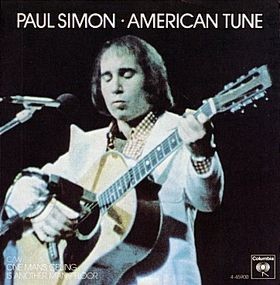
I’m writing this post in February of 2026, and it’s safe to say that there’s a lot goin’ on in this old world of ours. When my choir, the Cherry Creek Chorale, first started working on it I thought, wow, this is pretty on the nose. When did he write it? 1973, folks. Richard Nixon had just won re-election by a huge margin even as the Watergate scandal was heating up. The Vietnam War was grinding on, with America’s pullout almost exactly coinciding with the release of the song. It’s probably always safe to say “I wonder what’s gone wrong,” no matter the time or the place.
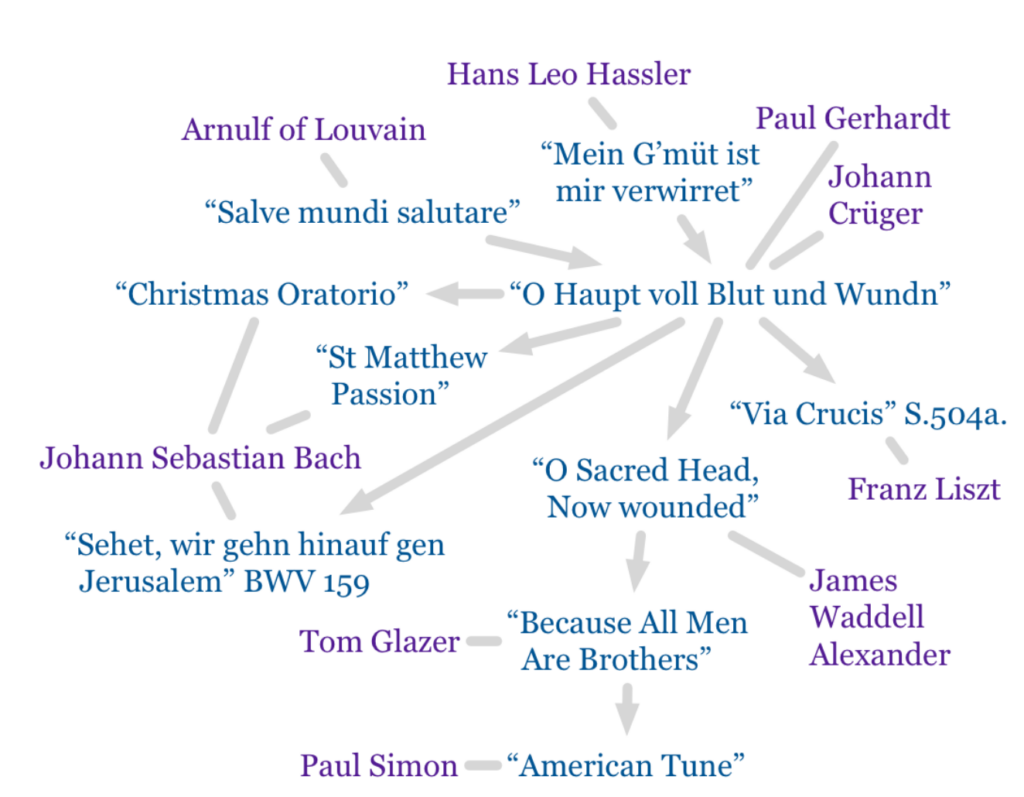
Before I get to the words, though, I’d like to spend just a sec on the tune since that’s where the Bach borrowing comes in. As I often say, I don’t do much if any musical analysis in these posts since 1) it doesn’t really interest me, and 2) I don’t know anything about it to speak of. However, in this case I kept running across the idea that “American Tune” is the same basic melody as J. S. Bach’s “O Sacred Head Now Wounded.” At first I thought, “No way.” But the more I listened (and watched YouTube videos), the more I was persuaded. It is indeed extremely similar. And did Paul Simon know this? Yes, he did, although he may have come across it by way of yet another borrowing by the folk singer Tom Glazer. (I’ve posted a video below of Peter, Paul and Mary singing it—Glazer has used Bach’s exact harmonies as well as the tune itself.) I ran across a great blog by the musician Ethan Hein wherein he sums up this whole idea:
My own experience of music making is that there are no original ideas. There are novel combinations of old ideas, but it’s neither possible nor desirable to make a genuinely new and unprecedented piece of music. If you want to hear truly original music, bang randomly on a piano keyboard. You’ll be playing something new and unprecedented, but it probably won’t be something you’d want to hear twice.1
Okay, you may say. But Bach wrote that original piece, right? Wrong. It goes way back. In fact, here’s Mr. Hein’s little family tree about the tune:
Well, back to the words—which Paul Simon can credit himself for, at least mostly:
Many’s the time I’ve been mistaken
And many times confused
Yes, and I’ve often felt forsaken
And certainly misused
Oh, but I’m alright, I’m alright
I’m just weary to my bones
Still, you don’t expect to be bright and bon vivant
So far away from home, so far away from home.
(Don’t you just love the use of “bon vivant”? And where’s “home”? I’ll let you decide.)
And I don’t know a soul who’s not been battered
I don’t have a friend who feels at ease
I don’t know a dream that’s not been shattered
Or driven to its knees
But it’s alright, it’s alright
For we lived so well so long
(Not quite sure what he means here—did we live so well so long? Like, when? During the Sixties? The Fifties? World War II? Is he being ironic? Etc., etc.)
Still, when I think of the
Road we’re traveling on
I wonder what’s gone wrong
(Can’t agree more here, Mr. Simon!)
I can’t help it, I wonder what has gone wrong.
And I dreamed I was dying
I dreamed that my soul rose unexpectedly
And looking back down at me
Smiled reassuringly.
(These lines are usually seen as evoking the idea that death is a release from the mess we’s in down here and that things will be better wherever that soul has gone. Sort of.)
And I dreamed I was flying
And high up above my eyes could clearly see
The Statue of Liberty
Sailing away to sea
And I dreamed I was flying.
(Again, very poetic and non-nail-downable. You could turn it into a cliché and say something like “the American dream is leaving us!” but the image itself is the point. There she is, that great symbol of America, sailing away out to sea. I was reminded of a verse from the Jewish Bible, I Samuel 4:21, when Israel is at war with the Philistines and a baby is born to one of the priests; the mother “named the child Ichabod, saying, “The glory has departed from Israel!”)2
We come on the ship they call The Mayflower
We come on the ship that sailed the moon
(Simon re-wrote this line for the Black singer Rhianna Giddens to say:
We didn’t come here on the Mayflower
We came on a ship in a blood red moon.
So his original line, most likely referring to those who’ve participated in America by helping with its new steps into the future, including the moon landing [which took place in 1969] has been changed to a reference about those coming to America by way of those horrible slave ships.)
We come in the age’s most uncertain hours
(Every age is uncertain, just to state the obvious.)
And sing an American tune
Oh, and it’s alright, it’s alright, it’s alright
You can’t be forever blessed
(Haven’t we all felt this way when things were going well: “How long can this possibly last?” Again, I don’t really know what Simon is referring to, when exactly it is that he thinks America has been “blessed.” It’s very hard to put this into other words, another mark of good poetry. I’d say something like “Get on with it, even though things have started going downhill.” But I’m not a poet.)
Still, tomorrow’s going to be another working day
And I’m trying to get some rest
That’s all I’m trying to get some rest
(So not an uplifting ending but instead a note of resignation and weariness.)
Simon called “American Tune” his “Nixon impeachment song,” and said that “I don’t write overtly political songs, although American Tune comes pretty close, as it was written just after Nixon was elected.”
I do have a second Paul Simon to get to in this post, so maybe I’d better get to work on that one:
“Bridge Over Troubled Water”
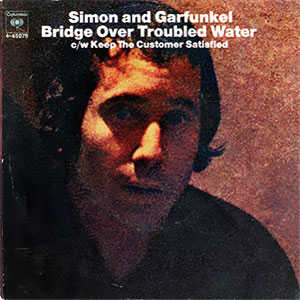
I’d never troubled myself much about the meaning of this song, assuming that it was roughly the same idea as in “Lean On Me” or “The Weight/Take a Load Off” or “He Ain’t Heavy, He’s My Brother.” And it is, but the idea of the “bridge” takes us outside of those other images. Where did it come from? Well, we know the exact source because Simon told us. He’d been listening a fair amount to a Black Gospel group called the Silver Swantones, and he’d heard the line ““I’ll be a bridge over deep water if you trust in my name,” words that had been improvised and inserted by Claude Jeter, the leader of the group, into the traditional spiritual “Mary Don’t You Weep.” (“According to gospel producer and historian Anthony Heilbut, Simon later acknowledged his musical debt to Claude Jeter in person, and additionally handed Jeter a check as compensation.” Wikipedia)
Simon acknowledges that there’s a musical phrase from “O Sacred Head” in this song as well—it comes on the words “when tears are in.” It’s hard to pick it out from the song as a whole, but it’s there. So we get Bach into this one, too.
Once you understand the central metaphor the lyrics pretty much explain themselves; there’s no need for deep philosophical meanderings here. I’ll just give a couple of introductory ideas. First of all, the idea of “laying down” oneself is taken directly from Christian theology and the sacrifice of Christ: “Hereby perceive we the love of God, because he laid down his life for us: and we ought to lay down our lives for the brethren.” (I John 3:16 KJV). I’m not implying that Paul Simon himself was referencing this verse, but it’s fair to say that the Rev. Claude Jeter was doing so when he improvised his line. On a much lighter note, “The phrase ‘Sail on, silver girl’ in the third verse is not about drugs, as sometimes rumored. Paul Simon revealed it is an affectionate, intimate reference to his first wife, Peggy Harper, who was dealing with her first gray hairs.” (Google AI Overview) Honestly, I wish songwriters wouldn’t insert private jokes into their lyrics. Talk about gray hairs! We poor bloggers have to scour the Internet to figure out what you mean! Give us a break!
Ho-kay. Here we go:
When you’re weary, feeling small,
When tears are in your eyes, I will dry them all;
I’m on your side. When times get rough
And friends just can’t be found,
Like a bridge over troubled water
I will lay me down.
Like a bridge over troubled water
I will lay me down.
When you’re down and out,
When you’re on the street,
When evening falls so hard
I will comfort you.
I’ll take your part.
When darkness comes
And pain is all around,
Like a bridge over troubled water
I will lay me down.
Like a bridge over troubled water
I will lay me down.
Sail on silver girl,
Sail on by.
Your time has come to shine.
All your dreams are on their way.
See how they shine.
If you need a friend
I’m sailing right behind.
Like a bridge over troubled water
I will ease your mind.
Like a bridge over troubled water
I will ease your mind.
And now for the good part: the videos! It’s hard to know where to start, but I guess we’d better start with the Simon original (or “original”) for “American Tune”–
And here’s the Tom Glazer “Because All Men Are Brothers” take:
And a very clever mashup between Bach and Simon:
This was the earliest live performance of “Bridge” that I could find by the original guys–everything before that is audio only:
And now a performance of “Mary Don’t You Weep” with the great Claude Jeter–again, sorry I don’t have an earlier live video, the resolution on this is horrendous, and there are some weird Chinese subtitles, but the sound is great:
A-a-a-nd, finally, the interview Paul Simon gave to Dick Cavett in which he talked about songwriting in general and especially the origins of “Bridge.” It starts out very awkwardly, and why on earth Paul Simon was wearing his HAIR like that . . . words fail me. It gets going after awhile, though:
(c) Debi Simons
- “No One Has Ever Written an Original Song” ↩︎
- You may have thought, Hey–what about Ichabod Crane in “The Legend of Sleepy Hollow”? Why would his mother have given him such a depressing name? Well, Wikipedia says that “Ichabod—meaning ‘without glory’ in Hebrew—comes from the biblical figure of that name. Irving might have borrowed the name from that of Ichabod Crane, a colonel in the US Army during the War of 1812, whom he had met in 1814.” But that explanation just moves the whole issue back a step. Why did the real mother of this real Army colonel name him “Ichabod”? I don’t know what to tell you, to be honest. Here’s a rather unsatisfactory note on the name from Ancestry.com: “It is worth noting that outside of this literary connection, the name Ichabod remains relatively uncommon in modern-day usage. Despite its rich biblical origins and literary association, the name has not gained widespread popularity. Nevertheless, its Hebrew roots and symbolic meaning continue to offer an intriguing glimpse into the history and cultural significance of names around the world. ↩︎

Another great analysis, Debi. Thank you!
As I listened to “Oh Mary, don’t you weep”, I heard the words from another Paul Simon song.” if I could, I surely would.”. From “I’d rather be a sparrow than a snail”. So enlightening thank you for all this hard work and for this information with us.