Who’s “Mary” in Mozart’s Requiem?

Mary Magdalene looking toward HeavenThe meaning of the the Requiem text, part 4.

Last week I wrote about animals in the Requiem. This week I’m concentrating on one person mentioned one time in the Requiem text. I guess I’m constitutionally unable to just go through the text line by line. You wouldn’t enjoy that anyway, would you? I’ve already talked about Abraham, David and the Sybils, so they’re covered. But that still leaves several other individuals or groups who should get an explanation, and that endeavor will take up this post and at least one more after that. In the “Recordare,” we have the lines:

Qui Mariam absolvisti
et latronem exaudisti
mihi quoque spem dedisti.

Read more

What’s the significance of the animals in the Requiem?

Sheep in a green pastureThe meaning of the Requiem​ text, part 3:

There are four different animals (by my count) mentioned in the Requiem. What’s their significance?

I’ll just go in order. The first two animals are sheep and goats, mentioned in the “Recordare” section sung by the quartet. “Recordare” means “Remember,” with the line as a whole reading “Remember, kind Jesus.” So here is the relevant section:

Read more

Why does Mozart keep talking about Abraham?

Abraham, Hagar, Ishmael, Sarah, and IsaacThe meaning of the Requiem text, part two:

Before I even get to David, Abraham, and the Sybils, I should probably mention the references in the very first section of the Requiem to Zion and Jerusalem: “You are praised, God, in Zion, and homage will be paid you in Jerusalem.” This line echoes the ideas in the New Testament book of Hebrews, “But you have come to Mount Zion, to the city of the living God, the heavenly Jerusalem. You have come to thousands upon thousands of angels in joyful assembly” (Hebrews 12:22 NIV). You can see that the words “Zion” and “Jerusalem” in these verses refer to literal places but have a deeper, spiritual meaning. The same can be said of the Requiem text.

Read more

The Meaning of the Requiem Text, Part One

Yellow and orange starI wrote last week about the constraints Mozart worked with as he composed the Requiem. Starting with this post I’ll look at the text of the various sections, as many as I can squeeze in, and perhaps an attempt at times to draw a connection between the words and the music.

What does the title itself mean? “Rest.” The funeral mass as a whole is named for its first word, from the Latin “requies.” 

Read more

How Does a Composer Compose?

Music manuscriptsThere’s a famous essay by Edgar Allan Poe titled “The Philosophy of Composition,” in which the poet and storyteller outlines what he says to be the method used in writing his famous poem, “The Raven.”  I rather blush to say that I have taught about this piece in a high-school English class (hey, it was in the anthology) and taken it seriously, as indeed a quick Google search will show that most reviewers do.
Read more

The Requiem’s Mysterious Origin

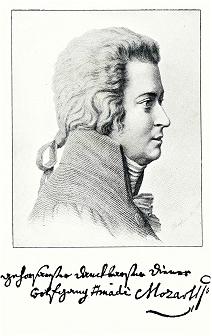
Mozart side portraitWho really commissioned Mozart’s Requiem, and who actually wrote it?

What a fantastically complicated story lies behind these two simple questions! All sorts of theories have been suggested: that Mozart thought the commission had come from the Underworld and that he was writing his own funeral music, that Antonio Salieri, Mozart’s musical rival, was behind the commission (and also behind Mozart’s death), and so on. We do have an actual anecdote, mentioned in several reputable Mozart biographies, that Mozart told his wife, Constanze, that he was thinking of death and didn’t believe he had much longer to live, that he felt that he was writing the requiem for himself, and that he was sure he had been poisoned. So Constanze took the score away from him for awhile until his spirits lifted. We have no concrete evidence that a) Mozart actually said this or b) he was actually being poisoned. Indeed, while there have been over 100 theories proposed as to the cause of his death, the most credible idea is that he died of a recurrence of rheumatic fever, a disease he had first contracted as a child.

Read more

A Charming Fable that Deserves More Fame

Statue of Apollo

The secular cantata A God in Disguise by the Swedish composer Lars-Erik Larsson with lyrics by the poet Hjalmar Gullberg is a fabulous work that is far too little known here in America. There are two ideas about its background that I’d like to discuss in this post: the actual story behind the lyrics and world events that were unfolding at the time of its composition.

Read more

How Is the Song “Men of Harlech” Connected to 9/11?

Picture
First a little background on the song itself. Harlech Castle was built in northern Wales by Edward I of England in the late 1200’s after he put down a Welsh rebellion against his rule. Harlech then became embroiled in the Wars of the Roses that raged between the houses of Lancaster and York in the 1400’s. From 1461 to 1468 the Lancastrians managed to hold onto the castle even as other strongholds fell to the Yorkists. Edward IV finally got fed up and ordered a huge army to besiege the castle, which surrendered after a month. This siege is often described as lasting for seven years, which is, we will charitably say, a slight exaggeration. The song originates from these events, but there are several versions and none of them was written before the 1800’s. It’s interesting to note that this stirring paean to freedom and bravery is actually about a civil war. One version includes the words “Now the Saxon flees before us . . . Britain wins the field!” So the Yorkists were seen as equivalent to the Saxon invaders of centuries before, but it’s fair to point out that the Lancastrians were being helped out by the French. Hmmm. Anyway, howe’er it was, the song itself is stirring and dramatic, and it’s very popular as a regimental march and is used in an adapted form by several Welsh football (er, rugby) teams.

Read more

Are the Welsh really allergic to vowels?

PictureThe second-longest known place name in the world refers to a location in Wales:
Llanfairpwllgwyngyllgogerychwyrndrobwllllantysilio-gogogoch
What does it mean? “Saint Mary’s Church in a hollow of white hazel near the swirling whirlpool of the church of Saint Tysilio with a red cave.” (Honesty forces me to admit that there are shorter forms of this name; the long version was invented in 1860 as a promotional tool.) How is it pronounced?

Read more

Why on earth is the Chorale singing the theme from the 1964 James Bond movie “Goldfinger”? 

Picture
photo from Wikipedia

Well, I can’t say that I have any special insight into the sensibilities of the artistic committee; all I can do is repeat the words of our conductor: “Well, this is a Welsh concert, and Shirley Bassey is Welsh, so . . . “

I could go several directions in this post. One possibility is to give you the plot of the movie, but I’ve read a couple of versions and find them all pretty much incomprehensible. Another is to take you line by line through the lyrics of the song, but even my obsessive English-teacher tendencies don’t stretch that far. So we’re left with a third subject, actually the most intriguing: Shirley Bassey herself. Her life in and of itself could be made into a very interesting film.

Read more