
I’ve had the great privilege of singing this work with my own choir, the Cherry Creek Chorale. We loved it! (So did the audience.) All three parts of the Nocturnes have lyrics from American poems, and I’m going to take a stab at clarifying them. As I’ve said this before, though, taking a poem apart to pry out the meaning is a little bit like explaining a joke: when you’re all done, you’ve destroyed the original. Still, there are some intriguing lines in all three selections that repay analysis. If you’d rather leave the mystery intact, you can skip the following.
Image accessed via Wikipedia; original painting is in the Museum of Modern Art, New York City
First of all, I have to confess my (former) utter ignorance about who Don McLean is. I was of course familiar with the song “American Pie,” but for some reason had never actually noticed who its original performer was. (And I’m much more taken with the parody version of it from Weird Al Yankovic.) So when I got the music for a 2017 concert with my own choir and I saw McLean’s name as the author of “Vincent,” I just assumed he was some sort of obscure artsy-jazzy guy who was interested in art and liked Vincent van Gogh. Well, au contraire! One YouTube version of McLean’s performance has had almost ten million views. (“American Pie” has had over 71 million views from one video; I didn’t go through and add up the numbers from them all but would guess it’s close to 100 million.) McLean is still alive and still performing, although none of his songs has ever approached the popularity of these two, both of which were on his second album, also titled American Pie, released in 1971.
If you had been around in 1902 and invited to the coronation of Queen Victoria’s son Edward VII (“Bertie” to his friends), you would have heard the premier performance of Sir Hubert Parry’s setting of Psalm 122 from the Church of England’s Book of Common Prayer, always known by its opening words: “I Was Glad.”
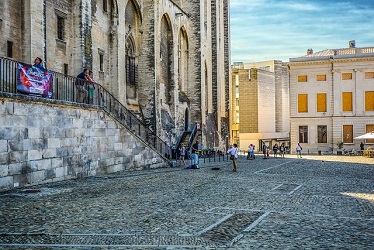
Psalm 122 in the Jewish Bible is one of a group of Psalms (songs) usually called “Psalms of ascent.” Scholars disagree on what exactly the word “ascent” refers, but the idea that’s usually listed first is that these psalms were sung by pilgrims on their way to Jerusalem to participate in various festivals in the Jewish calendar. Jerusalem is built on several hills (one of which had the name “Zion,” sometimes used to refer to Jerusalem as a whole), so you would indeed be ascending as you made your approach into the city.
When I sang this piece with my own choir, I was intrigued by the title of this piece, as I associated Racine with Greek mythology. As a French minor in college I had read Racine’s play Phèdre, which has a story line about the hero Theseus, his second wife Phaedra, and his son from his first marriage, Hyppolite. I won’t go into the story here, but it sure doesn’t have anything to do with Christian theology!
Well, duh. From the Bible, of course. We all know that. But when a pieces becomes so familiar, so ingrained in our consciousness, we forget sometimes that they’re actually about something–that the composers started with an idea, a nugget of truth, a theme.
Let’s first look a selection from Franz Joseph Haydn’s oratorio The Creation: “The Heavens Are Telling,” is not from the first chapter of Genesis as you might have expected. Instead, it’s from Psalm 19, the first verse of which is: The heavens declare the glory of God; and the firmament sheweth his handywork. (King James Version, thus the strange spelling of “sheweth” and “handywork.”)
I’ve sung with my choir a version of Gregorio Alberti’s “Miserere” edited by John Rutter, who includes a rather lengthy and somewhat technical commentary about how the current version of this piece came about. Rutter does not include the most famous story about how the piece became available to the general public, though, a tale about the child prodigy Mozart and his ability to write down music from memory, even music that he had heard only once. I’ll get to that story in a minute. (Don’t you just hate it when writers do that?)
The “Les Voici” chorus from Bizet’s opera Carmen, which takes place in Act IV as the bullfighters parade into town, makes a fine addition to a choral concert. The hero of the day is Escamillo, the “espada, la fine lame” (“The Matador, the skilled swordsman”), who first appeared in the opera back in Act II, when he and his fellow bullfighters visited the inn where Carmen was drinking and dancing. Escamillo was quite smitten with her at the time, but she had other fish to fry, namely the soldier Don Jose.
Haven’t we all known someone like Carmen? All the guys are after her and yet she herself is untouched. Her heart is never fully engaged. She tells us this herself in her famous “Habanera”–”Love is a rebellious bird that none can tame.” For Carmen, it is all about the thrill of the chase: “If you do not love me, I love you.” She is quickly bored, always ready to move on to the next lover; she’s a female Casanova. It’s fair to say that she has only one great love in her life: herself.
As long as her lovers are as footloose and fancy free as she is, all is well. She can garner admiration and passion and then move on. But the danger comes when someone takes her seriously, and that someone is Don Jose. What she considers to be a harmless flirtation he takes very much to heart. He ends up getting himself into more and more trouble because of her, deserting both the army and the kind, gentle girl from back home, Micaela, and in the end he kills Carmen.
Because the “Grand March” from Aida is so familiar, it’s easy to lose sight of what a masterpiece it is and what its significance is in the opera as a whole. The piece plays a central part in the plot of the opera and is also a great performance possibility on its own for choral groups. I’ve enjoyed singing that version with my own choir.
So, to begin, how does this music fit into the opera’s story? Aida has as one distinction that its plot actually makes a certain amount of sense. Basically (or, as my son used to say when he was little, basicawwy), Egypt is at war with Nubia. Aida is a Nubian princess who has been captured and is serving as the maid of Amneris, the Pharaoh’s daughter. No one at court knows Aida’s true identity, though. Both Aida and Amneris are (of course) in love with the same man, Radames, the captain of the army. So it’s a nice setup: Aida is obviously going to have to choose between her love for her country and her love for Radames. She ends up choosing . . . both. I think the ending of this opera is bone-chillingingly beautiful. Radames has been sentenced to death for the supposed betrayal of his country (by giving info on troop movements to Aida’s father, except he didn’t mean to!), and he’s been buried alive in a tomb, but Aida willingly shares his fate with him, having hidden herself there ahead of time. They sing “O terra, addio” (Oh earth, farewell) as they die, while Amneris kneels above at the entrance praying for Radames’ soul: “Pace, t’imploro, pace t’imploro, pace, pace, pace!” (“I pray for peace, I pray for peace!”) That final “pace” just floats out over the audience. (It didn’t strike me until I looked up a plot summary that Amneris doesn’t know Aida is down there dying, too.)
Maria Callas as Violetta; image accessed via Wikipedia
Here’s the storyline of Verdi’s La Traviata (“The Fallen Woman”): Alfredo, a young man from the provinces, has come to Paris and fallen in love at a distance with a woman of rather uncertain reputation named Violetta Valéry, finally getting to meet her face to face at a party she’s giving. He’s the one who leads the festivities with the chorus, “Libiamo ne’ lieti calici”– “Drink from the joyful cup.” (I’ve sung this chorus with my own choir on a program that featured selections from opera–it was great fun.) Then everyone except for Violetta moves into the next room for dancing, but she’s having a coughing fit. (Ominous foreshadowing here.) Alfredo comes back to find her and declares his love in the lovely “Un dì, felice, eterea”– “One day, happy and ethereal.” He leaves, Violetta declares that she must be “sempre libera”–”always free,” but we know she’ll get together with Alfredo when we hear his voice as he goes down the street outside, giving an encore of “Un di.” And that’s the end of Act One.
You wouldn’t believe the highways and byways I’ve traversed trying to get the full scoop on this one little phrase. I started out by googling, as usual. Of course the movie by that name came up—I’ll get to that in a minute. For the phrase itself, there was a lot about angels dropping coins from Heaven as a way of showing support and sympathy. Or departed loved ones doing so. Or both. It was a little confusing. The Oxford English Dictionary entry said: “pennies from heaven: money acquired without effort or risk; unexpected benefits, esp. financial ones.” It said that the phrase’s first use, at least in a printed source, was from something called Ghetto Messenger by A. Burstein, published in 1928. Well, I thought, that’s easy. I’ll just look it up on Google Books. Alas, they didn’t have the entire story but just part of the page with the phrase. There seemed to be a group of little boys involved, so I assumed that they were messenger boys, probably African-American, living in an inner city. I found the book in my library system and put it on hold, finally got it last week, and found out that my assumptions were pretty much wrong.