
 There are so many ideas packed into the texts of Lux Aeterna that it’s hard to know what to include. But since the main juxtaposition is that of light vs. darkness, I thought it would be interesting for my second essay on this masterpiece to look at other pairs of opposites before I regretfully move on to other pieces in our concert. (Next week: the deep inner meanings of “Zip-A-Dee-Doo-Dah.”)
How Many Sources of Light Are Mentioned in Lauridsen’s Lux Aeterna?
 Well . . . that depends. Probably the best answer is that there’s only one: God Himself. The first creative act of God recorded in the Bible, in the book of Genesis, concerns light: “And God said, Let there be light: and there was light” (Gen. 1:3 KJV). When we get to the last chapter of the last book of the Christian New Testament we see the same idea: “And there shall be no night there; and they need no candle, neither light of the sun; for the Lord God giveth them light” (Rev. 22:5 KJV). All through the piece there are references to light that have clear origins. I don’t want to give so many that I wear out your patience, so here are just three (using the translations printed in our sheet music):
“Oread Farewell” and Its Many Meanings
_(cropped).jpg)
One of the great privileges of performing classical music is that you get to delve into pieces written hundreds of years ago and others written within this century. If you’re fortunate you get to read or watch interviews with the composers and lyricists of modern music. Such is the case with the modern choral composer Dan Forrest, whose music my own choir has performed multiple times. We are also familiar with the work of poet/lyricist Anthony Silvestri, who provided the text. “Oread” was featured in our May 2018 concert as the closing piece, performed in the round.
So the first question is, “What’s an oread? And why is Forrest saying good-bye to whatever it is?” First things first. “Oread” is a term from Greek mythology meaning a mountain nymph. (Echo was one such, who was a consort of Zeus and was doomed by Hera, Zeus’s wife, to speak only the last words that had been spoken to her. Thus, when Echo fell in love with Narcissus, she couldn’t tell him how she felt and was forced to watch him falling in love with his own reflection in a pool.) So “oread” would be a suitable name for a mountain itself.
In which I follow the quest to find out the origin of “The Quest”
 I’m always interested in the origins of things: the why. So for the selection “The Impossible Dream” (titled “The Quest” in the actual script) from Man of La Mancha that I’ve sung with my own choir I wanted to know why on earth a popular Broadway show had been made from a 400-year-old, 700-page novel, Miguel de Cervantes’ Don Quixote. Doesn’t sound all that likely, does it? And yet it happened. (There are lots of other unlikely origins for Broadway musicals, though—Kiss Me, Kate is based on Shakespeare’s The Taming of the Shrew.)
What are Toto’s lyrics to their song “Africa” about, in toto?
Well, if  you thought you were going to get a clear explication about this song, you’re going to have to just accept the fact that we live in an imperfect world. The lyrics of Toto’s “Africa” have a number of explanations that have been given by members of the band, notably by David Paich, a band keyboardist and vocalist.
Thoughts on Gail Kubik (not a girl) and Polly-Wolly-Doodle (also not a girl).
 When my choir the Cherry Creek Chorale sang an arrangement of “Polly Wolly Doodle” by someone named Gail Kubik. I assumed that “Gail” indicated a woman. But Gail is a guy, and he lived in the 20th century, He wrote three operas, several violin concertos, and a number of film scores, including one for the Dr. Seuss animated film “Gerald McBoing Boing” for which he won an Oscar in 1951. But he didn’t rest on his laurels, no sir-ee. In 1952 he won the Pulitzer Prize in music for his “Sinfonia Concertante.” He kept busy throughout his life with teaching and commissions. “Polly” was commissioned by the Robert Shaw Chorale during the 1950’s. Kubik entered into the playful tone of the song, as you’ll be able to see if you watch the performance video at the bottom of this post.
How Much Verbiage Can Possibly Be Lavished on the History and Meaning of “The Battle Hymn of the Republic”?
 Answer: a lot. Like, a whole lot. The following isn’t at all definitive, but it should give you a sense of the historical milieu from which the song came.
I think all of us have a vague idea that “The Battle Hymn of the Republic” has something to do with the Civil War, and you may or may not be aware that its tune is the same as “John Brown’s Body.” a popular song among Union soldiers that they had adapted from an old Methodist revival song, “Say, Brothers, Will You Meet Us.” Wikipedia says this about the origin of the words, taken from an account by a soldier::
The Rich Imagery in Ferril’s Texts for Effinger’s “Four Pastorales”

Both Thomas Hornsby Ferril and Cecil Effinger are fascinating characters. Ferril was Colorado’s first poet laureate, holding that title from 1979 until his death in 1988. He was chosen to write the captions for the first-floor rotunda in the Colorado state capitol building in Denver, and his home in the Capitol Hill neighborhood is a historical and literary landmark. Effinger was a Colorado composer and contemporary of Ferril who should be much better known than he is, having written well over 150 works, including operas and symphonies. But his fame rests largely on the Pastorales, a fact that he was wont to get a little testy about at times. As he’s said, “I’ve got the Four Pastorales for Oboe and Chorus which has gone hog-wild all over the place! It is done time and time again, you know, and others that I think are just as good, somehow don’t find their way!”
I would love to know how Effinger chose these four poems; I thought at first that Ferril had put them together into a set, but that’s not true. The poems are from several different books of Ferril’s poetry and don’t have a unifying theme that I can see. I’m going to guess that these four just happened to catch Effinger’s eye. The suite has a lovely, haunting oboe accompaniment which adds to its evocative power and is probably one reason for its popularity. Here are the four poems with my attempts to analyze/explain them without ruining the poetry.
What’s the Real Story Behind “Grimsby Town”?
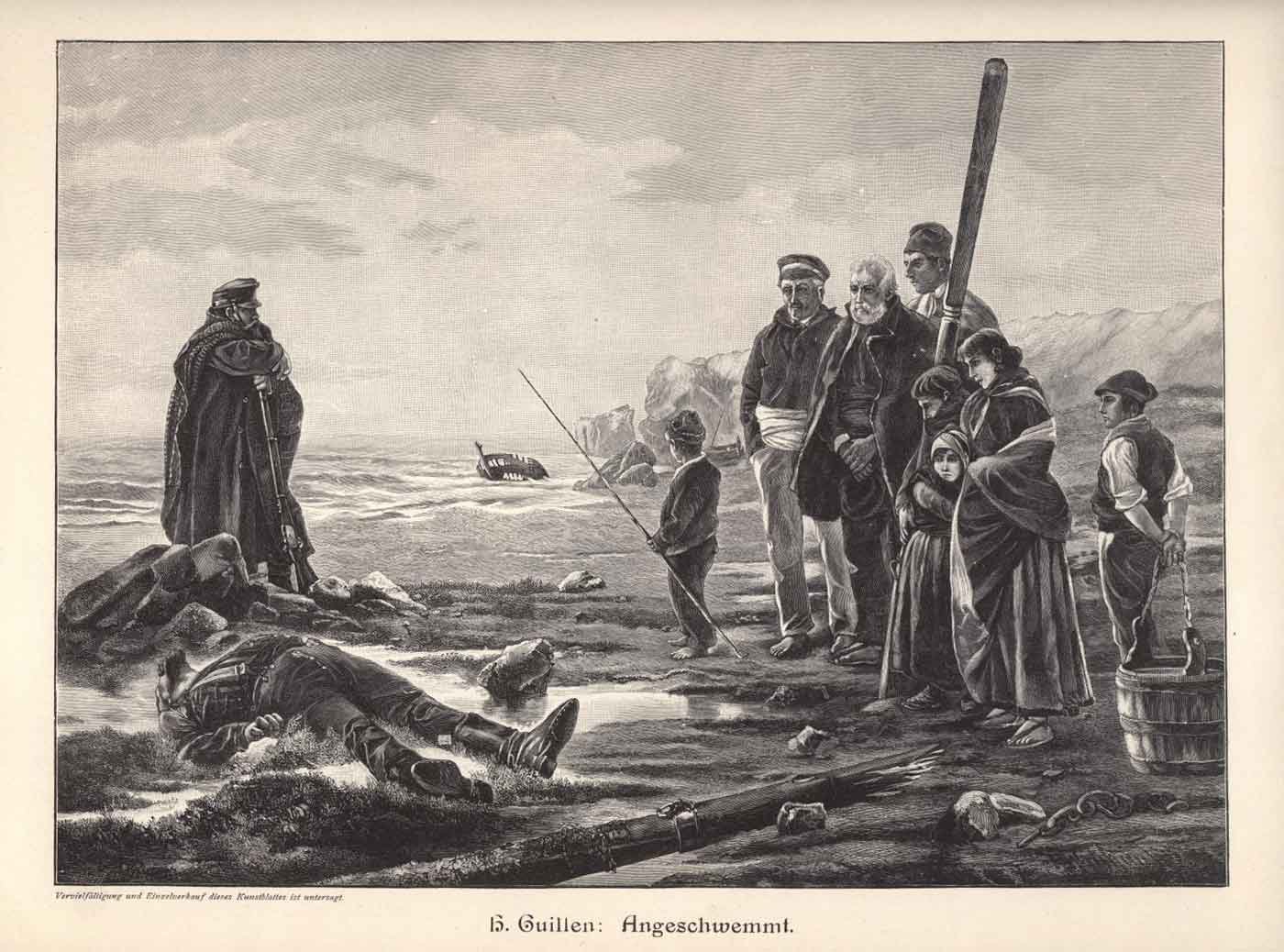
The short answer that this folk song describes an actual event that took place on February 8 and 9, 1889. That being said, there’s an almost endless array of discussion/argument about its wording. To give you just a taste of this backing and forthing, there are whole threads on discussion forums talking about why the song says “from Yarmouth down to Scarborough” when Scarborough is clearly north of Yarmouth. (Don’t believe me? Here’s the link to Google maps.) Since I’m no sailor, I can’t pretend to understand the reasoning as to why this wording is perfectly accurate in nautical terms, but it has something to do with the direction of the winds and currents. I think. And that’s just one small point in the whole mix. If you’re of a mind to do some reading yourself, google “Grimsby Town fishing disaster” and you’ll have more than enough to keep you busy. (Don’t just google “Grimsby Town” on its own, as all you’ll get is stuff about their football club—soccer to us ignorant Americans. Very interesting in its way, of course, but not much to our point here.)
About the lyrics to “Cailleach an airgid”–say wh-a-a-a-a-t?
 I know. This song is, like, seriously crazy. Right? Well, yes and no.
First of all, the crazy part. Or at least the let’s-not-take-this-too-seriously part. This is a get-up-and-dance, stomp-those-feet kinda tune. (Okay, I’ll try not to use any more hyphens.) The words don’t really matter all that much in the final analysis. I’ve been in a Celtic concert before in which we sang a song about a lonely fish! By comparison this one is a model of reason and logic. Still, by the time it has repeated “Si do Mhaimeoi I” about five hundred times any sense of the words is lost, whether you know the translation or not.