Britten in the mid-1960s, by Hans Wild; image accessed via Wikipedia.
I want you to imagine yourself in this situation: You’re a very popular English composer, becoming especially known for your operas. Your country has just gone through the rigors and horrors of World War II, the current king has died, and now a new queen is to be crowned. She’s young and quite attractive, and she’s been an inspiration during the war, speaking via radio to displaced children and joining an ambulance corps over the objections of her family. You’ve been asked to write an opera to be performed as part of the coronation festivities.
Stanford as a young man; anonymous public domain photograph; accessed via Wikipedia.
The master of this motet, “Beati Quorum Via,” was Charles V. Stanford, an Irishman who lived from 1852-1924 and who had an extremely distinguished career as a composer, teacher, and conductor. Out of the extensive list of his accomplishments I’ll just mention that he was one of the founders of the Royal College of Music, which is still around today. He produced over 200 works, including symphonies and operas, but nowadays the performances of his works are limited to some of his church music and an iridescent, shimmering piece “The Blue Bird” which I’ve performed with my own choir. Head over to that post if you’d like to read about it.
Two interesting tidbits about Stanford’s productive years: 1) He really, really wanted to be recognized for his operas and wrote nine of them. Only one had any success to speak of, Shamus O’Brien, which premiered in 1896 and ran for 82 performances. But it was a comic opera, not at all what he’d been writing previously in the genre. Alas! And while that number of performances was pretty good, guess who his comic opera competition was? None other than Gilbert & Sullivan. (Arthur Sullivan was also Irish, by the way). So Stanford was probably never going to get much traction if he’d pursued that path. But his serious operas got basically no traction at all, with a review of one, Savonarola, calling the music “crushingly tiresome.” 2) He was known for his combative personality. Here’s a description from his time on the board of the Royal College:
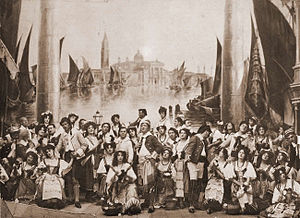
From Act I of the 1907 D’Oyly Carte production at the Savoy Theatre; image accessed via Wikipedia.
I’m a certified Gilbert & Sullivan junkie, as are my husband and his family. When I was in grade school I had a set of Golden Something-or-Other records and a little record player (yes, it’s true), and one of those ancient disks had G&S selections on it. I can remember listening over and over again to the Mikado’s “My Object All Sublime” and trying to figure out what on earth the words meant about the punishment doled out to a “billiard shark” (whatever that was): “On a cloth untrue/With a twisted cue/And elliptical billiard balls!” I finally realized that this was a pool table with a distorted tabletop, cues and balls. I’ve seen numerous productions of The Mikado and even two performances of the Hot Mikado, a jazz version that is, like, totally great. (The gentlemen of Japan are dressed in zoot suits.) I’ve seen H.M.S. Pinafore and The Pirates of Penzance on both film and in live performances. (Check out the Linda Ronstadt/Kevin Kline/Angela Lansbury version.) I’ve seen a live performance of Patience, one of the lesser-known in the canon. But until I participated in a concert that included the finale from The Gondoliers I’d never even heard of this particular creation.
Jugurtha in chains before Sulla, from Sallust’s La conjuracion de Catilina y la Guerra de Jugurta (Madrid, 1772)
Answer: You won’t believe how much. Keep reading to find out.
The contemporary American choral composer/arranger Daniel Morel has set to music a poem by Henry Wadsworth Longfellow about an African king named Jugurtha who was captured during (what else?) the Jugurthine Wars with Rome in the first century B.C. The king was brought back to Rome to be paraded in chains as a spoil of war by the Roman general who had defeated him. He then was taken to the Tullianum, a dungeon in Rome, and left to starve to death. I have no contemporary descriptions of Jugurtha as he lived out his last miserable days, but I was reminded of a scene in a historical novel about another captured king, the Gallic leader Vercingetorix, as he sits underground awaiting his own fate:
I moved the lamp so that I could see him. He shivered and trembled. He hid his face in his hands. Insects and glistening slugs crept amid the strands of his matted, filthy hair. A rat skittered between us. (from The Triumph of Caesar by Steven Saylor, accessed via Amazon)
How large was that audience? Well, estimates vary–all the way from 750 million to one billion. And I was one of them, folks.
Oh how well do I remember the early morning of July 29, 1981, when my mother came into the bedroom at 3:30 AM to get me up so that we could watch the wedding of Prince Charles and Diana Spencer live on my parents’ color TV. (The festivities began at around 10:30 AM British Summer Time, which is 7 hours ahead of Mountain Daylight Time, thus the unearthly rising time.) All I had at my apartment was a little black-and-white set, so we’d decided that I’d come over and spend the night and then get up with her. (I think my dad was working his night shift at the Post Office so he was out of the picture, in more ways than one—there’s no way he would have gotten up to watch it, I’m sure.) I remember groaning when she woke me up and saying, “I don’t want to do it” or something equally graceless, to which she said, “What? You don’t want to get up? You want to miss this?” So I heaved myself out of bed and we watched the whole thing. I have to say that my most vivid memory of the ceremony itself was thinking that the train on Diana’s dress looked kind of . . . strange. Like a hugely-long apron stretching down the aisle. Sorry! For some reason Diana did not consult me about the design of her gown. I also remember watching her climb out of that Cinderella coach and having to pull all those yards of silk out after her. Just as I thought, ‘Wow, that dress is really wrinkled,’ the commentator of the moment said that the dress had been made of heavyweight silk that would shed its wrinkles quickly. Well, maybe so.
“The Lady Greensleeves” by Dante Gabriel Rossetti, By Dante Gabriel Rossetti – No machine-readable source provided. Own work assumed (based on copyright claims)., CC BY-SA 3.0, https://commons.wikimedia.org/w/index.php?curid=2522302
I am constantly, I mean constantly, realizing that some piece of music I’ve heard all my life is full of unanswered questions. So, honestly, I had never asked myself, ‘Is someone actually wearing green sleeves in “Greensleeves”?’ When I saw this piece on the list for a concert by my own choir, however, I realized that I knew very little about it even though I’ve heard it all my life. The tune is also used for “What Child Is This?” and for one of the songs in the movie How the West Was Won, “I’ll Build You a Home in the Meadow.” So what’s what here?
Let’s start with the whole reason that this piece is seen as having some connection to royalty: the idea that King Henry VIII of England wrote it for the woman he loved, Anne Boleyn, who became his second wife and ultimately lost her head. Alas, my friends. That little idea seems to be a total myth, although it makes a good story. The first public appearance of the song was as a “broadside ballad” in 1580, but Henry had died in 1547, and his pursuit of Anne Boleyn had taken place well before that, in the mid-1520’s. Could he have written the song then, with its only being ublished over 50 years later? Well, of course he could have. Anything could have happened with this song, really. But is there any actual evidence of Henry’s authorship? Not a jot. There’s one glancing reference in another song using the same tune to “King Harries time,” and that’s it.
I’ve been doing a deep dive into the lyrics and the background of this mega-hit by the Queen of Soul. “Respect” has always been seen as a strong statement of a strong woman who’s insisting that her man treat her right. But is that view of the song really true? I have to admit that I was surprised when I actually looked at the words. It didn’t seem to me that the woman in the song was laying down a demand—more that she was begging for the bare minimum. (Her plea reminded me of something my mother said to me once about my room, “All I’m asking is that you at least quit throwing your clothes on the floor.”)
Billie Grace Ward from New York, USA / CC BY (https://creativecommons.org/licenses/by/2.0)
As I write this post my beloved choir has recently performed a great concert of Irish music in the latest of our every-other-year Celtic concerts. (Sadly, because of the pandemic, as of March 2020, we have just had to cancel our final concert of the year that would have been performed in May. But we’ll be back!) The tenors and basses (in other words, the men plus me) sang “Oft in the Stilly Night” with text by the early-19th-century Irish poet Thomas Moore. So I want to explore the imagery of the poem and then take a look at the composer of the version we sang.
“An Irish Peasant Family Discovering the Blight of Their Store” by Daniel MacDonald, 1847, public domain.
I just sat down and went through the entire Letters from Ireland book with its arrangements of Irish folk songs by Mark Brymer interspersed with texts, mostly taken from letters written in the relevant historical period. Some are what you’d call “rollicking;” others are very somber, with perhaps “Skibbereen” being the most tragic. So what’s going on here? I’m going to give some general ideas here, and if you find them interesting I’d encourage you to head on over to the page of this website where you can purchase my book that includes a chapter on each of the selections in this fabulous work.
To begin with, let me give you a couple of astoundingly obvious observations:
Hey! Who says Leroy Anderson is “lightweight,” anyway? That is, “containing little serious matter”? Just because his music is accessible and fun, with clever sound effects, does that mean it’s not worth our time? Okay, enough with the questions, Let’s get to some answers.
So no, Leroy Anderson was most decidedly not lightweight in terms of his accomplishments. If I were just to list what he did during his life I’d probably take up my entire word limit, so here are some highlights:




 Hey! Who says Leroy Anderson is “lightweight,” anyway? That is, “containing little serious matter”? Just because his music is accessible and fun, with clever sound effects, does that mean it’s not worth our time? Okay, enough with the questions, Let’s get to some answers.