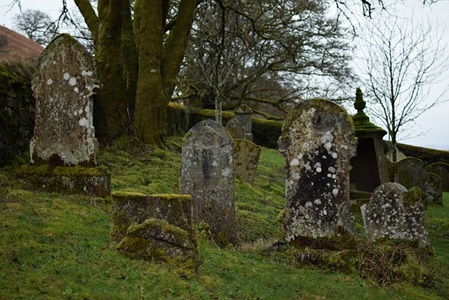
The Long and Winding History of “Ain’t No Grave”

Image by person678 from Pixabay

I used to get a Sunday newsletter from a journalist named David French, and he’d always include a video of a contemporary worship song. I’m not a big fan of such music as a usual thing, finding most of it syrupy and breathy. (Sorry!) But I’d usually click on the video at least briefly, and one Sunday he’d put up a performance of “Ain’t No Grave” with a singer named Molly Skaggs. Hmmm, I thought, is she related to Ricky Skaggs, the great bluegrass performer?

Oh my! She is indeed his daughter, and a worthy representative of his musical tradition. I don’t know how many times I’ve watched/listened to that video. (It’s great for getting myself going on cleaning up the kitchen.) I love the words, and the music, and Molly standing there with her acoustic guitar and belting out the song. No glamor, no glitz—just pure talent. Later I found out that the song had been covered by many, many artists—including Johnny Cash. (After I insisted that my whole family watch the video my son said he really liked the song, and when I expressed astonishment he said, “Someone made an animation sequence to go with the Johnny Cash version.” Oh.)

Read more

What’s With All the Rockin’ Goin’ on in Jerusalem?

Image by krystianwin from Pixabay

Warning: Thickets of parsing through a song’s lyrics word by word ahead. Enter at your own risk!

Let me start by quoting myself from the post “How Did We Get the Spirituals?”—

The simplified explanation of how Black spirituals came about goes like this: slaves heard about Christianity after arriving in the US and, especially on the southern plantations, came up with sung versions of those teachings that gave them hope of a better life, expressed their longings for deliverance, and often served as rhythmic work songs.

There’s the added wrinkle that the spirituals are true folk songs; that is, they were not originally written down but were passed down orally. Thus there are always multiple versions of any spiritual. Here’s a good explanation of how the process of transcribing the spirituals, but indeed any folk music, worked, as described in an article about the efforts of John W. Work III, a scholar and teacher at Fisk University in the early 1900’s:

Read more

When Will the “Great Day” Occur?

Well, it’s complicated.

“Great Day” is a spiritual, meaning that it falls into the category of true folk music, a genre that starts out with oral traditions and only later involves writing the words down. By the time a true folk song is committed to paper it almost always has multiple versions. And why do I keep using the word “true”? Because there are many songs written “in the style of” a folk song that aren’t truly so since they have a known, single author. In the case of this version of the piece (which my own choir, the Cherry Creek Chorale, will be performing in March 20241) there is an arranger, Warren Martin, but no composer or lyricist, so we seem to be in the “true folk” category. In my signature bopping around the Internet looking for clues I’ve found a number of sites that have published the lyrics, but there are none that try to unpack the layers of meaning contained in them. So I’m venturing out on my own here. If you’d like to read a general discussion of spirituals and their origins, I’d recommend that you read an earlier post on this website, “How Did We Get the Spirituals?

Read more

Hacking through the symbolism in “Children Go Where I send Thee”

Image accessed via SecondHand Songs

Man, if I went through this song line by line, starting to write as I am on Nov. 1, giving all the variants both of the song itself and also its precursors, Christmas would be long gone by the time I finished. I’m sure there have been whole doctoral dissertations written on just this subject. But not everyone shares my obsession with history and etymology, so I’m going to concentrate on this version, usually sung or performed as a Christmas song even though none of the verses except for the first one refers in any direct way to the Christmas story.

Read more

All the Ways the Storm Has Been Passing Over

Image by Tobias Hämmer from Pixabay

I’ve said this many times before and will say it again here: You just never know what you’re going to find when you start looking up information about a piece of music. My choir, the Cherry Creek Chorale here in the Denver area, is closing its October 2022 concert with the piece “The Storm Is Passing Over.” The composition credit is listed as “Charles Albert Tindley, arranged by Barbara W. Baker.”

So the obvious question was, “Who were these people?” Let me start with Tindley, a fascinating figure in American history who was born before the Civil War and ended up as the pastor of a 10,000-member mega church. And this was before mega churches were even a thing. A-a-a-a-a-nd, he’d been the janitor of that church to begin with. It’s a great, great story. Tindley was the son of a slave father and a free mother (how that happened I have no idea), considered to be free himself because of her. When his mother died he went to live with his mother’s sister in order to keep his free status. But he was expected to earn his keep, as it were, and was routinely “hired out,” never having the opportunity to attend school. Here’s what Wikipedia has to say:

Read more

What Are the Multiple Layers of Meaning in “I Got Shoes”?

PublicDomainPictures from Pixabay.com–these heavy, waterproof work boots would have been great for working in the South Carolina rice fields!

I guess we’ll start with a version of that puzzle you’ve probably seen in which you’re asked to pick the item that doesn’t belong with the rest. Here’s one:

Which one of the following does not belong with the others?
Binoculars, eyeglasses, goggles, handlebars, jeans, pliers, scissors, shoes, tweezers
Answer: The word “shoes” is the only “pair” that actually has 2 separate pieces.
(I didn’t get this one right, picking “jeans.”)

Read more

What’s the “Beautiful City,” and why does it have 12 gates?

The New Jerusalem. Armenian manuscript by Malnazar and Aghap’ir in New Julfa bible, 1645; accessed via Wikimedia Commons.

There are so many areas of interest implicit in this brief arrangement of several Black spirituals that I hardly know where to begin. I’ll start with encouraging you to read my post “How Did We Get African-American Spirituals?” Got that? Okay, let’s move on to this specific arrangement that includes texts from “Oh, What a Beautiful City” and “In Bright Mansions Above” as well as fragments from other sources. The words from these are melded seamlessly and beautifully, with the slower, quieter phrases from “Mansions” providing the bridge, or contrasting middle section, for the piece. And of course, since the actual spirituals dating from before the Civil War are all anonymous, anyone can do anything with them. Even if we did know authors’ names the copyright would long ago have expired.

So you may have thought when you read the title of this post that the answers were pretty obvious, and indeed they are to some extent. The “beautiful city” is, of course, heaven, and the “12 gates” are the “pearly gates” mentioned in the book of Revelation, the last book in the Christian New Testament. In fact, let’s just stop here for a moment and read the actual description:

Read more

What does “campground” refer to in the spiritual “Deep River”?

“Deep River,” like “My God Is a Rock,” belongs in the category of slow, quiet spirituals. These songs of despair and hope were sometimes forbidden by slaveowners or overseers, while more up-tempo songs were actively encouraged as being helpful to keep the work going.
Why do the words say, “I want to cross over into campground”? I’ve noticed before that “campground” doesn’t really fit the rhythm very well. And for me, the image conjured up is that of tents, campfires, and lots of children running around. Almost like a refugee camp. (The fact that I have promised myself that I will never, ever again sleep on the ground in a tent might color my perceptions a bit.) Someone else might think of Civil War soldiers’ camps. Why would persecuted people want to escape to something so . . . unrestful?

What’s the “rock” in “Elijah Rock”?

This seems like a pretty simple question, doesn’t it? But let me tell you, it isn’t! I’ve done lots of trolling the internet looking for answers and come across some pretty convoluted ideas, but there seems to be one answer that makes the most sense. The facts that there are several versions of the lyrics and the ideas seem somewhat truncated mark this as a genuine folk song, passed down orally for a number of years.

Before I get to the various meanings for “rock,” here are some ideas that do seem clear. “Comin’ up, Lord,” has to refer to Elijah’s being taken up to Heaven in a fiery chariot. One of the choruses in Mendelssohn’s Elijah also vividly depicts that event. Interesting to compare that composer with his background of wealth, privilege and refinement with the unknown slave who first came up with this spiritual and whose hands were roughened from cotton bolls and back was scarred from the whip. Could the two of them have found common ground if they had ever met? I truly think they could.

Read more

What’s a Mountain Got to Do with the Nativity? And Other Questions About “Go Tell It on the Mountain”

Image by Free-Photos from Pixabay

Mountains turn up all the time in the Bible. They can be places where God interacts with people, such as Mount Sinai where God gave the commandments to Moses to take back down to Israel, or where someone with “clean hands and a pure heart” can meet with Him, or where a chosen few disciples can see the transfiguration of Jesus. Or people can shout for joy from the mountaintops. And a mountain can also be simply a place from which to speak, with the most famous example being that of the Sermon on the Mount: “Now when Jesus saw the crowds, he went up on a mountainside and sat down. His disciples came to him, and he began to teach them.” (Matthew 5:1-2 NIV) Here’s this big crowd, and here’s a high place to sit which happens to be on a mountainside, so Jesus uses it.

Read more