The Fascinating Story behind “Fascinating Rhythm”

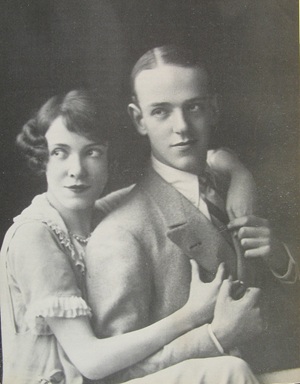
1919 publicity photo of Adele and Fred Astaire, accessed via Wikipedia.

Have you ever had the experience of paying attention to the lyrics of a familiar song and thinking, “Hmmm. This doesn’t say what I’d always thought it did”? You might take a look at my post about the song “Oh the Days of the Kerry Dancing” in which this same realization took place for me.1

Anyway, you’d think from the title of this song that it would be about how wonderful it is to be in thrall to a particular set of notes or to musical rhythm in general, but that’s not really what the words say. Here’s perhaps the clearest statement about the rhythm’s deleterious effects on the speaker:

I know that once it didn’t matter, but now you’re doing wrong;
When you start to patter, I’m so unhappy.
Won’t you take a day off?
Decide to run along somewhere far away off, and make it snappy!
Oh, how I long to be the man I used to be!
Fascinating rhythm, oh, won’t you stop picking on me?

Let me say first off that the song itself has very little to do with the plot of either the 1924 stage musical Lady, Be Good! or the 1941 film Lady Be Good in which it appears. I’m not even going to try for a plot summary of either one; suffice it to say that the song provides an excuse for a big dance number in each. In the stage version Fred Astaire and his sister Adele performed their dance midway through and then as the grand finale. In the movie the great Eleanor Powell gave an astounding tap routine.  

Read more

Were the Hills Ever Really Alive with the Sound of Music?

The real Maria von Trapp, late in life. Image accessed via https://www.factinate.com/wp-content/uploads/2020/12/Untitled-28-1.jpg

In other words, is there a true story behind the musical? And of course there is, and it’s much more interesting than the plot that could be crammed onto the stage or into a film. (Note the proper use of prepositions.)

We all know that when we see the words “based on a true story” at the beginning of a biopic or a docudrama that we’d better not take the storyline too seriously. Those warnings don’t appear at the beginning of The Sound of Music, but perhaps they should. I’ve thoroughly enjoyed researching the real von Trapp family and would urge you to follow the links below to get a fuller picture than I can give here.

Read more

A Song about Singing—“It’s a Grand Night for Singing”

Starfair1945poster.jpg
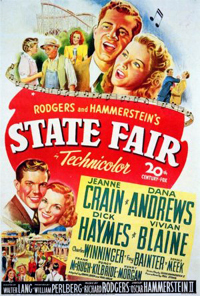
Image accessed via Wikipedia.

The long road to this song started with a novel, State Fair by Phil Strong, written in 1932. Its unifying event is . . . wait for it . . . the three days of the Iowa State Fair, in which a farm family consisting of a husband, wife, daughter and son have various adventures and romances over that period. And in case you were wondering, yes, the fair is still being held. I just looked it up. Now it lasts 11 days instead of three; the 2021 dates were August 12-22. It’s quite a production these days with all sorts of entertainment and events, some separately ticketed and some included with the general admission charge. There are still the various competitions including livestock, beekeeping and beermaking, and, of course, you can still get food in ample supply—including anything and everything you can eat off a stick. The fair had some COVID advisories in place this year but nothing mandatory; the fair was, however, canceled in 2020, marking the first cancellation of the event since World War II.

Read more

What’s the Meaning of the Phrase “Whistle Down the Wind”?

Image accessed via https://www.phrases.org.uk/meanings/whistle-down-the-wind.html

I am, of course, referring to the song from the musical by Andrew Lloyd Weber that premiered in 1996 and has been arranged for use by choral groups. But Weber wasn’t the first to title a major work by this name. Here’s the genealogy:

Read more

Is Candide Really Candid?


This is one of those posts in which I could go on and on and on. I could talk about the original novel Candide by the 18th-century French satirist Voltaire, or the character of Candide in the novel, or the musical in its many iterations overseen by Leonard Bernstein, from which our selection is taken. I’ll try to hit each of these areas just a little.

So, to answer my rather silly question in relation to the above: No. Candide is not candid, but Candide is. Little grammatical joke there.

Voltaire’s novel is not in the least candid; that is, it is not naïve, gullible, sincere, or innocent. We use the word today in a slightly different sense; if you say to someone, “I’m going to be candid with you,” you usually mean “I’m going to say something tactless to you.” But you can see how this idea derives from the original definition. If you’re very frank and open yourself you’ll tend to be that way with other people. The novel itself, however, is biting, bitter and sarcastic, full of truly awful events. Even for modern readers, steeped in horror movies and violent video games, it doesn’t make for pleasant reading. (I personally could barely get through the synopsis on Wikipedia.)

Read more

Three Lovely but Bittersweet Autumn-Themed Songs

Image by Pepper Mint from Pixabay

Introduction to the Medley

Ah, autumn! On the one hand it’s the start of crisp, invigorating fall weather and the new school year; on the other it’s the end of summer and the inevitable slide towards winter. I’ve always loved fall, but as a gardener I also mourn the end of the growing season, trying to comfort myself with the refrain, “Next year!”

Three pieces of film/stage music capture this two-sided aspect of autumn: “The Summer Knows” from Summer of ’42 (1971), “Les Feuilles Mortes”/”The Autumn Leaves” from the post-WWII French film Les Portes de la Nuit (The Gates of the Night), and “September Song,” originally written for the 1936 Broadway musical Knickerbocker Holiday and later used in the 1950 film September Affair.

I could write an entire post about each of these beautiful pieces, but since I originally sang them as a medley I’m combining them into one. (See info at the bottom of this post about the medley and its performance.)

Read more

In which I follow the quest to find out the origin of “The Quest”

I’m always interested in the origins of things: the why. So for the selection “The Impossible Dream” (titled “The Quest” in the actual script) from Man of La Mancha that I’ve sung with my own choir I wanted to know why on earth a popular Broadway show had been made from a 400-year-old, 700-page novel, Miguel de Cervantes’ Don Quixote. Doesn’t sound all that likely, does it? And yet it happened. (There are lots of other unlikely origins for Broadway musicals, though—Kiss Me, Kate is based on Shakespeare’s The Taming of the Shrew.)

Read more

Is There Any Truth at all to the Story of the “Phantom of the Opera”?

Phantom of the Opera Mask

It’s always fascinating to search for the inspiration of a creative work, and that’s certainly true of The Phantom of the Opera. I tried to read the original 1909 novel by Gaston Leroux after seeing a performance of the musical some years ago, but I found it to be pretty much impenetrable. (And I just took a look at it again before writing this post; it hasn’t changed.) To me there were two questions I wanted to answer: 1) What is the reason for the Phantom’s physical disfigurement? And 2) What so-called “real events” gave rise to the legend of the Phantom in the first place?

There doesn’t seem to be any reason given for the Phantom’s horrible face in the original novel, which describes it as a “noseless, lipless, sunken-eyed face which resembles a skull dried up by the centuries, covered in yellowed dead flesh.” It is simply the way the child, christened Erik, was born. The epilogue of the novel gives a brief synopsis of Erik’s early life, saying that his own mother couldn’t stand the sight of him and he therefore ran away from home as soon as he could, with the intriguing tidbit that his father (who died before the Phantom’s birth) was a master builder. While I couldn’t get into the original version by Leroux, I found the1990 novel Phantom by Susan Kay to be utterly compelling. If you’d like to read a re-telling of the Phantom story told with great empathy from several points of view I’d recommend this book. Kay adds some intriguing twists to the story at the end, but I won’t tell you what they are! In a couple of film versions there are specific reasons given for the deformity: an acid attack and an accident with a record presser. (That second one is set within the cutthroat world of the early music industry.)

Read more