
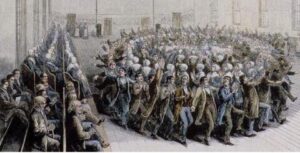
It seems a little unfair that the word “Shakers” nowadays calls up only a furniture style and, probably, the tune “Simple Gifts,” when this religious group had such a long and fascinating history. Honestly, the Wikipedia article about them is well worth a read if you’re at all interested in early American history and/or revivalist religious movements.
I’m going to get into Shaker music, but I do need to explain their beliefs and practices a bit in order to do so. This sect, which got its start in Britain around 1750, was a fascinating mixture of strict rules on the one hand and ecstatic outbursts on the other. Absolute celibacy was required for full membership; the sexes were housed separately and could not even shake hands or pass one another on the stairs. (I’m assuming the latter rule was in place because the staircases were so narrow.) They also lived communally and were strict pacifists. Yet their worship services were a mixture of music, dancing, and manifestations of spirituality that included twitching, jerking, and shouting, usually in some type of unknown language. (Those outward physical actions gave the group their name; originally they were called the “Shaking Quakers” and were an offshoot of the original Quakers.) They had to let off steam somehow, I guess. In spite of all the kerfuffle, though, the music itself was very plain, with no musical instruments used for accompaniment and no harmonies, just the melody. You can do a lot with a little; as our friend Wikipedia says:



 Here’s what you may already know about Antonio Vivaldi:
 And the answer is: an arch. We all know about Roman arches, don’t we? The architectural point, which ties in with the musical point, is that there are matching stones on each side of the arch, each one bending closer and closer to the center, with the top stone, the one that holds it all in place, called the “key stone.” Without that center stone that whole thing collapses.
 Talk about a wealth of material! I’m going to talk about John Rutter himself and his writing of our piece and then branch out into the meaning of the text in a couple of followup ones. I’d encourage you to follow the link at the end to some earlier material (including some words from the great man himself via Facebook) that I wrote when we sang the Gloria.