The Mysterious and Haunting “Skye Boat Song”—Tragic History told in Beautiful Music

Isle of Skye, Photo by Piotr Musioł on Unsplash

You’ll probably think as you read the lyrics below that they sound familiar, and you’d be right. This song has had a very long and popular life, starting with its first publication in the 1880’s. The most recent incarnation has been as the theme song for the long-running drama Outlander, based on a series of novels by Diana Gabaldon. I’m not going to deal with anything outside of the actual historical origins of the song, as there’s plenty to say just in that area.

The short version of the story behind the lyrics is that it centers around the Battle of Culloden in 1746, in which the Scots were soundly defeated by a much-larger English force. The battle had come about through an attempted restoration of the Stuart dynasty to Britain’s throne, with the Scottish forces being led by Charles Stuart, or “Bonnie Prince Charlie” (and often referred to in the material below as “BPC.”) It’s an incredibly complicated bit of history that I won’t go into in detail here. If you’d like to get a more thorough overview of the events referred to in the song, let me direct you to a post I wrote several years ago that tells the story behind yet another very famous song associated with this battle: “I’ll Take the High Road and You’ll Take the Low Road.

Read more

Is “The Days of the Kerry Dancing” a happy song? Well, no.

Imge accessed via https://explore.blarney.com/irish-dancing-history-today/

I’ve had the privilege of singing most of the pieces I write about on this site with my wonderful choir the Cherry Creek Chorale, and I remember getting the sheet music for “Kerry Dancing” on the first night of rehearsal for our March 2023 Celtic concert. As I glanced through it and read the words I felt a sense of longing and sadness. Why was that?

The first clue is the word “oh.” Not to belabor the point here too much, but have you ever thought about the rich array of meanings in this two letter word? It can mean:

Read more

William Butler Yeats’ Dreams of the Countess Kathleen and Her Blessed Spirit

Dante Gabriel Rossetti The Blessed Damozel.jpg
“The Blessed Damozel” by Dante Gabriel Rossetti; image accessed via Wikipedia.

William Butler Yeats, the great Irish poet of the late 1800’s and early 1900’s, was obsessed with Irish legends and the occult. The story behind his poem “A Dream of a Blessed Spirit” neatly encapsulates both ideas, since it concerns a mythic Irish character, the Countess Kathleen O’Shea, who sold all her goods and finally her soul to help her starving tenants. Because the Countess had given her soul for the good of others and not to enrich herself, God refused to let her be damned and instead brought her to heaven. Yeats also wrote a whole play about her, but it’s safe to say that it’s never performed these days. The poem, on the other hand, has provided the text for a lovely art song that is quite popular. My own group, the Cherry Creek Chorale in the Denver metro area, has programmed it several times. I found the words to be fascinating and puzzling:

Read more

Is There Actual History in the Song “With a Hundred Pipers”?

Prince Charles Edward Stuart. Eldest son of Prince James Francis Edward Stuart. Painted by William Mosman around 1750; accessed via Wikipedia.

I’ve written about the history of conflict between England and Scotland in several other posts, but if you’re coming to this material without having read those a bit of background is in order. Scotland and England fought each other for centuries, but it looked as though things were settled in 1603, when Queen Elizabeth I died and left no children, naming the king of Scotland, her cousin James Stuart, as her heir. He became James I of England and in theory united the countries. (He is perhaps most famous for commissioning the King James Bible.)

Alas, relations between the two countries did not remain peaceful. A big bone of contention was religion, even though both countries were Protestant. Charles I, James’ son, riled the Scots by his determination to control Scottish church government. England was also determined not to go back to the Roman Catholic church. In 1688 James II, who was James I’s grandson, was kicked off the throne over this very issue. He had converted to Roman Catholicism before becoming king, and his second wife was French and Catholic.  But his first wife had been Protestant and English and his two daughters from that marriage had been raised Anglican. So the English kept their fingers crossed that he wouldn’t have any sons from this second wife. A male heir would automatically take his place at the front of the succession line, but James was 51 when he became king and his wife had a long history of miscarriages and stillbirths. So what could possibly go wrong? Well, as it turned out, a lot. James’ wife did indeed finally produce a surviving son, and a Catholic dynasty seemed in the offing. England rose up against him and offered the throne to Mary of Orange, the eldest daughter of James’ first marriage, and her husband William. (“Orange” is a region in The Netherlands.)

Read more

How do we know that “She Moved Through the Fair” is a true folk song?

Image accessed via the “Why Donegal?” Facebook page; no source given.

We know this because it has so many different versions, points of origin, and people claiming to have had a part in its creation. Any time you have a song that simply refuses to be pinned down, rest assured that it can truly be categorized as “folk.” If there is a known author, then the most you can say is that the piece is “in the style of” a folk song. I have been fascinated to read the Wikipedia article on this piece; the various claims and counterclaims are so multi-branching that they almost form a spider’s web.

Read more

In the Blurred Line Between Waking and Sleeping, Reflections on the Past in “The Stilly Night”

Billie Grace Ward from New York, USA / CC BY (https://creativecommons.org/licenses/by/2.0)

As I write this post my beloved choir has recently performed a great concert of Irish music in the latest of our every-other-year Celtic concerts. (Sadly, because of the pandemic, as of March 2020, we have just had to cancel our final concert of the year that would have been performed in May. But we’ll be back!) The tenors and basses (in other words, the men plus me) sang “Oft in the Stilly Night” with text by the early-19th-century Irish poet Thomas Moore. So I want to explore the imagery of the poem and then take a look at the composer of the version we sang.

Read more

Why is there such a swing from merriment to tragedy throughout “Letters from Ireland”?

“An Irish Peasant Family Discovering the Blight of Their Store” by Daniel MacDonald, 1847, public domain.

I just sat down and went through the entire Letters from Ireland book with its arrangements of Irish folk songs by Mark Brymer interspersed with texts, mostly taken from letters written in the relevant historical period. Some are what you’d call “rollicking;” others are very somber, with perhaps “Skibbereen” being the most tragic. So what’s going on here? I’m going to give some general ideas here, and if you find them interesting I’d encourage you to head on over to the page of this website where you can purchase my book that includes a chapter on each of the selections in this fabulous work.

To begin with, let me give you a couple of astoundingly obvious observations:

Read more

What’s the Real Story Behind “Grimsby Town”?

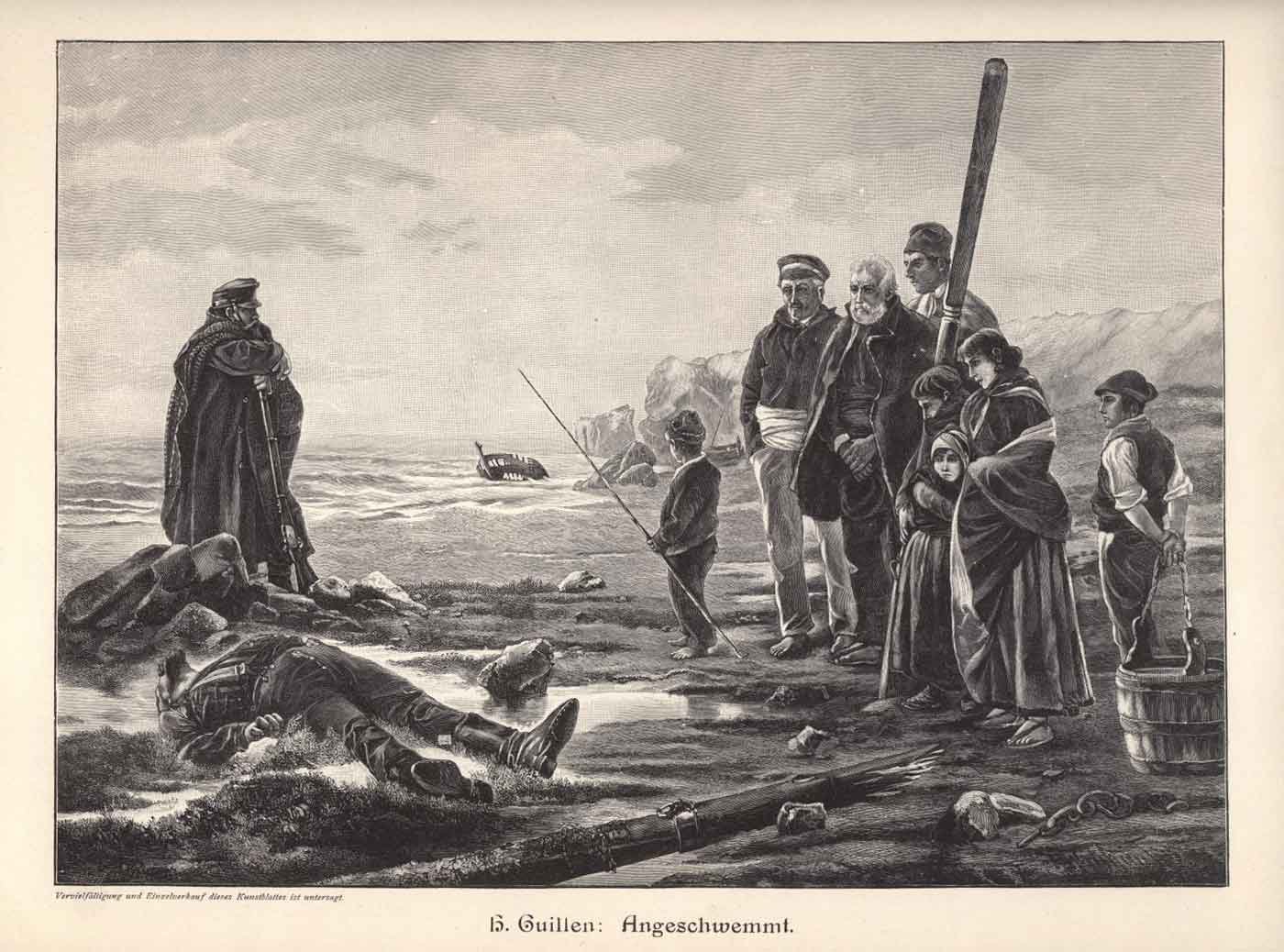
c1900 Art Print Engraving Tragedy Drowned Fisherman Washed Ashore By H.Guillen – Original Magazine Print, accessed from Amazon.com.

The short answer that this folk song describes an actual event that took place on February 8 and 9, 1889. That being said, there’s an almost endless array of discussion/argument about its wording. To give you just a taste of this backing and forthing, there are whole threads on discussion forums talking about why the song says “from Yarmouth down to Scarborough” when Scarborough is clearly north of Yarmouth. (Don’t believe me? Here’s the link to Google maps.) Since I’m no sailor, I can’t pretend to understand the reasoning as to why this wording is perfectly accurate in nautical terms, but it has something to do with the direction of the winds and currents. I think. And that’s just one small point in the whole mix. If you’re of a mind to do some reading yourself, google “Grimsby Town fishing disaster” and you’ll have more than enough to keep you busy. (Don’t just google “Grimsby Town” on its own, as all you’ll get is stuff about their football club—soccer to us ignorant Americans. Very interesting in its way, of course, but not much to our point here.)

Read more

About the lyrics to “Cailleach an airgid”–say wh-a-a-a-a-t?

I know. This song is, like, seriously crazy. Right? Well, yes and no.
First of all, the crazy part. Or at least the let’s-not-take-this-too-seriously part. This is a get-up-and-dance, stomp-those-feet kinda tune. (Okay, I’ll try not to use any more hyphens.) The words don’t really matter all that much in the final analysis. I’ve been in a Celtic concert before in which we sang a song about a lonely fish! By comparison this one is a model of reason and logic. Still, by the time it has repeated “Si do Mhaimeoi I” about five hundred times any sense of the words is lost, whether you know the translation or not.

Read more

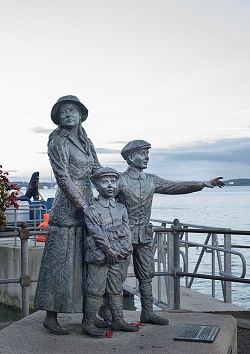
Was Annie Moore in “Isle of Hope, Isle of Tears” a Real Person?

Why yes. I’m glad you asked.

First, a little personal context. I’ve just spent awhile trying to find a picture that has haunted me ever since I visited Ellis Island back in the summer of 2010. I think it’s one of the many blown-up photographs that line the Great Hall, the area where immigrants were initially processed, but I haven’t been able to find it. So I’ll just describe it: a woman on her hands and knees, with a bucket and a brush, scrubbing a hallway. Her back is to the picture and you can’t see her face. Out of all the old photographs I saw that day I remember only this one. To me it’s a representation of the life that many of these people faced. On that same trip we also toured a tenement museum, trying to imagine the lives of people just like the woman in that photo, living in crowded apartment buildings with no running water and barely enough space to breathe. People slept in all sorts of strange contortions, the most memorable being that of the boys who had their upper bodies on a couch and their feet on chairs. (Visit the Tenement Museum the next time you’re in NYC!)

Read more