Who was Zadok the priest, and what does he have to do with royal British coronations?

The Anointing of Solomon by Cornelis de Vos. According to 1 Kings 1:39, Zadok anointed Solomon as king. Image accessed via Wikipedia.

To answer that question it’s necessary to delve into the following ideas:

1. A history of British coronations dating back to 973.

2. An explanation of why a German composer, George Frederick Handel, was commissioned to write a set of coronation anthems for a British ceremony in 1727.

3. A look at the source of the actual text for the anthem referencing said Zadok.

Let’s start with #3. Zadok was the high priest of Israel at the time of King Solomon’s coronation around 970 BCE. The story about his role in this event comes from the book of I Kings in the Jewish Bible; the text for the anthem is shortened and simplified to read:

Read more

Hallelujah and Alleluia–from the Psalms to Shrek

Image by Avery Fan from Pixabay

I’m not really going to cover the millennia of this word’s usage; there are whole books on the subject. Instead, I’ll concentrate on the word itself and on pieces my choir has sung that include it. I will include a brief foray into its usage in Shrek, though, so keep going to the end if you want to get that!

It’s stunning to look at the pieces that are either totally built around this one word or include it as a significant part of the lyrics. Why is it so powerful and attractive? Such questions are always in the end unanswerable. I’d postulate, though, that the sound of the word itself and its use as an exclamation of praise can claim at least partial credit.  Why are there two spellings, by the way? Very simple: “hallelujah” is a transliteration from the Hebrew Old Testament and “alleluia” is a Latinized version of the same word in Greek.

Read more

Britain’s Great “Song of Thanksgiving” from Its Great Composer Ralph Vaughan Williams

Image accessed via Wikimedia Creative Commons, Piccadilly Square pictured as supporters celebrate VE Day, May 08, 1945. Photo taken by Sgt. James A. Spence, during his service in World War II

Introduction:

What a great centerpiece to a concert centered around the theme of thankfulness! Vaughan Williams’1 15-minute-long work consists of a soloist, adult mixed choir, speaker, children’s choir, and orchestra and was commissioned by the BBC in late 1944 to be performed once the hoped-for and expected victory over the Axis powers was accomplished.

Here’s a description of the piece from the publisher of the sheet music, the Oxford University Press: “Originally entitled ‘Thanksgiving for Victory,’ ‘A Song of Thanksgiving’ is a powerful and moving work that celebrates the Allies’ victory in World War II. It was first recorded in 1944 while the war was still ongoing, but was not broadcast until victory had been achieved in May of the following year. Comprising seven movements, it sets texts from the Bible alongside words by Shakespeare and Kipling, lending the work a sense of timelessness and grandeur.”2

Isn’t it great that there was the will and the appetite after years of war and destruction to commission a piece of music to celebrate victory? There’s no information available on how much or whether Vaughan Williams was paid for the piece, and it’s rarely performed nowadays because it was written for a specific occasion. One reviewer on Amazon for a CD performance says, “Vaughan Williams’ ‘A Song of Thanksgiving’ is the greatest piece of music ever written that almost no one has heard.”

Read more

Robert Frost and Randall Thompson’s Frostiana (with other rabbit trails along the way)

Robert Frost in 1941; image accessed via Wikipedia

Introduction

This will be very long for a blog post/article but too short for a whole separate book, so note the Table of Contents box above that you can use as needed or desired. My goal here is to focus primarily on Randall Thompson’s Frostiana, looking at the circumstances of its composition and the seven poems individually that comprise it, but with plenty of info about Robert Frost the man and poet and also a bit about a couple of other composers who have set Frost’s poetry to music. An individual video is included for each song, with a full performance of the Thompson suite at the end. Other bonus videos are included!

Let me start by explaining my own history of singing music set to texts by Robert Frost.  As a member of the Cherry Creek Chorale here in the Denver area I’ve sung “The Pasture” by Z. Randall Stroope, “The Road Not Taken” and “Choose Something Like a Star” from Frostiana by Randall Thompson, and “Sleep” by Eric Whitacre, which started out its life as a setting of Frost’s “Stopping by Woods on a Snowy Evening.” Then, as a grand finale to all this Frost-y stuff (sorry), I’m getting to sing the entire Frostiana in May of 2022 with my group. If you’re reading this before May 6-7 2022, you can follow the link above to visit the choir’s website and attend the concert. It’s going to be g-r-e-a-t!

Read more

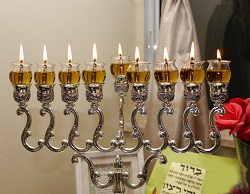
Menorah Mysteries

PictureFirst question:  Why is the pictured lamp stand more authentic and correct as a part of the Hanukkah celebration than the usual candelabra?

Answer:  Because the whole story of Hanukkah is about oil, not candles.

Second question:  Should there be seven or nine branches on a menorah?

Answer:  It depends. . . .

Read more

Britten’s Blunder but with a Bright Side–Choral Dances from Gloriana

Benjamin Britten in his library
Britten in the mid-1960s, by Hans Wild; image accessed via Wikipedia.

I want you to imagine yourself in this situation: You’re a very popular English composer, becoming especially known for your operas. Your country has just gone through the rigors and horrors of World War II, the current king has died, and now a new queen is to be crowned. She’s young and quite attractive, and she’s been an inspiration during the war, speaking via radio to displaced children and joining an ambulance corps over the objections of her family. You’ve been asked to write an opera to be performed as part of the coronation festivities.

So what would be a good subject for said opera?

Read more

How did William Mathias attain the honor of having one of the largest audiences ever to hear the premier of a musical work?

Image by sandid from Pixabay

How large was that audience? Well, estimates vary–all the way from 750 million to one billion. And I was one of them, folks.

Oh how well do I remember the early morning of July 29, 1981, when my mother came into the bedroom at 3:30 AM to get me up so that we could watch the wedding of Prince Charles and Diana Spencer live on my parents’ color TV. (The festivities began at around 10:30 AM British Summer Time, which is 7 hours ahead of Mountain Daylight Time, thus the unearthly rising time.) All I had at my apartment was a little black-and-white set, so we’d decided that I’d come over and spend the night and then get up with her. (I think my dad was working his night shift at the Post Office so he was out of the picture, in more ways than one—there’s no way he would have gotten up to watch it, I’m sure.) I remember groaning when she woke me up and saying, “I don’t want to do it” or something equally graceless, to which she said, “What? You don’t want to get up? You want to miss this?” So I heaved myself out of bed and we watched the whole thing. I have to say that my most vivid memory of the ceremony itself was thinking that the train on Diana’s dress looked kind of . . . strange. Like a hugely-long apron stretching down the aisle. Sorry! For some reason Diana did not consult me about the design of her gown. I also remember watching her climb out of that Cinderella coach and having to pull all those yards of silk out after her. Just as I thought, ‘Wow, that dress is really wrinkled,’ the commentator of the moment said that the dress had been made of heavyweight silk that would shed its wrinkles quickly. Well, maybe so.

Read more

Meet the Artists Behind Our Premiered Commission–Silvestri and Veros

For over seven years I’ve been writing background posts for the Cherry Creek Chorale’s concert selections. It’s been a great experience all around, with the special privilege of learning about, and in some instances contacting, living composers. I was able, for instance, to contact John Rutter via his Facebook page with a question about the reasons for his many commissions from America, and he graciously responded. That was a thrill, to be sure.

This past Tuesday night provided another thrill when the lyricist for our newly-commissioned piece,     “-RADIANCE-,” did a Skype call with us. Charles Anthony Silvestri has developed a career over the past 20 years as a provider of “bespoke” lyrics. (I love that word! It means “custom made.” The only other context in which I’d heard it was that of an English suit, one tailored to the individual’s measurements.) What a wonderful experience for me to sit with some dozen or so other Chorale members who were able to come early and listen to this man talk about his work and ask him questions. At one point our conductor mentioned that Silvestri seemed to be in his studio. Not his writing studio, you understand: his painting studio. Not only does he have a career as a lyricist and poet, not only is he a full-time professor of Medieval and Renaissance history at the University of Kansas, but he also paints in the styles of the same periods about which he teaches. (And makes his own paint!) If any living person deserved the title of “Renaissance Man,” well . . .

Of course our main questions for him centered around his collaboration with Santiago Veros for our own piece. It was very much of an ongoing process as he described it, with the two of them communicating back and forth. Veros had given Silvestri the title, so the word “radiance” was a must-have in the lyrics. For a composer the experience of writing music to fit the words of a text that is already written, especially by someone who has died, is a far different experience from the ongoing process that can occur with a living author.

Read more

What’s Everybody So Glad About in “I Was Glad”?

If you had been around in 1902 and invited to the coronation of Queen Victoria’s son Edward VII (“Bertie” to his friends), you would have heard the premier performance of Sir Hubert Parry’s setting of Psalm 122 from the Church of England’s Book of Common Prayer, always known by its opening words: “I Was Glad.”

Psalm 122 in the Jewish Bible is one of a group of Psalms (songs) usually called “Psalms of ascent.” Scholars disagree on what exactly the word “ascent” refers, but the idea that’s usually listed first is that these psalms were sung by pilgrims on their way to Jerusalem to participate in various festivals in the Jewish calendar. Jerusalem is built on several hills (one of which had the name “Zion,” sometimes used to refer to Jerusalem as a whole), so you would indeed be ascending as you made your approach into the city.

Read more

Why is the joyful “Carol of the Bells,” written in a minor key? Aren’t minor keys supposed to sound sad?

Now bear with me here. I’m not a music theorist, so you musicians reading this may wince a little in places. This post will be very much of a layperson’s view of the whole major/minor issue and its relationship to the mood of a piece. I’m probably spelling out more than I need to in places; no intention is meant to insult anyone’s musical intelligence!

Where to begin? I guess with the question of what makes a key minor. Hoo boy. That question opens up a real kettle of fish of a different color. In modern tuning there are 7 major keys using sharps and 7 using flats (with some overlap, but I’m not going to get into that). There is also one key, C major, which has no flats or sharps. If you want to find the minor key that has the same key signature, that is, the same number of flats or sharps, as the major, then you count down three half steps and that’s the starting point for your relative minor scale. Even if you don’t play an instrument you probably have access to a keyboard of some sort. So start on middle C and play just the white keys up to the next C. There’s your C major scale.

Read more