

My own choir, the Cherry Creek Chorale, has performed quite of few of Elaine Hagenberg’s choral compositions, and we were privileged to be part of the original commissioning consortium for her first extended work, Illuminare. She burst on the classical choral world in 2013 with “I Will Be a Child of Peace,” an arrangement of a Shaker hymn, and hasn’t looked back since. We are now heading towards yet another Hagenberg premiere, her new major work Aeterna Via. We are performing the Colorado premiere on May 8 & 9, and its worldwide introduction will be in Paris this June. If you live in the Denver metro area and would like to attend this very special concert, you can get your tickets here. Below is a two-part post about some other Hagenberg works we’ve performed in the past. “You Do Not Walk Alone” will be a part of this upcoming program in May.
Art Songs
Aaron Copland Does More than Required for his Old American Songs
Copland, the Commission, and the Composition
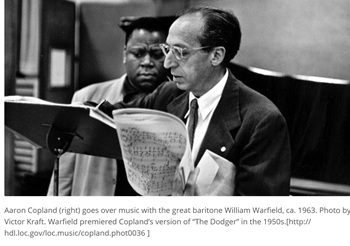
Once again I’m on the hunt for the origins of a famous piece of music. Aaron Copland’s suite of early American tunes was commissioned by none other than Benjamin Britten and was presented at that composer’s newly-launched Aldeburgh Festival in 1950. Britten had developed a keen interest in performing American folk music, at least partly because of his long visit to the US from 1939-1942. While there he and his partner Peter Pears had spent a lot of time with Copland; he said later that Copland was “by far the best American composer.” Perhaps because of Pears’ abilities as a singer, he and Britten regretted the dearth of songs in the Copland catalog. So they decided to do something about that, and in 1950 commissioned a set of American folk songs to be performed at the Festival. Well! Copland dove into this commission head first, only coming up for air after he’d ransacked the sheet-music archives at Brown University for material. He did an enormous amount of work for what turned out to be a set of pieces that together total less than 13 minutes’ worth of performance time. But this wouldn’t be the first time Copland got completely caught up in writing music that he didn’t think would result in much return on his investment; he said about the ballet music for Appalachian Spring, “It took me about a year to finish and I remember thinking how crazy it was to spend all that time because I knew how short‑lived most ballet scores are, but [it] took on a life of its own.”1
Virgil Thomson Sets Thomas Campion to Music
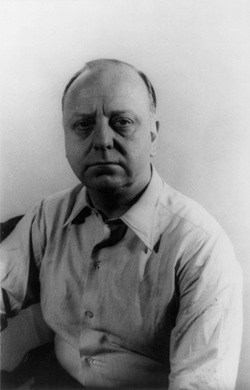
Virgil Thomson is right up there in the pantheon of 20th century composers along with Aaron Copland and Benjamin Britten, men whose works he criticized rather harshly and whose greater popularity and success he envied. Alas! Even the greatest artists can have feet of clay. But he had much in common with these other two towering figures, not the least of which was an abiding interest in the proper setting of texts to music. How he ran across the four poems of the Renaissance poet Thomas Campion is unknown; I consulted the only authoritative biography available about him and saw no fascinating backstory such as the one I discovered about Benjamin Britten’s A Ceremony of Carols. Thomson did believe, however, that Campion’s poetry and music displayed the same qualities that he strove for: simplicity and directness, with the music serving the text instead of the other way around.
Campion wrote in various genres, but in these brief lyric poems he typically shows a delicacy of feeling about his subject: an idealized woman. Campion is not writing about real flesh-and-blood females in whom he has a romantic interest but is instead presenting a concept of beauty itself. If you read these poems as descriptions of real romantic relationships you might find them a bit depressing, but the metaphysical realm is always inspiring, I guess. Here one can go haring off into Platonic love and courtly love and the whole nine yards, but I do try to keep these posts somewhat reasonable in length. I will just say that the poet is striving for a certain effect and doesn’t necessarily have any emotional skin in the game. Beyond that it’s impossible to know what was going on in his head as he wrote his poems. He never married, so perhaps he preferred the ideal to the real. As for Thomson, we know his interest in the concept of female beauty was theoretical and not personal, as his romantic pursuits were confined to men.
The Deeper Meaning behind Copland’s “Ching-A-Ring-Chaw”
 Note: This post was written about an earlier concert of the Cherry Creek Chorale in which we sang Part 2 of Copland’s “Old American Songs.” We will be performing the songs from Part 1 for our upcoming concert on March 6 & 7 2026. But there’s so much interesting background on Copland in general below that I wanted to go ahead and post it again.
Sometimes I start researching these posts thinking that I know what’s what and I just need to fill in a few blanks, only find out that my ideas have been completely wrongheaded. Other times I think there’s not too much to say and end up with enough material for a doctoral dissertation. This post fulfills both conditions. Racism and the transformative power of art are all packed into this one short selection.
The Inspiration for Sid Robinovitch’s “Canciones por las Americas”

One of the great pleasures of writing the posts on this site is that I’m sometimes able to get in touch with living composers and badger them with nosy questions. I was extremely curious about this set of songs because they all have Spanish texts, and yet Sid Robinovitch is Canadian, has a Jewish background, and wrote the pieces as a commission for the Association of Canadian Choral Conductors. There didn’t seem to be much of a Latin tango connection in any of this. So originally I professed my mystification and moved on, but later it occurred to me that I could just ask. I e-mailed Robinovitch after looking up his contact info on his website, and here is part of his very gracious and prompt reply:
Two Bittersweet Ballads Teamed Up in a Melancholy Medley

Fall is my favorite time of year: I love the colors, the smells, and the crisp air. I remember so vividly how exciting it was for me as a kid to go shopping for school supplies with my mom. There was the pristine Big Chief tablet and new pencils. Maybe even an unsmudged pink eraser. Everything seemed possible.
But for some autumn is a sad season, as it starts the inevitable slide toward winter with its darkness and cold. Two songs with lyrics by Johnny Mercer portray this viewpoint: “Autumn Leaves” and “When October Goes.” They’ve been put together in a lovely medley by the modern composer/arranger Paul Langford, a true powerhouse whose arrangements I’ve sung myself. Both of these songs have a fascinating backstory.
“Swifter than Flame”–Elaine Hagenberg Hits Another One Out of the Park and Up into the Stars

This latest piece (as of June 2024) from Elaine Hagenberg perfectly embodies her style: the use of an unfamiliar and enigmatic text and dramatic, sweeping musical lines: “Swifter than Flame,” for SATB chorus with the text from a poem by Carl John Bostelmann, who wrote primarily in the 1920’s and 30’s. I don’t do musical analysis in these posts and so will simply say that she manages harmonic sweetness that never topples over into syrupiness. There’s an edge there, a drive. My own choir, the Cherry Creek Chorale, has sung a number of her pieces and also participated in the commissioning consortium for her first major-length work, Illuminare, with Hagenberg herself participating in one of our rehearsals during concert week. Those of us who were privileged to be present that evening will never forget it.
I was very intrigued by the lyrics and wanted first of all to know more about the author, Carl John Bostelmann. He is perhaps best known as having written a behind-the-scenes look at John D. Rockefeller, Neighbor John, in cooperation with the photographer Curt E. Engelbrecht, who was allowed unusual access to the usually camera-shy Rockefeller. Bostelmann was also involved with various historical survey projects. For my purposes here, though, I’ve found that he published at least four volumes of poetry, a couple of which are available on Google Books, and that his work appeared during his lifetime in a number of poetry magazines. “Swifter than Flame,” however, doesn’t show up in any of these available sources.
Which Came First, the Symphony or the Song? (Or Is It a Spiritual?)

(Note: The Cherry Creek Chorale in the Denver area will be performing this lovely piece in its “American Songbook V” concerts on May 17 and 18, 2024. If you live in the area, make your plans to attend! Tickets may be purchased on this page or at the door.)
Haven’t you vaguely always understood that the second movement of Dvořák’s “New World” symphony was based on an American folk tune? I sure have. Turns out that, like most vague understandings, it’s not true. Dvořák wrote the tune himself; he said to one inquiring conductor that ““I tried to write only in the spirit of those national American melodies.”1 You can assign some kind of folksy charm to the horn solo in Movement #2, but it’s not necessarily American charm:
It has been said that Dvořák’s themes in his symphony were inspired by American folk melodies, especially Afro-American. But his themes are just as similar to Czech or Bohemian folk music and probably came from his own country’s music tradition.2
So all of that is well and good, but my focus in this post is on the words to the song that were written using that horn solo theme in the “Largo” movement. Such a reputable outlet as National Public Radio says that the words were written by Harry Burleigh, a Black composer whom Dvořák befriended while in New York. But they were actually written by another American protégé of Dvořák, a student of his named William Arms Fisher, who was White but who chose to write the lyrics in what he perceived to be some sort of African-American dialect. (Note my somewhat skeptical tone here.) So it’s “jes” instead of “just” and “’spectin’” rather than “expectin’” or “expecting.” And “goin’” is written as “gwine.”
As the song became more popular and mainstream, the dialect was considerably softened or omitted. In fact, although I haven’t been able to find a reproduction of the full original sheet music, I did find an image of the first page, which says at the bottom: “When desired the text may be sung without dialect.”
Here’s what Fisher himself had to say about African-American spirituals in general, in an introduction to an anthology of spirituals that he produced:
A Bouquet of Roses from Morten Lauridsen

Lauridsen and His Love of Poetry
Choral composers are always on the hunt for suitable texts. Unless you’re writing something along the lines of the “Humming Chorus” from Madame Butterly or Rachmaninoff’s “Vocalise,” you have to find suitable words. As I’ve outlined in other material, choral texts can have many sources: You may be commissioned to write a piece with the proviso that you use a certain text, or you may love a certain poem and decide to set it to music, or you may have an idea for a melody and look for words that fit, or you may ask someone to write the text for you, or you may write it yourself.
Gwyneth Walker as Poet and Composer in “Refuge”

I am reminded of this quotation: “It is not enough to be right. You must prevail.” Let me rephrase that wording to fit here: “It is not enough to be creative. You must be heard.” Gwyneth Walker certainly fits into that principle, as she has become a successful composer first through talent (of course) but then through sheer hard work and business savvy. She has a very interesting website that includes some of the interviews and lectures she’s given over the years, and I was especially struck by her essay “Yes, This Is a Business!” The entire piece is well worth reading; here I’ll quote just one definitive statement: “I feel that a composer cannot live in his/her own world entirely. Music is a communicative and social language. It requires composers, performers and audiences. And all three need each other.”