
Table of Contents
Copland, the Commission, and the Composition
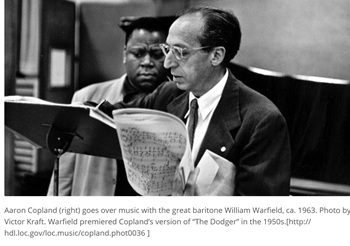
Once again I’m on the hunt for the origins of a famous piece of music. Aaron Copland’s suite of early American tunes was commissioned by none other than Benjamin Britten and was presented at that composer’s newly-launched Aldeburgh Festival in 1950. Britten had developed a keen interest in performing American folk music, at least partly because of his long visit to the US from 1939-1942. While there he and his partner Peter Pears had spent a lot of time with Copland; he said later that Copland was “by far the best American composer.” Perhaps because of Pears’ abilities as a singer, he and Britten regretted the dearth of songs in the Copland catalog. So they decided to do something about that, and in 1950 commissioned a set of American folk songs to be performed at the Festival. Well! Copland dove into this commission head first, only coming up for air after he’d ransacked the sheet-music archives at Brown University for material. He did an enormous amount of work for what turned out to be a set of pieces that together total less than 13 minutes’ worth of performance time. But this wouldn’t be the first time Copland got completely caught up in writing music that he didn’t think would result in much return on his investment; he said about the ballet music for Appalachian Spring, “It took me about a year to finish and I remember thinking how crazy it was to spend all that time because I knew how short‑lived most ballet scores are, but [it] took on a life of its own.”1
The same can certainly be said about both Old American Songs suites; the first one was such a hit in England that there was a followup performance in the US, and Copland wrote a second suite in 1952. Both suites have gone through several arrangement iterations; the choral versions were published on 2011, over 20 years after Copland’s death. Each song represents a specific genre of American music; in this post I’ll examine the ones in the first set.
First, though, I want to quote from a great blog that I’ve just discovered, The Listeners’ Club, by a fantastically prolific writer, performer and teacher named Timothy Judd:
Aaron Copland’s Old American Songs are full of ghosts. The collection of folk melodies Copland arranged in the early 1950s, at the request of Benjamin Britten, evokes memories of, and nostalgia for, the distant past. It’s easy to get a similar feeling taking in the small slices of rural American landscape visible in brief glimpses from a moving car…an old dilapidated barn, a picturesque village church, the leafy solitude of an obscure roadside cemetery…2
In the following material I give some introductory commentary, then the text itself with explanations if needed, and then performance videos. Copland originally wrote these to be sung by Peter Pears, the British tenor, and you can look those up if you want to; they’re available on YouTube. I just don’t think that these songs work when sung with a British accent. (Sorry, Peter!) Copland re-wrote them for the fabulous African-American baritone William Warfield (who’s pictured above with Copland), and he performed them in the American premier. I’ve included some of his versions and some of Samuel Ramey. Please feel free to pick and choose below according to your interests. (But really you should read and listen to everything, of course.)
“The Boatmen’s Dance”
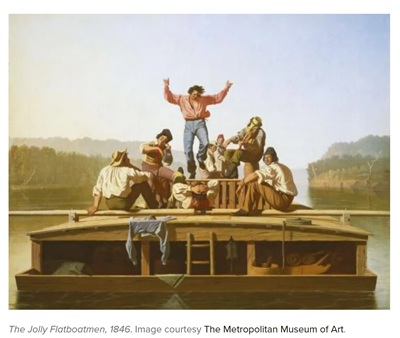
This song started out as a piece performed in minstrel shows; I would encourage you if you’re interested in the historical background of this fascinating piece of Americana that you head over to the post I wrote in connection with Copland’s adapted minstrel song in his second set of American folk songs, “Ching-a-Ring Chaw.” I will quote myself here from that post: Copland has “taken something from an offensive source, recognized its inherent musicality, and transformed it.”
The original author of the song was a White man, Dan Emmett, whose main claim to fame is that he wrote “Dixie.”3 He also kinda sorta got minstrel shows going, founding the Virginia Minstrels in 1842, although individual blackface performances had been common long before that date. His innovation was that he put together a group of performers who traveled throughout the North before the Civil War and throughout the US as a whole in the years afterwards. These group performances became extremely popular and could be very elaborate, continuing up until the decline of this form of entertainment in the 1920s as vaudeville took over. “With their ludicrous dialects, grotesque make-up, bizarre behavior, and simplistic caricatures, minstrels portrayed blacks as totally inferior.”4
Before I get to the song itself (and about time, some of you may be thinking), I must mention that the boatmen song, and minstrel shows in general, show up in a most unexpected place (to me, anyway), and that’s in the Laura Ingalls Wilder Little House books. Pa (the real Pa, not that pretty-boy Michael Landon travesty on the TV show) plays a song on his fiddle called “Away Down the River on the O-hi-o!”(almost certainly the “Boatmen” song) in By the Shoes of Silver Lake. But an actual fully-staged minstrel show, blackface and all, is performed in Little Town on the Prairie, which takes place while the Ingallses are living in DeSmet, South Dakota, with the specific events in this book covering summer 1881-December 1882. Here’s how the show begins: “Up the center aisle came marching five black-faced men in raggedy-taggedy uniforms. White circles were around their eyes and their mouths were wide and red. Up onto the platform they marched, then facing forward in a row suddenly they all advanced, singing.” And on it goes, with singing, dancing, and many jokes. The crowd is left weak with laughter, although Ma, Laura, Carrie and Grace are quite perturbed at the thought that Pa is one of the performers and must have shaved off his whiskers for the occasion. Turns out that, as Laura says, ”You blacked them and smoothed them down behind that high coat-collar!” When I first ran across this description I was very dubious about its truthfulness; after all, how on earth could these frontiersmen have put on a performance such that ”The famous minstrel shows in New York surely could not be better than that minstrel show had been”? Well, it turns out that I was sadly misinformed; there were instruction manuals available for use in amateur performances. The idea in the book seems to be that the five men have been getting together and rehearsing in secret for their big show. Goodness to gracious and merciful heavens me, not one person in the town thinks it’s anything other than good, clean fun. (No Blacks were living in DeSmet, of course.) Just to be clear, I’m not a fan of retroactive cancel culture. I love the Little House books, but that doesn’t mean that I’m blind to the sometimes-awful attitudes displayed therein.
Ah well. Back to the song, which has gone through a number of iterations both in its minstrel and modernized versions. Copland removed the dialect and some of the verses in his quest to make the song more universal. In essence, he’s made the figure of the Ohio River boatmen (which could have comprised free Blacks, poor White laborers, and perhaps some slaves who had been rented out by their owners) into the stereotypical sailor, who has a girl in every port and who comes onshore to drink and party whenever his boat docks. If you take a look at the Ohio River’s course, you’ll see that it originates in western Pennsylvania and then cuts through a number of states including Ohio and Indiana before joining up with the Mississippi River at Cairo, Illinois. (If you know your Huckleberry Finn that town’s name will ring a bell; Huck and the runaway slave Jim miss Cairo in the fog on their journey down the Ohio to get Jim to free territory.)
There are several versions of the dialect minstrel song. I’ll confine myself to Copland’s lyrics with some interpolations from me:
High, row the boatman, row
Floatin’ down the river, the Ohio
(traditional call, implying the high energy and spirits of the boatmen)
The boatmen dance, the boatmen sing
The boatmen up to everything
And when the boatman gets on shore
He spends his cash and works for more
(The boatmen work hard and play hard)
Then dance, the boatmen dance
Oh, dance, the boatmen dance
Oh, dance all night to broad daylight
And go home with the gals in the morning
(The boatmen will get back on the boat at the same time that the “gals” they’ve been dancing with all night go home.)
I went on board the other day
To see what the boatmen had to say
There I let my passion loose
And they crammed me in the calaboose
(Who’s speaking in this verse? It’s not clear—it seems to be someone on shore who goes on board and picks a fight with the boatmen. Why? Maybe this is the on-shore lover of one of the “gals”? That’s the best I can do. There must have been some kind of on-board prison cell, a brig, or “calaboose,” in which to keep unruly passengers or sailors.)
The boatman is a thrifty man
There’s none can do as the boatman can
(But I thought that the boatmen would spend all their cash on shore and come back to work to make more—to go spend on shore again. This verse seems to contradict that first verse.)
I never see a pretty girl in my life
But that she was a boatman’s wife
(The boatmen get all the beautiful women.)
Oh, dance, the boatmen dance
Oh, dance, the boatmen dance
Oh, dance all night to broad daylight
And go home with the gals in the morning
High, row the boatman, row
Floatin’ down the river, the Ohio
High, row the boatman, row
Floatin’ down the river, the Ohio
Here’s a great performance by the baritone Samuel Ramey. (I have a soft spot in my heart for him, as I once had the privilege of writhing at his feet in the role of a damned spirit in Boito’s Mefistofele. A great experience!)
Here’s an okay-ish choral performance–a little on the stuffy side, but there aren’t very many of these on YouTube:
“The Dodger”
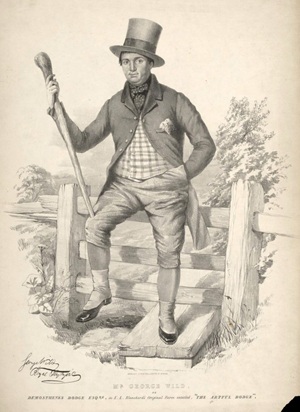
You would not believe the amount of material available about this one song. The American Folklife Center at the Library of Congress has three separate posts about possible origins of the piece, which are linked to below.5 I will (mercifully) summarize the overall content, which says that the song almost certainly dates back to 1840’s England with a Scottish tune that’s even older. And I realized, rather belatedly, that of course there’s a main character in Charles Dickens’ novel Oliver Twist named “The Artful Dodger” who is the leader of Fagin’s band of child thieves. This dodger is particularly skilled at picking pockets.
The word “dodge” of course has the main meaning of “evade” or “duck,” and these ideas can be positive or negative: you can dodge a blow or you can dodge a commitment. Did you know, by the way, that the Dodgers baseball team took its name from “trolley dodgers,” pedestrians who had to dodge the new high-speed electric trolleys that came into use during the 1890s in Brooklyn? Locals on the way to Ebbets Field brought the name into the team’s consciousness and it became first the unofficial and then the official team name. Now the Dodgers are in Los Angeles, but the name stuck in spite of the move.
Anyway, the song has been put to many uses and seemed especially suited to the 1884 election between Grover Cleveland and James Blaine, with both men being accused at one time or another of “draft dodging” in the Civil War, a practice that involved paying someone else to take your place as a draftee and which was perfectly legal but seemed a little . . . dodgy. Right? (Ahem. I have draft dodgers in my own family history, cousins who went to Canada during the Vietnam War as they were conscientious objectors because of their Mennonite faith. I’ve never really gotten the full story on this; all I know is that at least one cousin came home with a Canadian bride after Jimmy Carter issued his blanket pardon in 1977.)
Copland chose to include only three stanzas in his arrangement out of the myriad choices available to him, concentrating on what he must have considered to be the main categories in society of grifters: politicians, preachers, and womanizers. Plus ça change, plus c’est la même chose, as they say. Let’s take a look at these three characters:
Yes the candidate’s a dodger,
Yes a well-known dodger.
Yes the candidate’s a dodger,
Yes and I’m a dodger too.
He’ll meet you and treat you,
And ask you for your vote.
But look out boys,
He’s a-dodgin’ for your note.
(Here a “note” may be a bank note or a promissory note—some type of financial gain.)
Yes we’re all dodgin’
A-dodgin’, dodgin’, dodgin’.
Yes we’re all dodgin’
Out away through the world.
(The song acknowledges that all people get involved in some type of “dodgery” as they make their way through life.)
Yes the preacher he’s a dodger,
Yes a well-known dodger.
Yes the preacher he’s a dodger,
Yes and I’m a dodger too.
He’ll preach you a gospel,
And tell you of your crimes.
But look out boys,
He’s a-dodgin’ for your dimes.
(Hmmm. This verse was written w-a-a-y before the advent of the megachurch and the televangelist. See the French maxim above!)
Yes we’re all dodgin’ . . . etc.
Yes the lover he’s a dodger,
Yes a well-known dodger.
Yes the lover he’s a dodger,
Yes and I’m a dodger too.
He’ll hug you and kiss you,
And call you his bride,
But look out girls,
He’s a-tellin’ you a lie.
(Again—written way before the advent of online catfishing. You had to do your deceptive womanizing in person.)
Yes we’re all dodgin’ . . . etc.
I’ll give Warfield a turn here.
A choral performance with lots of verve. Be sure to listen to the actors’ lines–especially the one from the lover. Just note that this performance took place about a week after the November 2008 election. I’m pretty sure that the “candidate”–the woman in the red dress–is supposed to be Hillary Clinton. There’s no doubt, however, about whom the “lover” is. You young ‘uns reading this may have to go back in history to the “I did not have sexual relations with that woman” line to figure it out. Use Google!
“Long Time Ago”

This song is usually identified as a “traditional ballad,” but sometimes it’s also labeled as having a minstrel-show origin. Minstrel shows in their full expression would typically have three acts, the first of which could include sentimental songs as well as more lively ones. So who knows? The song itself is truly lovely, and it forms quite a contrast to the idealized love in the Virgil Thomson songs that are also included in my choir’s March 2026 concert. To me, and I don’t think I’m terribly susceptible to emotional manipulation, the piece conveys an almost-unbearable poignancy as it portrays a fleeting time when this real and all-too-mortal woman lived and died. It’s as if we’re spiraling down to a specific scene when the speaker spoke his love to her:
While to my fond words she listen’d
Murmuring low,
Tenderly her blue eyes glisten’d
Long time ago.
And there the song ends. We know that she died, but that’s it. Here are the complete (and very short) lyrics as used by Copland:
On the lake where droop’d the willow
Long time ago,
Where the rock threw back the billow
Brighter than snow.
Dwelt a maid beloved and cherish’d
By high and low,
But with autumn leaf she perished
Long time ago.
Rock and tree and flowing water
Long time ago,
Bird and bee and blossom taught her
Love’s spell to know.
While to my fond words she listen’d
Murmuring low,
Tenderly her blue eyes glisten’d
Long time ago.
We don’t get anything more—just that one little vignette from the past. I was hoping that there were more lines and that Copland had used only part of the poem, but this is all I’ve been able to dig up.
Thought I’d give this guy’s recital at least a few more views–his voice just floats:
And the always-reliable Atlanta Master Chorale give us their version:
“Simple Gifts”
Since I’ve written so much about this song already, I’m going to refer you to my other posts about the piece and also about the Shakers, the religious group that produced it. Here I’ll just point out that, in spite of its being the product of such a strict sect, this song is actually about the ecstatic dances of the group during their worship services. As Laurie says to Jo in Little Women, “What can I do? my feelings must have a went.” We’ll bring back Samuel Ramey for this one:
Then another performance by the Atlanta Master Chorale, but this time it’s a longer arrangement of Copland’s all-too-brief version by David Conte, whose suite of three Mexican folk songs was a part of our own concert in Oct. 2025:
“I Bought Me a Cat”
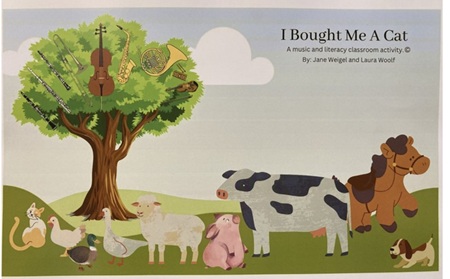
Be honest: Have you ever asked yourself, “What indeed is the deeper meaning behind ‘Old MacDonald Had a Farm’?” as you led your kids in endless repetitions of the song on long car rides? (Note the complicated punctuation in the previous sentence.) Well, no–you haven’t. All of your kids are busy playing games on their phones or iPads. Sigh. But would you if you had? No, you wouldn’t. You’d have known instinctively that this is a song just for fun, with kids learning the inestimable skill of being able to imitate animal sounds. (Yes, we’ve all taught little kids that cows say “moo.” That info should help them immensely in the job market of the future, right? They’ll probably be saying, “What’s a cow?” But we’ll leave it there.) There have been some sensitive souls who’ve objected to the line “I bought me a wife” in the last verse of the song, changing it to “I got me a wife.” But folks, really–it’s a joke. Just laugh along with it.
In the interest of giving at least a little musical background here, let me point out that “Cat” falls into the category of a “cumulative song.” That is, each verse gets added to all of the verses that came before. “The Twelve Days of Christmas” is this type, as is (my personal favorite) “I Know an Old Lady Who Swallowed a Fly.”
We will bring back the fabulous William Warfield to take us out. Folks, he gets into it:
And to close out this set, a choral version that has just about as much fun with the song as Warfield does:
So there you have it: Copland picked one rollicking boatmen’s song, one parodic and witty song that could be used in manifold situations, one beautiful and lyrical ballad, one religious song, and one children’s song. How many days did he spend picking out these five? It would be fascinating to find out!
A-a-a-a-nd, if you’ve persevered and read all the way to the end of this post, you get a lagniappe (as a New Orleanian might say), a clip of Samuel Ramey singing “Ecco Il Mondo” as mentioned above, although not, and I repeat, NOT, the performance I was privileged to be a part of 50 years or so ago. He’s been given a balloon, for heaven’s sake! Our production featured some kind of plexiglass hollow ball which he was given strict instructions not to smash during rehearsals as the stage crew had made only two of them, one for each actual performance. Anyway, here he is in all his shirtless glory:
(c) Debi Simons
- Susan Halpern Program Notes “Appalachian Spring . . . Aaron Copland” ↩︎
- The Listeners’ Club—Old American Songs ↩︎
- It’s fair to point out here that Emmett didn’t mean for his song to become a rallying anthem for the Confederacy; he was a loyal Northerner, and his song was written well before the Civil War. However, the lyrics express a freed slave’s longing to return to “Dixie,” the South. It fits in with the whole minstrel show attitude of the happy-go-lucky slave mentality, so I’m not sure that Emmett had too much to complain about. The name “Dixie” for the South refers to the Mason-Dixon Line that divided free Northern states from slave Southern ones, and/or it could refer to so-called “dix” notes, $10 bills issued by the Citizens’ Bank of Louisiana in the years before the Civil War. ↩︎
- “Blackface: The Sad History of Minstrel Shows” in American Heritage magazine. This is an excellent article, and if you’re interested in this chapter of American history I can’t recommend it highly enough. I learned quite a bit from it, and I thought I was pretty well informed on this subject. ↩︎

Debi! Stellar job on this! Great info and stories.
And shirtless Samuel Ramey? It just doesn’t get better than that! (And I love his voice, too.)