
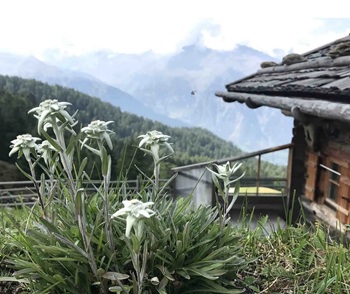
Well, no—at least not officially in terms of being Austria’s national anthem or anything like that. But the choice of this little Alpine flower as the centerpiece of an iconic song in the musical does indeed come from its cultural significance. So I guess the real answer is yes, kinda sorta. (You can hear a beautiful choral arrangement sung by my own choir, the Cherry Creek Chorale, if you come to our October concert in the Denver area. Follow this link to get your tickets now! Note that there’s a special post-concert reception for the Saturday matinee that is separately ticketed. I’m in charge of the desserts!)
I’m not going to be able to tell you exactly how the lyrics to this song occurred to Oscar Hammerstein III. What we do know is that “ten days before The Sound of Music opened on Broadway, Richard Rodgers felt something was missing. He decided that the non-singing Captain Von Trapp needed his own signature tune: a chance for the grumpy ‘good Austrian’ to say farewell to his beloved homeland.” There is a mention of the flower in the actual script, or book, of the musical, written not by Rodgers and Hammerstein but by the team of Howard Lindsay and Russel Crouse. I looked up the scene—Gretl, the youngest of the seven von Trapp children, presents a single edelweiss to Baroness Elsa Schraeder, Captain von Trapp’s current love interest at the beginning of the show. I’m sure that the scriptwriters just thought, Hmm. Gretl should present a typical Austrian flower to her possible future stepmother. What would that be? And they decided on an edelweiss, or “noble white.” (Are you curious about how this whole writing-a-musical works? Read the first couple of paragraphs in this post.) So it wasn’t much of a leap for Hammerstein to use the flower in the Captain’s final song.
Gretl would be in trouble if she picked an edelweiss today, as that action is now illegal. The edelweiss is protected by the Austrian government and appears on coins and military insignias. It is indeed a beloved emblem of Austria, but it doesn’t appear (as far as I can tell) in any actual folksongs and isn’t mentioned in either Austrian national anthem. It’s often seen as an emblem of courage and resilience because it can thrive in high altitudes and freezing temperatures. The phrase “blossom of snow” refers to the flower’s color, not any capability of actually blooming while there’s still snow on the ground. But who knows? Oscar Hammerstein may not have been totally up on his botany and just liked the wording.
Because the song became so popular it was assumed by many in the general public that it must be an actual folk song or perhaps the Austrian national anthem. Theodore Bikel, who played the original role of the Captain, said in his autobiography that he remembered one native Austrian telling him: “I love that Edelweiss…Of course, I have known it for a long time, but only in German.”
When in 1984 Ronald Reagan hosted Austrian President Rudolf Kirchschläger for the first official state visit by an Austrian head of state to the United States, he quoted from the song but did indeed put it into its proper context: “At one point in The Sound of Music, the character who plays Baron von Trapp sings a song about the edelweiss, an Austrian flower. And before the song ends, the lyrics become a prayer for Austria itself. It is a prayer Americans join in – ‘Blossom of snow, may you bloom and grow — and bless your homeland forever.’” Austrian media outlets very much nitpicked his reference, implying that the US president didn’t know beans from baloney (as my father would say) about what was and was not a true Austrian song. Well, boo-hoo! Reagan was perfectly clear in his speech about the song’s source, and President Kirchschläger said that he could not understand what the critics were talking about. And the Marine Band did not play the song at the Austrian president’s entrance. Here’s the straight scoop, straight from Ronald Reagan’s diary:
He & his wife are very nice & he was deeply moved when our Marine Orch. played the music that was played by Americans when the occupation ended and Austria regained it’s [sic] independence.
I absolutely cannot believe what a deep rabbit hole I’ve dived (dove? doven?) down while trying to get the straight story about this state dinner. So, to end this rather rambling post, here’s a joking reference I ran across in all the diving about how Americans can’t keep “Austria” and “Australia” straight:
Any visitor to this country who wants to get the phone number of the Austrian embassy should do as the natives do:
“Hello, I’d like the number for the Austrian Embassy.”
“Is that the one with the kangaroos?”
“No, it’s the one with Julie Andrews.”
“Oh, of course; the number is . . .”1
Well, enough of that. Here’s the scene from the movie in which the Captain sings the song to his children:
Honestly, folks–I don’t say this very often, but this choral arrangement with orchestra is so beautiful that I got a little choked up:
Finally, here at the very end: If you love musical theater and great how-it-all-happened history, you can’t do better than Something Wonderful: Rodgers and Hammerstein’s Broadway Revolution by Todd S. Purdum. Get it from Amazon or your library.
(c) Debi Simons
