
Podcast: Play in new window | Download
Introduction and Origins
As readers of this blog know by now, I’m obsessed with origins, especially the origins of creative ideas. So I’m fascinated that Lin Manuel-Miranda was inspired to write his musical Hamilton by reading the Ron Chernow biography of this fascinating figure. (35 hours in audio form, folks. I know this from experience.) Stephen Schwartz got the idea for Wicked from a conversation on a snorkeling trip in Hawaii, when someone mentioned having read the book Wicked: The Life and Times of the Wicked Witch of the West. He says, “As soon as I heard this I had one of those light bulb moments where something just said this is a really great idea.” And Anthony Lloyed-Weber says that he bought a copy of the original Phantom of the Opera novel by Gaston Leroux for a dollar at a used-book stall in Paris and fell in love with it.
So what about Benjamin Britten and his famous A Ceremony of Carols? Another long and complicated backstory is involved here, with Britten’s having visited the US in 1939 for what was supposed to be a brief time, getting ill, and staying until 1942. By then WWII had started, of course, and so Britten was very much in danger of U-boat attacks. An excellent article on the work says “It seems almost bizarre that this spirited and Christmassy work was written on a rickety merchant ship (the MS Axel Johnson), as part of a naval convoy across the Atlantic, and vulnerable to torpedo attacks at any time.”
The ship didn’t trek directly across the Atlantic from New York but instead went up the coast to Halifax, Nova Scotia. If you look at a map you’ll see why this route was taken—it means a somewhat shorter hop across the Atlantic to the landing at Liverpool in England. All did not go smoothly, however, as the ship’s funnel caught fire and the rest of the convoy left the Axel Johnson behind. Thankfully, no German subs attacked.
Britten was bored and irritated with life on board the ship, a situation that pushed him to work on compositions as a way to pass the time. One such effort was a re-writing of his “Hymn to St. Cecelia,” work being necessitated by the confiscation of his original manuscript by the New York customs office out of fear that it contained encrypted information. Mostly, however, he worked on a first draft of his Ceremony, using selections from The English Galaxy of Shorter Poems, a book he’d picked up during the stopover in Halifax. His use of the harp as an accompaniment for the Carols must have stemmed at least partly from the conversations he’d had in the US with the harpist Edna Phillips, who’d wanted him to write a harp concerto for her. Although Britten never wrote it, Phillips wondered if her request sparked his interest in using that instrument for the Carols. She said later, “’He composed the Ceremony of Carols on the ship taking him back to England and used the harp in such an original and wonderful way in it. . . . It really doesn’t matter that he didn’t accept our commission. That is a great work for the harp.” I ran across a fascinating podcast that includes lots of info about harpists playing the piece today.
With all of the foregoing background in mind, let me now proceed to the texts of the carols themselves.
“Procession”
| Hodie Christus natus est: Hodie Salvator apparuit: Hodie in terra canunt angeli: Laetantur archangeli: Hodie exsultant justi dicentes: Gloria in excelsis Deo. Alleluia! Alleluia! Alleluia! | Today Christ is born: Today the Saviour has appeared: Today angels sing on earth: Archangels rejoice: Today the righteous exult, saying: Glory to God in the highest. Alleluia! Alleluia! Alleluia! |
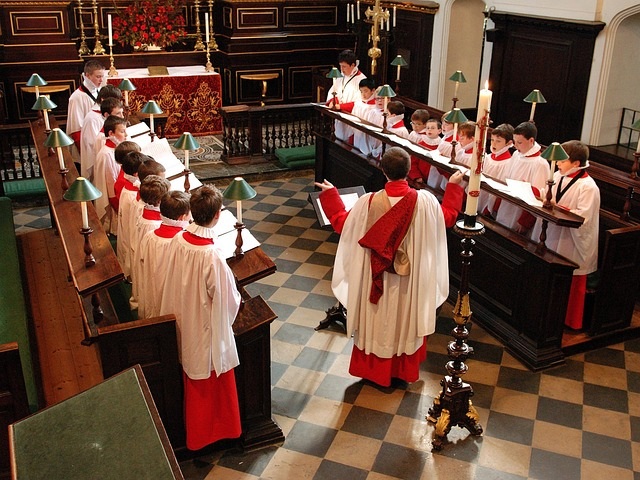
The opening and closing sections of the Ceremony were added when Britten decided to put the various songs he’d written using the texts from the English Galaxy together into a set. The words and music are taken from a pre-existing Gregorian chant which Britten somewhat modified. He envisioned the choir precessing in while singing this first selection, and he apparently wanted it to be sung entirely a cappella, since the performance note says “Accompaniment to be played only when an actual procession is impossible.” In other words, he wanted this section to resemble as closely as possible an actual religious procession in a church service. Well, it’s a nice idea—but most modern choirs go ahead and use the harp accompaniment even though the choir is marching in while singing. Having someone playing your pitches is certainly helpful! And there is a concession made to practicalities in that if the choir is large or the church aisle long, the final two alleluias can be repeated as many times as necessary for the singers to take their places in the front.
A couple of notes about the meaning of the text:
Glory to God in the highest what?
A look at other translations usually shows the word “heaven” added, so the meaning becomes something like, “Let God’s glory be known in the highest heaven.” That makes a certain amount of sense, I guess, but logically speaking the highest heaven would be the one place where God’s glory would already be known, wouldn’t it? The Christian New Testament was originally written in Greek, and here’s what the phrase looks like in that language: Δόξα ἐν ὑψίστοις Θεῷ (Doxa en hypsistois Theo). That very cool word “hypsistois” means “most highly exalted.” The phrase make sense as saying “God’s glory should be recognized as the very highest.” Don’t know what Greek scholars would make of my rather amateurish attempts at translation, but there it is.
What does “alleluia” mean?
I wrote a whole article on this one word. You’ll even get a clip from Shrek if you read it. But here’s the gist, from Google’s AI search engine:”Alleluia” is a Greek transliteration of the Hebrew phrase “hallelu-yah,” which means “praise the Lord.” The Greek word itself is ἀλληλουϊα (/ℎ𝑎𝑙𝑙ē𝑙ū𝑖𝑎) and functions as a joyful acclamation to praise God.”
“Wolcum Yole!” [“Welcome, Yule!”]

Wolcum, Wolcum, Wolcum [Welcome] be thou hevenè [heavenly] king [Christ],
Wolcum Yole [Yule]! Wolcum, born in one morning [that is, on a specific morning],
Wolcum for whom we sall [shall] sing! [That is, the Christ child]
Wolcum be ye, Stevene and Jon,
Wolcum, Innocentes every one,
Wolcum, Thomas marter [martyr] one,
Wolcum be ye, good Newe Yere,
Wolcum, Twelfthe Day both in fere [all in company],
Wolcum, seintes [saints] lefe and dere [loved and dear],
Wolcum Yole, Wolcum Yole, Wolcum!
Candelmesse [Candlemass], Quene of bliss,
Wolcum bothe to more [rich] and lesse [poor]
Wolcum, Wolcum, Wolcum be ye that are here,
Wolcum Yole, Wolcum alle and make good cheer,
Wolcum alle another yere, Wolcum Yole, Wolcum!
“Yule” can be traced back at least as far as Old Norse with the word “jol,” meaning the time of midwinter feasting celebrating the winter solstice, the longest night of the year, and the now inevitable turning towards spring. These celebrations were then absorbed into Christmas festivities.
“Stevene” is Steven, the first Christian martyr, who was stoned because of his sermon in the NT book of Acts. His feast day is December 26. “Jon” is St. John, John the Evangelist (as opposed to John the Baptist), whose feast day is the 27th. The “Innocentes” are the children under the age of two massacred by King Herod in the Gospel of Matthew. If you’d like to read a-l-l about that event, read my post on “The Coventry Carol.” It’s quite a story! Their feast is Dec. 28.
“Thomas” isn’t the doubting disciple from the gospels but Thomas à Becket, Archbishop of Canterbury, murdered by Henry II of England for his refusal to compromise on church authority. Henry supposedly said, “Will no one rid me of this troublesome priest?” and four of his knights took him at his word. Becket was canonized two years later, and his feast day was Dec. 29.
The days between Christmas and the Feast of Epiphany (Jan. 6) were, of course, the twelve days of Christmas, or the Christmas season. The 12 days are counted from the day after Christmas to the Feast of Epiphany, which takes place on January 6 and is the traditional date of the arrival of the Magi, or Three Kings, to visit the Christ child. There’s a whole quagmire of information about why these dates were chosen, and you can spend your entire holiday season trolling the internet on this subject if you’re so inclined. I will just say here that the story of the Magi in the Gospel of Matthew is very clear that these men, whoever they were, didn’t arrive until Jesus was a “young child,” not a baby, and that he was living in a house, not a stable. But that’s enough nitpicking for now. The final night of the twelve days was called, appropriately enough, Twelfth Night. Yes, just like the Shakespeare play. It was a time of merrymaking and feasting.
The days named in the carol could end here, but the anonymous author decided to include “Candelmesse” or “Candlemass” which is celebrated on Feb. 2 and commemorates the presentation of the Christ child at the Temple and Mary’s purification 40 days after giving birth as outlined in Jewish ceremonial law. Candles are traditionally blessed that day to show Jesus as the Light of the World. (“Candlemass” is also the name of a Swedish epic doom metal band, but we will perhaps inquire no further into them except to say that at least in some of their concerts they have real candles burning.)
“There is no Rose”
There is no rose of such vertu [virtue, character]
As is the rose that bare Jesu.
Alleluia.
For in this rose conteined [contained] was
Heaven and earth in litel space,
Res miranda. [“Marvelous thing.”]
By that rose we may well see
There be one God in persons three,
Pares forma. [“Equal in nature,” lit. “in the form of the father.”]
The aungels sungen the shepherds to [sang to the shepherds]
Gloria in excelsis Deo,
Gaudeamus. [Let us rejoice.]
Leave we all this werldly merth
And follow we this joyous birth,
Transeamus. [“Let us follow” Christ, the result of “this joyous birth.”]
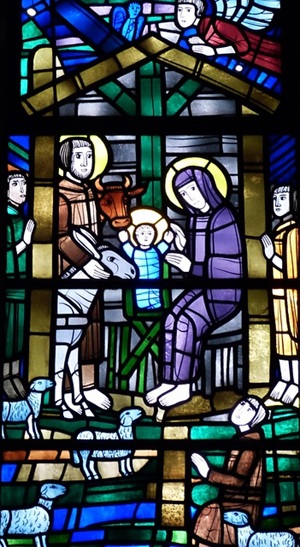
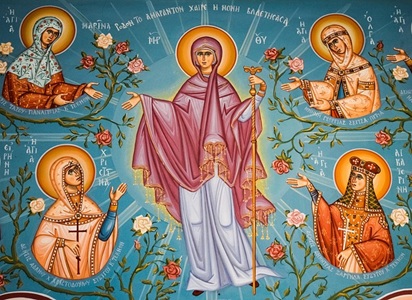
The Christ child himself is often compared to a rose, although a “Christmas rose” is actually a plant called a hellebore, known for blooming in the winter. Here, though, the rose, an actual rose as opposed to a hellebore, is Mary. As the rose was seen as the queen of flowers so Mary has been seen as the queen of heaven. The lines “for in this rose conteined was/Heaven and earth in litel space” echoes lines from John Donne’s poem “Annunciation”—
Thou hast light in dark, and shutst in little room,
Immensity cloistered in thy dear womb.
and also a somewhat a little-used verse in “O Come, All Ye Faithful”—
God of God, Light of Light,
lo, he abhors not the virgin’s womb;
Mary’s womb (or even in some lyrics such as “O Magnum Mysterium,” her “viscera,” or, well, her internal organs, her guts, as it were) come in for a lot of attention in Roman Catholic theology about her. She is the vessel for the Christ child.
And honestly (this shows my ignorance about some aspects of Roman Catholicism), I had never, ever realized that the rosary, that is, the string of beads used to count out prayers, is named for the rose, with its meaning something along the lines of “rose garden.”
You’ll note that these lyrics are a mixture of English and Latin, thus earning the label “macaronic.” I went on a total tear about the term in this post. And yes, as a teaser, I’ll just say that macaroni the pasta is indeed related to this term.
“That Yongë Child”
That yongë child when it gan weep
With song she [Mary] lulled him asleep:
That was so sweet a melody
It passed [was superior to] alle minstrelsy [musicianship]
The nightingalë sang also:
Her [that is, the nightingale’s] song is hoarse and nought thereto [unpleasant and nothing compared to Mary’s song]:
Whoso attendeth to her [the nightingale’s] song
and leaveth [forsakes, ignores] the first [song, the one Mary sang] then doth he wrong.
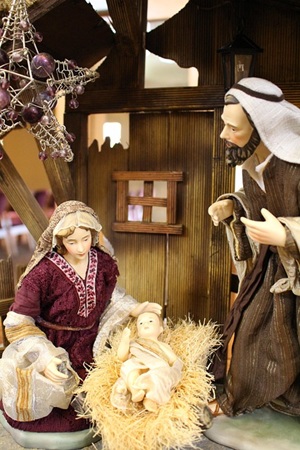
The meaning of this lyric is pretty clear, setting up a contrast between Mary’s lullaby to the Christ child and the song of a nightingale which symbolizes earthly melody. I will just say, in my hard-headed realistic view of things, that there is no mention of Mary’s doing any singing to the infant Jesus in the actual scriptural account. But she may have!
“Balulalow”

O my deare hert, young Jesu sweit [sweet],
Prepare thy creddil [cradle] in my spreit [spirit],
And I sall [shall] rock thee to my hert [heart],
And never mair [more] from thee depart.
But I sall praise thee evermoir
with sanges [songs] sweit unto thy gloir;
The knees of my hert [heart] sall I bow,
And sing that richt [right] balulalow [old Scottish word for “lullaby].
Unlike most of the lyrics for the Ceremony, these lines have known authors, three Scottish brothers, John, James and Robert Wedderburn, who lived during the 1500’s and were poets and religious reformers. Their beliefs caused them to be accused of heresy and so they fled to Europe, notably Germany. There they became acquainted with Lutheran hymns, and their “Balulalaw” is adapted from a Christmas song written by Martin Luther himself and designed to be sung by children as they ask for the Christ child to take up residence in their own hearts.
While the Wedderburns’ version of Luther’s lyrics is very similar to his, they have put in one striking image that is original with them: “the knees of my heart shall I bow.” They were almost certainly thinking of these verses from the NT book of Ephesians:
That at the name of Jesus every knee should bow, of those in heaven, and of those on earth, and of those under the earth, and that every tongue should confess that Jesus Christ is Lord, to the glory of God the Father. (2:10-11 KJV)
“As dew in Aprille“

| I sing of a maiden That is makèles [matchless]: King of all kings To [be] her son she ches [chose]. He came al so stille, There his moder was, As dew in Aprille That falleth on the grass. He came al so stille To his moder’s bour [bower], As dew in Aprille That falleth on the flour [flower]. He came al so stille, There his moder lay, As dew in April That falleth on the spray [as in a spray of flowers or leaves]. Moder and maiden was never none but she: Well may such a lady Goddes moder be. | I sing of a maiden That is matchless: King of all kings To be her son she chose [consented to]. He came as silently where his mother was As dew in April that falls on the grass. He came as silently to his mother’s bower As dew in April that falls on the flower. He came as silently where his mother lay As dew in April that falls on the spray. Mother and maiden was never none but she: Well may such a lady God’s mother be. |
This selection is what is called a “Marian” carol; that is, celebrating the Virgin Mary. I ran across a very cool website that told me this:
The first line of “I Syng of A Mayden” makes a pun; makeles means spotless, matchless, and without a mate — a triple pun, using two different words, preserved in Modern English as match and mate.
You have to read lines 3-4 carefully; if you don’t, you might think that Mary was choosing Jesus to be her son, when in reality she is choosing to submit to what God has decided for her. There’s an echo here of her words in the Gospel of Luke in response to the angel Gabriel: “And Mary said, Behold the handmaid of the Lord; be it unto me according to thy word.” (Luke 1:38 KJV)
The central image in this carol is, of course, spring dew. Even today, when we know all about condensation and the dew point and other such scientific stuff, we still use phrases such as “the morning was fresh with dew.” At the time this carol was written there was no such understanding, and dew was thought to be some kind of silent, perhaps miraculous, rain. It came to symbolize the work of the Holy Spirit in theology, and specifically in the idea of the miraculous incarnation of Christ:
And the angel answered and said unto her, The Holy Ghost shall come upon thee, and the power of the Highest shall overshadow thee: therefore also that holy thing which shall be born of thee shall be called the Son of God. (Luke 1:35 KJV)
So this whole “he came al so stille” idea can have a double meaning: that the conception of the Christ child was in itself silent, and also that the birth of Christ in such humble surroundings was also silent in the sense that there was no big public proclamation. (Although those loudly-singing angels weren’t very silent.) I’ve always loved these lines from the carol “O Little Town of Bethlehem”—
How silently, how silently
the wondrous gift is giv’n!
So God imparts to human hearts
the blessings of His heav’n.
The three items that have dew falling on them, grass, flowers, and a spray or branch, all have echoes in the Jewish Bible and symbolize God’s blessings on his people.
“This little Babe”
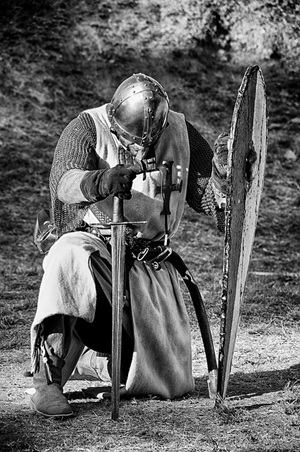
This little Babe so few days old,
Is come to rifle [plunder] Satan’s fold [area or enclosure, a reference to a sheepfold];
All hell doth at his presence quake,
Though he himself for cold do shake;
For in this weak unarmed wise [way]
The gates of hell he will [take by] surprise.
With tears he fights and wins the [battle]field,
His naked breast [he’s dressed only in strips of cloth, not armor] stands [in] for a shield.
His battering shot are babish cries,
His arrows looks of weeping eyes [both images are of helplessness, since all a baby can do is to cry].
His martial ensigns [symbols on a coat of arms] Cold and Need,
And feeble Flesh his warrior’s steed [he has no warhorse, just his small weak body].
His [war] camp is pitched in a stall [that is, an animal’s stall, something quite small],
His bulwark [defenses] but a broken wall [seeing the stable as dilapidated];
The crib his trench [an unseen barrier against the enemy], haystalks his stakes [for lining said trench to skewer the enemy];
Of shepherds he his muster [troops] makes;
And thus, as sure his foe to wound,
The angels’ trumps alarum sound [so he has angels on his side, sounding their trumpets for battle].
My soul with Christ join thou in fight;
Stick to the tents that he hath pight [pitched].
Within his crib is surest ward [protection];
This little Babe will be thy guard.
If thou wilt foil [defeat] thy foes with joy,
Then flit [flee] not from this heavenly Boy.
Once you understand Southwell’s overall extended metaphor of the poor and defenseless baby as compared to a warrior and have a few unclear words explained, the overall meaning of the poem is clear. I find Southwell himself to be a fascinating character and writer; Britten obviously felt the same way, as two of his selections are by him. Here’s a good summing-up of Southwell’s career and death, which I saw no need to paraphrase since it’s so good on its own:
Robert Southwell is not particularly well known today, but his story is remarkable. When he was ordained in France in 1584, it was a capital crime under the rule of Elizabeth I for native Englishmen to enter the Roman Catholic priesthood and remain on English soil for more than forty days. But Southwell returned to his home country two years later as an underground Catholic missionary. After six years of such work, he was arrested and tortured, and spent three years as a prisoner in the Tower of London. In 1595, at the age of around 35, Robert Southwell was tried and convicted on charges of treason, and was hanged, drawn, and quartered. His writings, which were very popular for several decades after his death, are said to have influenced, among others, Shakespeare and Donne. In 1970, he was canonized by Pope Paul VI.
Britten must have really liked Southwell since he used a second poem of his for the next selection:
“In Freezing Winter Night“
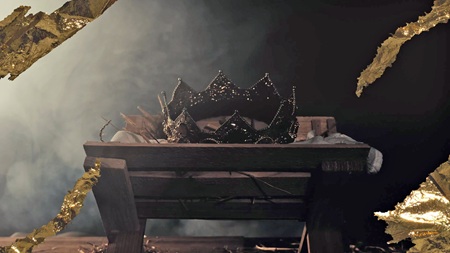
Behold, a silly [pitiable, helpless] tender babe,
In freezing winter night,
In homely manger trembling lies,
Alas, a piteous sight!
The inns are full; no man will yield
This little pilgrim bed.
But forced he is with silly beasts
In crib [not a baby’s crib but an animal’s stall] to shroud his head.
This stable is a Prince’s court,
This crib his chair of State;
The beasts are parcel [part] of his pomp,
The wooden dish [manger] his plate [store of precious metal vessels].
The persons in that poor attire
His royal liveries [uniforms] wear;
The Prince himself is come from heav’n;
This pomp is prized there.
With joy approach, O Christian wight [being],
Do homage to thy King,
And highly praise his humble pomp,
which he from Heav’n doth bring.
In this poem Southwell uses the extended metaphor of the Christ child as a king. Some of the ideas repay fuller explanation while others may just need a word or two clarified, which I have done above in brackets. Here are some further ideas:
The idea that “no man will yield” a bed to the child’s obviously-pregnant mother and, by extension, to him, isn’t really clear in the biblical story. It simply says “there was no room for them in the inn.” I’ve written a very extensive post on this subject which you might find interesting; I’ll just say here that the hard-hearted innkeeper of song and story probably didn’t exist, as there wasn’t an actual commercial inn in Bethlehem at the time.
Southwell makes a turn in his poem at the line “this stable is a Prince’s court.” Yes, he’s saying, it all seems very lowly and humble, but in reality it’s the birthplace of the Prince of Peace. Look around and you’ll see that nothing is as it seems. You think you’re standing in a dirty stable (which was perhaps a cave or grotto) with animals, looking at a newborn baby lying in a feeding trough since there’s nowhere else to put him but on the floor. But that “wooden dish” that animals eat from is actually a king’s golden treasury of plates, bowls, cups, etc. made out of precious metals. You think that the poor people gathered around, including shepherds who’ve just been sleeping in the fields, are pretty much a rabble. In reality, they’re the uniformed servants of the king of heaven. The whole set of contradictions is summed up in the phrase “humble pomp,” a true set of opposites. Surely Southwell was thinking of the images in the NT Epistle to the Philippians: which says that Christ “made himself of no reputation, and took upon him the form of a servant, and was made in the likeness of men” (2:8 KJV).
“Spring Carol“

Pleasure it is
to hear iwis [certainly],
the Birdes sing,
The deer in the dale,
the sheep in the vale,
the corn springing.
God’s purvayance
For sustenance,
It is for man;
Then we always
to give him praise,
And thank him than [then].
I think Britten saw the need for a little lightness before marching on to his grand conclusion. It may seem a little incongruous to include a carol about spring in a set of Christmas poems, but the winter solstice indeed looked toward spring since the days are going to get longer from that point on.
“Deo Gracias“
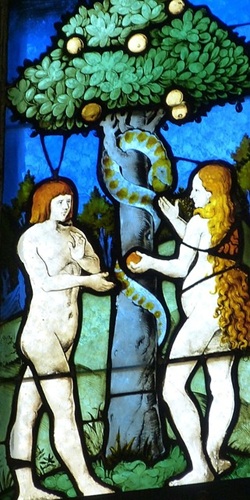
| Deo gracias! Deo gracias! Adam lay ibounden, bounden in a bond; Four thousand winter thought he not to long. Deo gracias! Deo gracias! And all was for an appil, an appil that he tok, As clerkes finden written in their book. Deo gracias! Deo gracias! Ne had the appil take ben, the appil take ben, Ne hadde never our lady a ben hevene quene. Blessed be the time that appil take was. Therefore we moun singen. Deo gracias! Deo gracias! | Deo gracias! Deo gracias! Thanks be to God! etc Adam was bound in sin for four thousand winters, which he thought not too long [for him to endure} Thanks be to God! etc And it was all for an apple that he took, as clerics find written in their book. Thanks be to God! etc Had the apple not been taken, then our Lady would not have been heavenly queen. Blessed be the time that the apple was taken. Therefore we must sing: Thanks be to God! etc, etc |
There’s an incredible amount of theology packed into this one short piece. Let me unpack at least some of it. We start with Adam and the fall of man, which medieval scholars believed to have taken place 4,000 years before the coming of Christ. But Adam looked forward to the coming of a promised redeemer, so his waiting seemed “not to long.” And what brought about this binding in sin? An apple! (The account in Genesis doesn’t say that it was an apple; I’m not sure where that idea originated. It’s the fruit of “the tree of the knowledge of good and evil,” which God has forbidden Adam and Eve to eat from. The disobedience is the sin, not the type of fruit.) How do we know this? The song tells us that it’s written in a book that clerks (that is, clerics—priests, monks, etc.) can read. A little nod here to the fact that most people couldn’t read when this poem was written and wouldn’t have had access to a printed Bible anyway.
But the second section of the carol says that it’s actually a good thing that the apple was taken and man fell, because otherwise Mary would never have been made queen of heaven. This reasoning is a wrinkle on a much more common theological view, at least in Roman Catholic thinking of the time, that the fall of man was actually fortunate (“felix culpa”) since it caused the coming of Christ to earth as redeemer. I’ve never seen the particular viewpoint in this poem expressed anywhere else, that Mary is actually the reason why the fall of man was a good thing. I feel compelled to say here that Mary herself would have been horrified at the idea of being called the “queen of heaven.” If you’d like to read about her responses to being told she will bear the Messiah, you can read my post here.
The Ceremony ends as it began, with the choir marching out to the strains of “Hodie Christus Natus Est.”
Here’s a good recording of the entire work, performed by treble voices as Britten originally wrote the piece. (And yes, I know the sound had to be dubbed in later in order for it to have the quality it does.)
And here’s the piece as later revised for SATB voicing:
(c) Debi Simons

Wow! Debi! This is so informative, fascinating and helpful! Brilliant! Thank you. I will sing all this with much more understanding now!!
Thanks so much, Debbi! Quite interesting!
thank you for this lovely post!
i was looking for a reference to the phrase “… all at sixes and sevens. I thought it w was in Ceremony of Carols”. I didn’t see it amongst the lyrics. Do you know if it’s in this piece? or where the phrase is from?